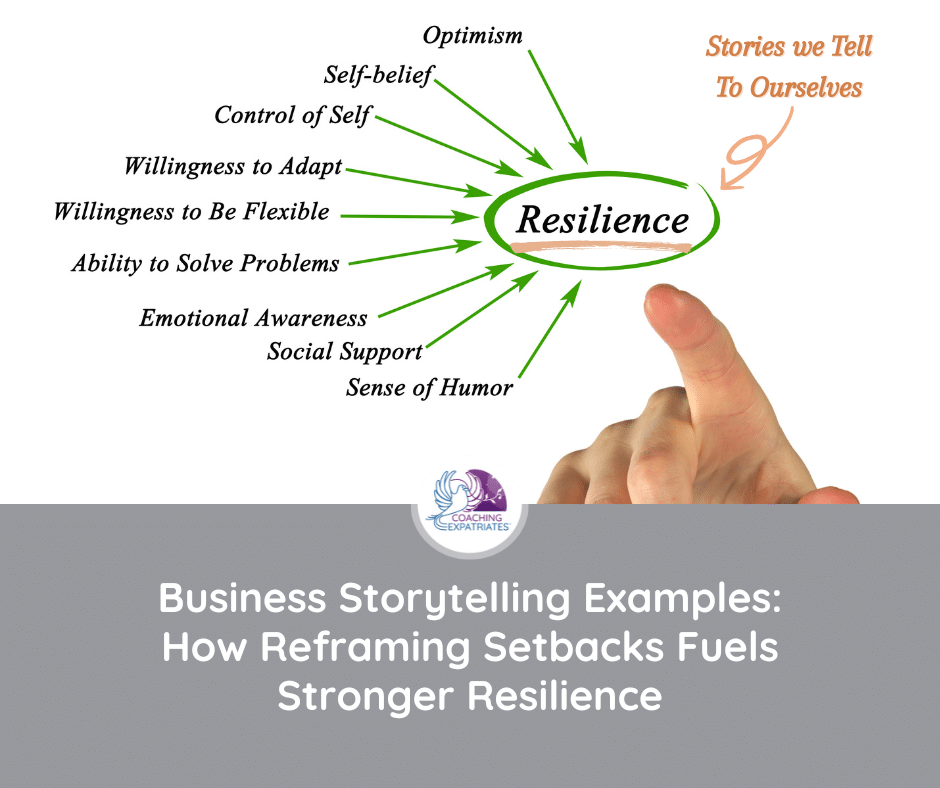
When we think about types of storytelling examples, we often imagine compelling speeches, bestselling novels, traditional marketing or Hollywood narratives, or powerful brand messages. But what if I told you that the most influential success stories aren’t the ones we tell others, but rather the ones we tell ourselves? Our internal narratives — the way we frame our experiences, setbacks, and achievements — can be the a powerful tool and determining factor between success and failure.
For leaders, this isn’t just philosophy; it’s a critical factor in decision-making. The way we interpret challenges directly impacts the choices we make, the risks we take, and, ultimately, the results we achieve. Some of the most successful global executives have mastered the key elements to reshape their internal narratives, turning obstacles into opportunities and setbacks into stepping stones. Simply with a powerful story.
Beyond personal growth, internal narratives also influence communicating across cultures. The way we perceive our own abilities, our confidence in unfamiliar environments, and even our ability to navigate differences are all shaped by the stories we tell ourselves.

In this article, we’ll explore how internal storytelling affects resilience, leadership, and success — and how reframing your own narrative can transform the way you lead, decide, and communicate.
The True Spark In The Universe
The Big Bang theory was first proposed by Belgian physicist and priest Georges Lemaître in the 1920s and 1930s. Read more here about this interesting and beloved character of today’s story.
While the scientific explanation of the Big Bang focuses on a purely physical event — the rapid expansion that led to the formation of the universe — many spiritual and philosophical traditions view creation as something sparked by a thought. Some interpretations suggest that a divine being initiated the universe through an act of will or creative thought, essentially making the Big Bang the result of an idea coming into existence.
While I cannot prove or disprove this notion, there’s one thing I do have very strong emotional connection to: every human thought sparks something and sets things in motion. Our thoughts shape our realities, influencing our actions, decisions, and ultimately, our outcomes. These thoughts, often referred to as our internal narratives or internal dialogues, are what determine the course of our daily lives.

Internal Narratives: The Invisible Force Behind Success Or Failure
It is my personal belief that internal narratives trigger everything in the universe. They are the foundation of success or failure, recognition or obscurity.
Consider Albert Einstein — his internal narrative is what drove him to explore the nature of the universe. Though he passed away decades ago, his thoughts, his curiosity, and his relentless questioning continue to shape our understanding of physics.
Einstein’s groundbreaking Theory of Relativity began with a single thought experiment:
“What if I could ride a beam of light? What would the laws of physics look like from that perspective?”
This one question set him on a deeper level journey that ultimately led to a discovery that reshaped science. But imagine if, instead of following that thought, Einstein had told himself:
“This is an interesting question, but I’m not smart enough to answer it.”
Had he succumbed to the powerful narratives of self-doubt — that we all face from time to time — the world might have never known the theory of relativity.
Storytelling Example: What If Edison Had Given Up?
Similarly, imagine if Thomas Edison had allowed his internal narrative to defeat him during his quest to invent the light bulb. History tells us that he failed nearly a thousand times before finally succeeding. If his mindset had been, “I should stop; this isn’t working,” rather than, “I’m one step closer with each attempt,” the world would have been a very different place.
If Edison had let self-doubt win, we might not have had the advancements in electricity that transformed modern civilization. You might not even be reading these words right now.
Although I used an engaging narrative, with storytelling strategy, to convey my point that positive internal narratives can lead to impressive feats, it would be remiss of me not to mention that actually the invention of the lightbulb was in fact a conversion of many contributions besides Mr Edison‘s.
The Stories We Tell To Ourselves Shape Our Reality
Everything in the world starts in our minds. Everything.
The personal stories we tell ourselves determine our actions. They shape how we approach challenges, opportunities, and setbacks. They can either propel us forward or hold us back. Our internal narratives are not just passive thoughts; they are the driving forces that dictate the trajectory of our lives. Each one of them have a deeper connection to our actions and, ultimately, our successes (or failures).
And just like Einstein and Edison, we all have a choice: to let our internal stories work for us or against us.
Do Setbacks Trigger Resilience Or Discouragement?
Let’s be real — no one enjoys setbacks. Who in their right mind would say, “Yeah, bring it on, failure! I love you!”? No one. Setbacks are frustrating, discouraging, and sometimes even infuriating.

I don’t know about you, but with the charged emotional impact brought by a major setback, my first instinct is often to curl up under a blanket and stay there until the world resets itself. But after that initial wave of disappointment, what happens next depends entirely on one thing: my internal narrative.
The Power Of Internal Narratives In Overcoming Setbacks
If your internal narrative is positive, you’ll find a way to push through the setback, reassess the situation to gain clarity and look for solutions. If it’s negative, you’ll spiral into avoidance, procrastination, or even complete resignation.
I recently experienced a situation that tested this firsthand. What you are about to read is not exactly a customer success story, so bear with me.
My Setback With IngramSpark
As many of you know, I recently published a book. And let me tell you, writing the book was the easiest part of the entire journey. I’ve had a long, accomplished career in Corporate America and global organizations, tackling high-stakes leadership roles and navigating all kinds of crazy challenges. But publishing this book? Ouff… It turned out to be one of the most challenging experiences of my professional life.
One of the biggest hurdles I faced was dealing with IngramSpark as an independent author. If you don’t know, publishers who want to distribute their content at scale, especially globally, will probably partner with them.
Like any other user, I went to their website, signed up, and provided all essential elements and details, including tax information. Their policy stated that my account review would take three to five business days.
You see, their customer testimonials and reviews were not very promising, according to the video content creators that I follow. Still, I brushed them off, dangerously assuming the poor customer loyalty was actually due to their specific context and issues.
Two weeks passed. And nothing.
I reached out to customer service, inquiring about the delay and offering to provide any additional information to facilitate the review. Their response? Just wait.
Another week went by. I followed up again, only to be met with the same response: “It’s still under review. Please wait.”
Then, suddenly, I was locked out of my account. Confused, I contacted support once more, only to receive a vague response:
“Your account has been closed as it could not be verified.”


To make matters worse, my author email was now permanently tied to an inaccessible account. I couldn’t even sign up again because “the user was already taken.” The level of neglect and dismissal was beyond frustrating. What a customer experience, huh?
When I shared this with people close to me, their own emotional response weren’t exactly supportive; I received discouraging advice:
“You’re an unknown indie author. Just forget about working with them right now.”
That didn’t sit right with me, somehow. And then, a memory resurfaced — one that completely reshaped my internal narrative years ago. Let me share with you a possibly inspiring example of how internal narratives can be quite powerful at the emotional level, when it matters the most.
My First Job Interviews: A Defining Moment Of Resilience
At the time, I was still in business school and applying for an internship — my first real job. I had an interview scheduled with a major global corporation on a Thursday at 2 p.m. I walked into the waiting room, where five other candidates sat, exuding confidence. I, on the other hand, was shaking with nervousness. I was literally shaking.
My internal dialogue at the time?
“I have no experience. No certifications. No qualifications. Why would they ever hire me? Everyone here is probably far more impressive than I am.”
Time passed. The clock ticked. And ticked. And ticked.
Hours went by, and one by one, the candidates grew frustrated and stormed out. It was almost 7 p.m., and not a single person had come to say a word.
At this point, I was livid. But as I sat there, something inside me shifted. My internal narrative changed. I no longer saw myself as an inexperienced, unqualified nobody. Instead, I told myself:
“I don’t deserve to be treated like this. I may be young, but I’m a quick learner. I have international experience. I speak multiple languages fluently. I’m graduating from one of the top 20 business schools in the world. I have grit. I am worthy.”
When I was finally called into the HR director’s office after more than five hours of waiting, my indignation fueled my confidence. Had I gone into that interview at 2 p.m., full of self-doubt, I might not have made an impression. But at 7 p.m., I walked in through that door with self-assurance and an executive presence. My chest was full, my chin was up.
“I am a professional. I am a young talent. They would be lucky to have me.”
The next day, I received the call — the one that launched my global career. I never asked why they made us wait that long or if it was intentional. In the end, it didn’t matter.
What mattered was that this experience served a greater purpose in that very moment. It helped me through — something I might not have been able to do on my own. Isn’t it curious? Looking back, I can now see that interview setback as one of the greatest opportunities of my life because it led me to a global career. That’s the power of hindsight.

As for the IngramSpark situation? I don’t yet know what it will lead to. I can’t say it will be one of the greatest opportunities of my life. But what I can do is choose to act as if it were. I can approach it with the same resilience, the same positive mindset, and the same belief that setbacks often disguise opportunities — ones we may only recognize in hindsight.
When the moment or situation is still happening, we may not fully understand the significance of certain events. But what we can do is consciously reshape our internal narratives into positive ones and choose to respond with a mindset that turns challenges into opportunities. This is something called “Reframing Stories.”
Reframing Setbacks: Ingram’s Loss, Not Mine
Remembering that defining moment, I realized my experience with IngramSpark was no different. I could have accepted their decision as a rejection of my worth as an author. I could have resigned myself to the idea that I was “too small” to work with them.
But that’s not the story I choose to tell myself.
I am not an indie author struggling to break into the publishing world.
I am a global executive with decades of leadership experience. I am an accomplished professional with valuable knowledge to share. I am someone who has spent years guiding others toward success.
If IngramSpark doesn’t recognize that, then that’s their loss — not mine. And I’m not just saying this to make myself feel better; I say it because every action we take — whether as individuals or as companies — is a direct reflection of our values.
It’s their loss because if they’re indifferent to the damage caused by a poor customer experience, it speaks volumes about their priorities as a company. A business that disregards its reputation for service excellence is one that inevitably faces long-term consequences.
The truth is, I never set out to become a millionaire by selling books — that was never my goal or expectation. My true intention is to empower leaders to deliver their complex concepts, ideas, and communication in a way that is more memorable, engaging, and impactful. By doing so, they can foster happier, more productive, and ultimately more profitable workplaces. This mission isn’t just professional; it’s a direct reflection of my core values as an individual.
UPDATE: At the time of publishing this article, IngramSpark reached out to me to resolve the issue and has fully reinstated my account. I’m now completely operational on their platform and maintain a professional relationship with the company. While I still don’t recommend their customer service based on my experience, I acknowledge that the company continues to demonstrate a commitment to supporting experienced professionals turning into authors.
Self-Recognition: The Foundation Of Resilience
Too often, people confuse self-recognition with arrogance. They assume that acknowledging their own value means being prideful. Means boasting or self-promoting. But self-worth isn’t arrogance — it’s an essential foundation for resilience.
When we recognize our own value, we don’t crumble at setbacks. We don’t internalize rejection as a reflection of our worth. Instead, we see obstacles as stepping stones, setbacks as setups for comebacks.
And at the core of it all? The stories we tell ourselves.
Our internal narrative is the difference between resilience and defeat, between persistence and giving up. Change your story, and you change your reality. And changing your story is under your control. It’s a choice.

Storytelling Examples With Viktor Frankl
And, of course, no discussion on internal narratives and resilience would be complete without referencing Viktor Frankl, bestselling author of “Man’s Search for Meaning.” He powerfully illustrates the idea that the stories we tell ourselves — and the attitudes we adopt as a result — are entirely within our control:
“Everything can be taken from a man but one thing: the last of the human freedoms — to choose one’s attitude in any given set of circumstances, to choose one’s own way.”
This quote beautifully encapsulates Frankl’s philosophy — that while we cannot always control our circumstances, we can control how we respond to them. Our ability to choose our mindset and the compelling stories we tell ourselves, even in the face of adversity, is what ultimately defines our experience and resilience.
Final Thoughts: Your Story Is Yours To Shape
In this article, we explored the power of storytelling through some storytelling examples and concepts. We exposed storytelling not just as a tool for communication but as the foundation of our internal narratives and the intimate connection with ourselves. We talked about how the stories we tell to ourselves can shape our resilience, determine our success, and even transform setbacks into opportunities. We also touched on the art of storytelling through reframing — choosing to see challenges through a lens that empowers rather than limits us.
But this is just the beginning.
In my book, Mastering Business Storytelling, I go far beyond these concepts. I dive deep into the different types of compelling narratives — internal, external, and collective — and how mastering narrative structures can elevate your leadership, career, and impact. I explore powerful, effective storytelling techniques for reframing authentic stories in ways that drive action, inspire change, and shift perspectives. If you enjoy easy to follow frameworks, you’ll love how I structured practical step-by-step processes to use storytelling as a leadership and communication tool. And for those who appreciate a data-driven approach, I uncover the neuroscience behind storytelling, backed by extensive research on why effective stories influence our decisions, emotions, and behaviors.
If today’s discussion resonated with you, imagine what transforming your entire approach to storytelling could do for your leadership and influence.
Your story is being written every day — are you shaping it intentionally?
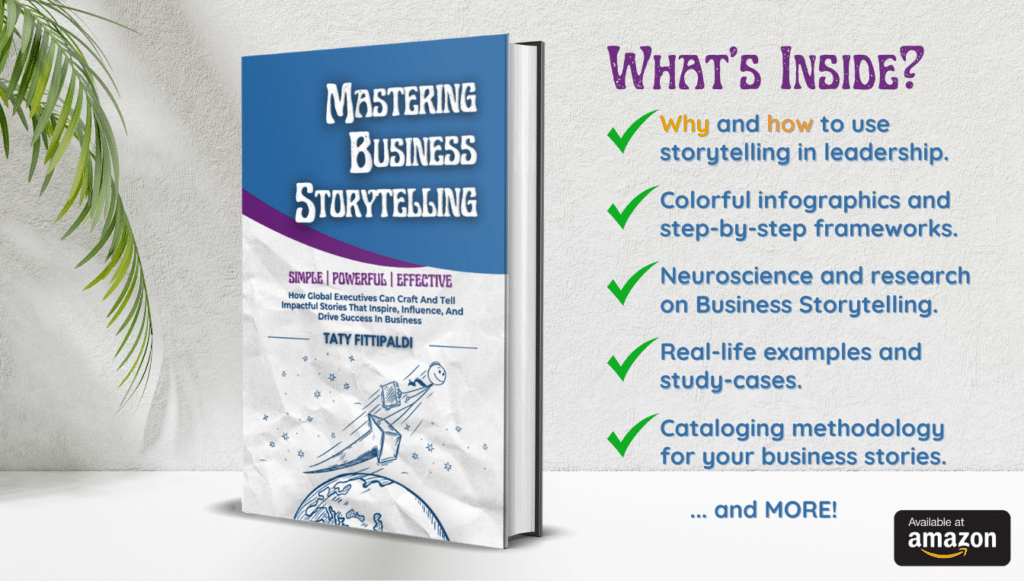
🔹Get your copy of Mastering Business Storytelling and start mastering the power of storytelling today.
🔹You can also subscribe to our free 6-day Email Business Storytelling Mini-Course. It delivers one core storytelling concept daily for 6 days and its summary workbook PDF.