In global organizations, performance alone doesn’t guarantee the progression to becoming a successful global leader. You can meet targets, exceed expectations, and lead teams to success — but if the collective perception of who you are doesn’t align with your leadership branding, you might find yourself stuck behind an invisible ceiling.
It’s a reality many professionals face, especially in complex environments with layered hierarchies, cross-cultural dynamics, and legacy biases. In these settings, your brand isn’t just what you say or do — it’s what others believe you represent. And that belief is shaped less by data and more by stories.
Stories that circulate in hallway conversations, stakeholder meetings, and team chats. Stories based on a handful of moments, or worse — based on someone else’s behavior before you ever stepped into the role.
Reputation, in this sense, isn’t always a reflection of truth.
It’s a reflection of perception — of collective narratives formed through assumptions, impressions, and shared meaning-making.
And when those narratives don’t match the bold leader you know yourself to be, the question becomes:
How do you reshape the story without seeming defensive, pushy, or desperate to prove yourself?
Let’s explore what that looks like — starting with a real story from the manufacturing world.
The Plant Manager’s Missed Promotion
He had the numbers to prove it — months of consistent performance, operational targets not only met but exceeded, downtime slashed across critical lines, and a team that delivered under pressure.
By all practical measures, he was ready for more.

The next step was clear: a promotion to lead one of the company’s larger, high-stakes manufacturing plants.
But behind closed doors, the leadership team saw it differently. Despite his achievements, a collective narrative had formed around him — and it wasn’t favorable.
He was seen as too transactional, not strategic enough.
Too reactive, rather than planning-oriented.
Too messy and unpolished, lacking the executive presence and business acumen expected of someone at the next level.
He didn’t agree with this perception. He felt misunderstood — boxed into a version of himself that didn’t match how he operated or who he was becoming as a leader.
But the reality was undeniable: this misalignment was blocking his career advancement.
It wasn’t about capability — it was about branding. And the story being told about him wasn’t his own.
What happens when the story about you becomes the very thing standing in the way of your career?
When Collective Narratives Misalign With Your Personal Brand
In every organization, department, or team, a collective narrative is always forming. It’s the shared story people tell about “how things work here,” “who’s easy to work with,” or “what someone is like.”
These stories shape culture, drive decisions, and — more often than not — travel faster than facts.
When they align with your personal and authentic leadership brand, they can amplify your leadership presence.
But when they don’t, they can create silent friction, misunderstanding, or even missed opportunities.
✦ Why This Happens
Sometimes, it’s a simple misunderstanding. Other times, it’s legacy — you’re stepping into a role where the behaviors of your predecessor have unconsciously shaped how people perceive the position, not just you. This is especially common in large, fast-moving organizations where roles become branded by the habits, communication styles, or leadership gaps of those who held them before.
In multicultural or high-turnover environments, this effect is even more pronounced. People rely on mental shortcuts — known in behavioral science as heuristics — to make quick judgments in uncertain or high-complexity settings. Instead of pausing to evaluate new information objectively, the brain fills in the blanks using what’s familiar or previously experienced. It’s a survival mechanism for processing ambiguity, but in the workplace, it often leads to oversimplified narratives about people.
Studies have shown that it takes just 7 seconds to form a first impression — and that once formed, these impressions can take up to 8 consistent encounters to start meaningfully change. In leadership settings, where moments of visibility are often limited, those 7 seconds can shape someone’s entire perception of your leadership style, trustworthiness, and potential.

Add to this the power of group reinforcement, where perceptions are echoed and subtly validated in meetings, performance reviews, and informal conversations, and you get something more stubborn than a single opinion — you get a collective narrative.
And the more senior your role, the less likely people are to challenge that narrative to your face.
✦ How Collective Narratives Connect To Leadership Identity And Branding
When perception gaps emerge in the workplace, they don’t just reflect a misunderstanding — they point to a deeper misalignment between how a leader shows up and how they are perceived. This is where personal leadership and personal branding come into play.
Every business leader — whether emerging or already a senior leader — carries with them a leadership identity shaped by their core values, positive leadership and decision-making style, and approach to leadership. Over time, these elements inform your leadership brand statement — a kind of unspoken message people receive when they interact with you, observe your decisions, or hear your name in a meeting.
And whether we like it or not, that brand is always under the influence of public perception.
In high-visibility roles, especially with direct reports, cross-functional teams, or multicultural environments, a strategic approach to communication becomes a crucial aspect of effective leadership. Why? Because the stories people tell about you — both online and offline — shape your online presence, your reputation, and ultimately your trajectory toward your career goals.
This is why strong leadership isn’t just about making good decisions. It’s about communicating those decisions in ways that reflect a consistent message, a clear mission statement, and alignment with your key values. It’s about showing up as an authentic leader, not just an authentic person. The distinction matters.
And as your leadership journey evolves, so must your leadership skills. Practicing storytelling, refining your communication, and being mindful of how your actions and words are perceived by others aren’t “nice-to-haves”—they are core skills for long-term success.
Effective leaders who invest in this side of development — who operate with a growth mindset and a strong commitment to continuous learning — are far more likely to build and sustain a leadership brand that reflects who they are and where they’re going.
After all, your approach to leadership is only as effective as others’ ability to recognize and align with it.
And that’s why your leadership brand matters — not just for your current role, but for your continued success.
✦ What You Can Do To Align Perceptions
Here’s how to shape a new narrative with intention:
1. Listen First—Without Defensiveness
Before you can change a narrative, you need to understand it. That starts with listening — not with the intent to react or defend, but with the intent to understand. Seek feedback from people who work closely with you: your manager, cross-functional peers, and even direct reports. Ask questions like: “How would you describe my leadership style to someone new?” or “What’s one word you think people associate with me?”
Pay close attention not just to what’s said, but what’s not said. Silence can reveal just as much as feedback. You may notice patterns, repeated language, or subtle pauses when certain topics come up — these are all clues to the underlying perception.
It takes courage to hear what others think about you, especially if it challenges your self-perception. But this step is critical. You can’t close perception gaps if you don’t know where the edges are.

2. Identify The Perception Gap
Once you’ve gathered input, the next step is to reflect deeply on where perception and reality diverge. This is where your core values, leadership brand statement, and approach to leadership come into focus. Are you being perceived in ways that don’t reflect your true intent? Is there a mismatch between how you act and how others interpret your actions?
For example, you may value thoughtfulness and reflection — but if you stay quiet in meetings, others may label you as disengaged or lacking initiative. Or maybe your direct and assertive communication style is meant to drive efficiency, but it’s being read as harsh or cold.
These misunderstandings often stem from cultural filters, previous leadership legacies, or different communication expectations. The goal isn’t to change who you are — but to recognize where and how the signal of your leadership is being distorted on the receiving end.
3. Share Micro-Stories That Reposition You
The most effective way to shift a narrative about you isn’t by insisting on telling who you are — it’s by showing who you are through stories. Short, purposeful, real-life examples are what stick in people’s minds and reshape how they see you.
These stories don’t need to be epic. A moment where you mentored a junior employee, admitted a mistake, or aligned multiple teams around a new solution can all be powerful micro-stories. What matters is that they reflect your core leadership identity and reinforce the traits you want others to associate with you — whether that’s strategic thinking, empathy, decisiveness, or collaboration.
You can share these moments in casual conversations, project updates, or during team meetings. Think of them as narrative nudges: consistent, authentic cues that slowly reprogram perception.
4. Reinforce The Story Through Visible Behaviors
A story alone is powerful, but a story backed by consistent behavior becomes unshakeable. Once you’ve clarified the narrative you want to reshape, look for ways to embody it in your daily actions — especially in moments that matter: meetings, reviews, cross-functional collaborations, and executive visibility windows.
If you’re working to overcome a perception of being “hard to approach,” show up early to team meetings and ask open-ended questions to start conversations. If you want to be seen as more strategic, start framing your updates in terms of long-term impact and business goals. If you’re trying to project a stronger executive presence, work on eliminating filler language, refining your tone, and using clear, outcome-driven language that shows your business and financial acumen.
Consistency is key here. People don’t change their minds after one “good impression.” They change their minds after they see a new pattern emerge — and trust that it will last.
5. Use Allies Strategically
Changing a collective narrative isn’t a solo act — it’s a networked effort. Trusted peers, sponsors, mentors, and even direct reports can become powerful amplifiers of the narrative you’re working to reshape. When they echo your core values, reinforce your leadership identity, or share stories that highlight your strengths, they help reframe public perception organically and credibly.
This is where stakeholder mapping becomes an essential leadership skill. It’s not just about identifying who holds formal power — it’s about understanding who holds influence over the story being told about you. Who shapes the room before you enter it? Who carries weight in informal conversations? Who’s repeating an outdated version of your leadership style?
Knowing who’s who in the ecosystem of your personal or leadership branding allows you to be intentional in your engagement. Some stakeholders may need clarity. Others may need to see a different side of you in action. And a few may already be allies — you just need to equip them with the right message to support your evolution.
In the end, shaping a narrative isn’t just about what you say — it’s about who else is willing to say it with you.
Changing a collective narrative doesn’t happen overnight — but it can happen.
The key is consistency and intention. After all, “Water dripping day by day wears the hardest rock away.”
And remember: just because a story was told about you doesn’t mean it’s the story you have to live. You are not who people say you are. You are who you decide to be — and who you consistently show up as.

➡️ If this topic hits close to home, check out our 2-episode series on Perception on The Leadership Nest podcast.
We talk about how perceptions are formed, how they influence your leadership brand, and what to do when they don’t reflect the real you. You can check it out here.
Study Case: How He Reclaimed The Narrative
Realizing that perception — not performance — was standing in his way, the plant manager made a bold and strategic decision: instead of continuing to push harder on results, he shifted his branding efforts to focus on the narrative surrounding his leadership identity.
But he didn’t do this blindly. With guidance, he followed a structured action plan that aligned with his career aspirations, grounded in the core storytelling tools from Mastering Business Storytelling. His goal wasn’t just to earn the promotion — it was to craft an authentic brand message that truly reflected his key attributes, personal leadership approach, and commitment to the basics of leadership that drive organizational success.
✦ Reframing Process
He began by reframing how he presented his decisions during team and leadership meetings. Instead of jumping straight into updates or metrics, he framed decisions through a broader lens — emphasizing business impact, long-term implications, and cross-functional strategy. This allowed his career mapping efforts to align more closely with what company leaders were looking for in the next-generation general managers: someone who could think beyond tasks and shape outcomes strategically.
✦ Show, Not Tell
He stopped saying, “I’m strategic.” Instead, he began sharing stories — brief, powerful narratives that highlighted moments where he had anticipated problems, collaborated across functions, or improved processes through foresight and planning. These moments demonstrated his core qualities in action and made his leadership style accessible to a broader audience. He showed how strategic he was through these micro-stories, instead of simply telling people he was strategic.
✦ External And Collective Narratives
He also began planting what we called “echo stories” — short anecdotes from team members, customers, or successful leaders that reinforced his role in driving results.
For example, during a quarterly town hall, he casually shared how a regional leader had praised his team’s fast turnaround on a critical equipment failure. Instead of taking full credit, he quoted what the leader said: “Your team was the only one that gave me a clear plan with checkpoints — and then actually delivered ahead of time.” This positioned him not only as a capable leader, but as someone trusted and respected by upper management. That small moment — shared in passing — began circulating upward and sideways, reinforcing a more strategic and reliable image.
These third-party validations helped shape new external narratives while also subtly reshaping the collective narrative within the leadership team. He even gathered informal 360-degree feedback to understand how his personal attributes were being perceived across layers of the business during this reshaping.
✦ The 4-Step Framework
Using the book’s storytelling structure, he applied the 4-step framework in high-stakes presentations and informal leadership updates:
- Step 1 – The Hook: Start with a quick, relatable problem to get attention.
- Step 2 – The Why: Explain through thoughtful stories why this problem mattered to the business or team.
- Step 3 – The What: Share the principle, decision, or key idea he wanted to communicate after the story.
- Step 4 – The How: Show how that idea created a meaningful shift in process, results, or mindset.
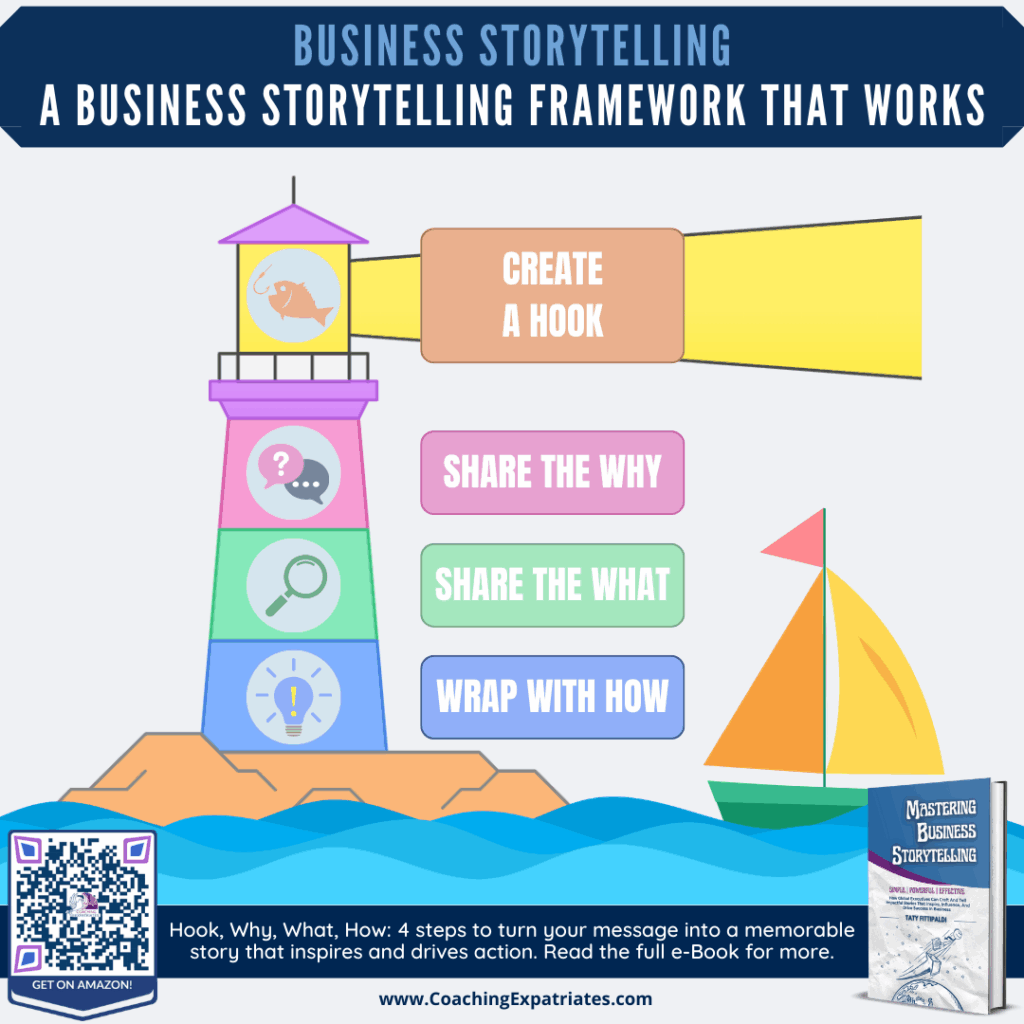
This structure gave his communication a compelling strategy feel — making it easier for others to connect the dots between his actions and the company’s central aspect of business strategy.
✦ Angel’s Elixir
He went further by applying what the book refers to as the Angel’s Elixir — crafting stories that activated the audience’s emotions and attention through the right hormonal responses:
- Endorphins through humor or humble self-awareness.
- Oxytocin by spotlighting moments of trust, team support, or customer impact.
- Dopamine by creating anticipation and curiosity around what was coming next.
This emotional intelligence, combined with structure, helped him create moments of connection that had never existed in prior meetings.

✦ Clarity & Focus Techniques
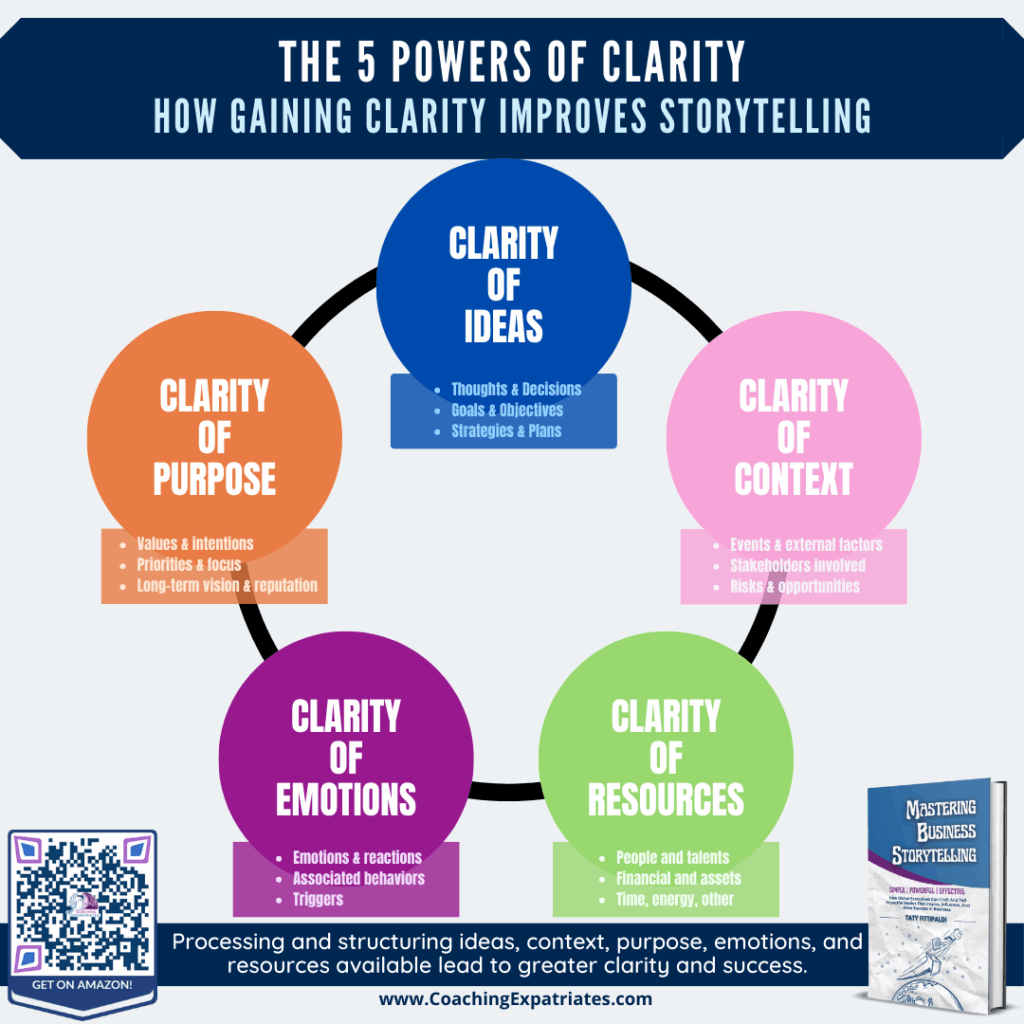
He also reworked his speaking and writing style, embracing 2 importance concepts to be more concise, forward-looking, and impactful: The 5 Powers of Clarity and Focus Management. He practiced trimming unnecessary details, aligning his messages with his basic mission statement, and tying each point back to a clear business or human outcome. This reinforced his commitment to excellence and positioned him as a leader with not only vision — but also control and strategic focus.
In the span of six months, a shift began. Leaders started responding differently to his input. He was asked to speak in broader operational reviews. His updates were referenced by other senior leaders. And when the next opportunity came for a general manager role, he wasn’t just considered.
He was requested.
Not because he had changed who he was — but because he had learned how to communicate the leader he had become, and how to share it with others in a way that reflected his truth, his growth, and his leadership potential.
The Tools Behind The Shift: How Storytelling Coaching And Strategy Made The Difference
The plant manager’s transformation didn’t happen by accident. He was coached directly by me as part of a targeted effort to reshape how he was perceived inside the organization — and a major part of our work together was grounded in the storytelling strategies I outline in my book, Mastering Business Storytelling.
Through our sessions, he didn’t just talk about leadership — he learned how to communicate it strategically, using storytelling techniques that helped others finally see the executive potential he had all along.
Together, we built a tailored action plan that applied key tools from the book, including:
- The Reframing Process, which helped him shift the way he communicated decisions, framing them through business outcomes and long-term impact.
- The Art of Show, Not Tell, allowing him to express strategic thinking and leadership through real stories rather than self-declarations.
- External and Collective Narratives, used to amplify his influence through the voices of others — direct reports, peers, and regional leaders.
- The 4-Step Framework for structuring impactful stories that resonated with stakeholders and decision-makers.
- The Angel’s Elixir to build trust, connection, and attention through stories that activated the right emotional and neurological responses.
- Clarity and Focus Techniques to make sure his communication was not just clear — but executive-level.
This was not generic leadership development. It was a strategic storytelling intervention — and it worked.
📘 If you’re a leader looking to shift how others perceive your leadership style, presence, or potential, Mastering Business Storytelling offers the same tools and frameworks used in this case, applied not only for personal branding but any leadership and communication messaging in global environments. You can explore all the concepts at your own pace — or combine the book with coaching for an even deeper impact.
If the video is not displaying due to your cookies’ settings, you can watch it on YouTube by visiting this video’s link.
You can get your copy of this fantastic book here and begin shaping the narrative your leadership deserves.
Final Remarks
In today’s complex global environments, conscious leadership is no longer just about performance metrics — it’s about current perceptions, presence, and the ability to shape meaning through clear, intentional communication.
As this real-life story illustrates, even high-performing leaders can hit a ceiling when their internal leadership identity doesn’t align with the external story others are telling. But that gap isn’t permanent — and it’s not personal. It’s strategic. Which means it can be intentionally addressed.
Whether you’re aiming for your next career move, navigating misaligned perceptions, or simply strengthening your leadership competencies and brand, you don’t need to do it alone.
📌 If you’re ready to take action, my Executive Coaching for Global Leaders offers individualized support to help you apply the storytelling techniques from Mastering Business Storytelling to your unique context — transforming how you’re perceived while staying authentic to your values and mission.
📚 If you’re looking for a deeper, structured development experience, check out The Global Leadership Pillars — my online executive leadership training designed for ambitious leaders seeking to expand their core leadership skills in personal leadership, communication, trust-building, cultural intelligence, storytelling, impressions management, and even business and financial acumen. It’s a complete self-paced growth journey for the modern global executive.
🎧 Not quite ready for coaching or training? You can start with The Leadership Nest — our free podcast that nests stories, science, and knowledge to soar the leadership in you. Each episode brings you practical insight, expert opinions, and narrative-driven tools to grow your influence from the inside out.
💡 And if you’d like curated insights delivered straight to your inbox, don’t miss our private weekly newsletter. Every week, I share bold leadership reflections, real client stories and insights, and a curated roundup of global trends to help international leaders stay sharp, informed, and ahead of their game. Subscribe here.