Most global leaders and executives spend countless hours trying to fix external factors — market shifts, team dynamics, or company politics — yet the most effective ones focus first on what they can actually control. This is where the Circles of Control come in. Popularized by Stephen R. Covey in The 7 Habits of Highly Effective People, the Circles of Control and Influence teach us to lead from the inside out, directing energy toward our own proactive mindset, choices, and behavior rather than reacting to external circumstances, tied to the “circles of concern.” Grounded in psychology and the idea of locus of control, this concept has influenced everything from modern behavioral therapy to leadership and personal development practices worldwide.
Understanding this model goes far beyond self-help theory — it’s a leadership compass for a success and growth mindset. In this article, we’ll unpack the three circles through both a practical and narrative lens, explore why storytelling enhances their impact, and see how applying them can transform how you lead, decide, and communicate.
What Are The Three Circles Of Control?
In leadership, focus management is everything. Yet so many leaders spend energy in the wrong places — worrying about what they can’t control, over-investing in things they can’t fully influence, or neglecting the one space where they have full creative power: themselves.
In my book, Mastering Business Storytelling, I talk about the importance of aligning focus and attention to obtain maximum results. Now, I’d like to explore where this focus and attention can be concentrated, and what it means for your storytelling journey.
Here is where the classic concept of the Circles of Control, Influence, and Concern comes in.
Imagine three concentric circles:
- At the innermost circle is your Circle of Control — the smallest, but most powerful. These are the things you completely control: your thoughts, your actions, your responses, your mindset.
- The next concentric ring is your Circle of Influence — the things you can influence, in other words, are in our sphere of influence, but not control outright. This includes relationships, team performance, client decisions, and even how your ideas land with others.
- The outermost circle is your Circle of Concern — all the things you care about, but can’t do much about directly. Global trends, economic shifts, government policies, company restructures, the collective mood or culture — this circle is vast, but slippery.
In essence, the more we focus on what we can control, the more empowered we feel. The more time we spend fixating on things in our concern circle (without influence), the more helpless and reactive we become.
If your video is not showing due to your cookie settings, you can watch it directly on Youtube using this link.
The Positive Psychology Behind The Circles Of Control
When you think about it, the Circles of Control are more than just a neat visual — they’re a map for how our mind handles pressure, priorities, and energy. The core idea sits right at the intersection of positive psychology, stress management, locus of control, and good old common sense.
In positive psychology, researchers have long emphasized the importance of agency — that sense of “I can do something about this.” This idea traces back to the concept of locus of control, first coined by psychologist Julian Rotter in the 1950s. He found that people who believe they have control over their actions and outcomes (an internal locus of control) tend to be more resilient, optimistic, and effective when facing challenges. Those with an external locus — who believe that outcomes depend on luck, fate, or other people— in other words, external factors— often experience higher stress and lower motivation.
If your video above is not showing due to your cookie settings, you can watch it directly on Youtube using this link.
➡️Self-Efficacy And Control
Stephen Covey popularized this in The 7 Habits of Highly Effective People by showing leaders how to focus on what they can control, influence what they can’t fully control, and release what they can’t influence at all. That’s essentially the mindset of emotional regulation in action — knowing where to place your energy. Psychologist James Gross (1998) described emotional regulation as the ability to manage one’s feelings in response to external circumstances, and Covey’s framework gives that idea a very practical form for leaders.
Modern positive psychology builds on this idea with interventions that help people strengthen their inner circle of control. For example, Albert Bandura’s (1997) research on self-efficacy shows that when people focus on what they can do — their behaviors, choices, and mindset — they reinforce their belief in their own capabilities, which in turn boosts motivation and performance. Likewise, Martin Seligman’s (1990) work on learned optimism demonstrated that shifting attention from what’s uncontrollable to what’s within reach reduces helplessness and builds resilience after setbacks.
Then there’s James Gross’s (1998) work on emotional regulation, which explains how awareness of what’s controllable versus uncontrollable lowers anxiety and enhances adaptive coping. This is precisely why the Circles of Control are so effective in stress management: they give structure to emotional clarity. You can’t control everything, but you can always control your response — and that makes all the difference.
These findings are also why gratitude practices and health journals aren’t just feel-good rituals; they train your brain to notice what’s going right and what’s within your influence. Similarly, Mindfulness techniques and restorative practices teach leaders to pause before reacting, accept reality, and choose intentional responses instead of spiraling into worry or frustration.
This focus on what we can influence is also central to health professional therapies like Cognitive Behavioral Therapy (CBT) and Acceptance and Commitment Therapy (ACT). CBT helps people challenge cognitive distortions — those automatic negative thoughts that distort reality (“I’ll never get this right,” “No one listens to me,” etc.). ACT, on the other hand, invites you to accept what’s outside your control while committing to action that aligns with your values. Both align perfectly with Covey’s model and are widely used in mental health strategies and coaching sessions to help clients regain clarity and focus.
In leadership, applying these concepts means learning to regulate emotions before they overflow into meetings, conversations, or decisions. When leaders practice mindfulness, gratitude, and perspective-shifting, they expand their Circle of Influence naturally. They stop trying to control every outcome — and start shaping culture through presence, trust, and consistency.
Because in the end, that’s what the Circles of Control are all about: mastering your inner world so you can influence the outer one — without burning out in the process (or losing your mind!).

The 3 Circles With A Narrative Power: A Business Storytelling Lens
Now, let’s take this a step further.
What if each of these circles didn’t just represent control… but also a layer of storytelling?
What if your personal power as a leader grew not only from what you do in each circle — but from how you tell the story within each one? The Circles of Control concept isn’t just a mindset tool — It’s a Strategic Storytelling Map.
Let’s break it down.
🟢 1. The Circle Of Control: Your Inner Narrative
This is your personal core. It’s where your mindset, beliefs, and internal monologue live. You might not control how people act, what they think about you, or what happens in your environment, but you do control what story you tell yourself about it.
And that’s no small thing.
Your inner narrative defines how you interpret setbacks, how you bounce back, how you decide what’s possible — and how you lead others through uncertainty. If your internal script is one of fear, self-doubt, or powerlessness, it will color every decision you make. But if your inner story is grounded, intentional, and constructive — you show up with calm clarity, even when the storm is raging.
🎤 This is where leadership storytelling begins: within. Before you speak a word to the team or clients, your own story about what’s happening will shape your tone, your choices, and your presence. The leaders who master business storytelling start here — with self-awareness and self-authorship.
🟡 2. The Circle Of Influence: Your External Narrative
This next layer is where most communication lives: presentations, strategy briefings, 1:1 conversations, public speaking. It’s everything you say and share to influence outcomes — but outcomes are never guaranteed.
You can’t control how people interpret your words. But you can shape your narrative intentionally, aligning it with values, context, and what matters most to your audience.
That’s what business storytelling does so well: it bridges logic and emotion. It translates vision into a narrative that others can feel and follow.
📢 This is where communication becomes a leadership tool. In this circle, your storytelling builds trust, persuades stakeholders, and turns ambiguity into action. You’re not just passing information — you’re moving people.
🔴 3. The Circle Of Concern: The Collective Narrative
This is the biggest and most abstract of all. It’s made up of all the things happening around you that you care about deeply — but can’t change directly. Social trends. Cultural shifts. Economic conditions. Employee morale. Organizational habits. The mood of the room.
You can’t control these things, and often you can’t even influence them much — unless you first learn to read the story they’re telling.
This is where great leaders shift from storytelling to sensemaking. Instead of resisting the collective story, they study it. They listen to what’s said (and unsaid). They become fluent in the collective narrative — and then position their own story to respond, realign, or reframe.
🧭 This is where narrative leadership becomes a strategic advantage. The more you understand the collective story, the more wisely you can intervene — not to control it, but to contribute something meaningful to it.

🔁 Why This Narrative Lens Matters
Storytelling isn’t just a communication technique — it’s a navigational tool for leadership.
Each circle comes with a different kind of narrative responsibility:
- Your inner story creates your mindset.
- Your external story influences outcomes.
- Your understanding of the collective story determines your strategic relevance.
✍️ Start inside. Move outward. That’s how leaders shift from reactive to intentional — and from being a passenger of change to becoming a co-author of it.

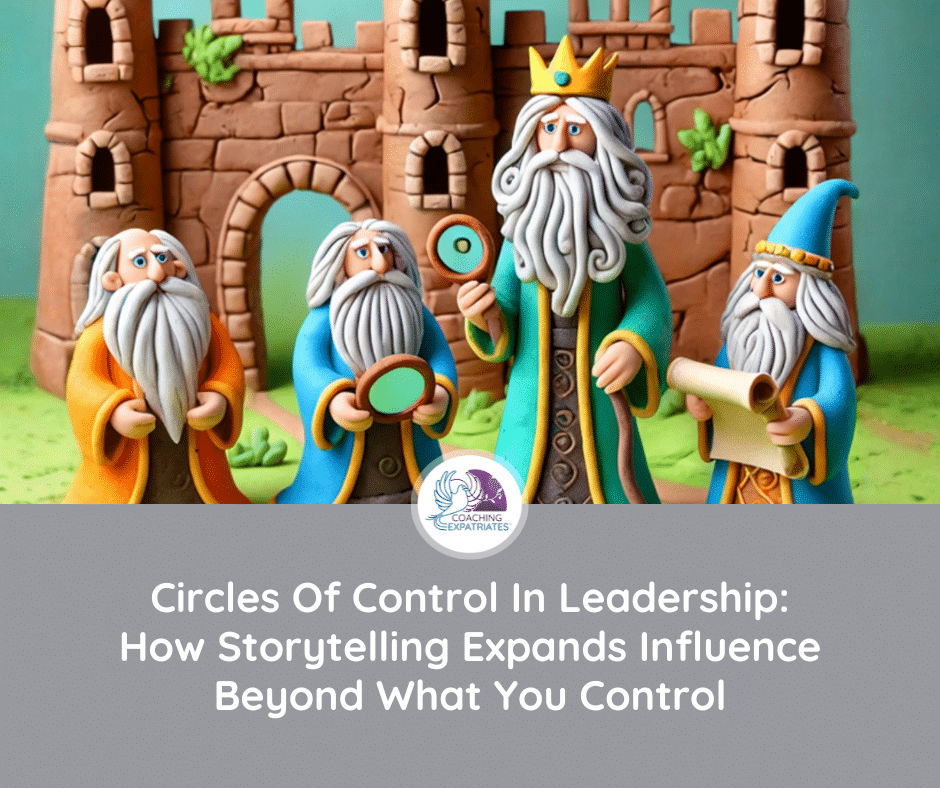
🏰 Story: The King And The Three Wise Men
A Leadership Parable About The Circles of Control, Influence, and Concern
Once upon a time, a king stood before the ruins of his once-mighty castle. Its towers had fallen, its walls worn thin — not from war, but from the slow erosion of time, weather, and one overlooked truth: what you don’t tend to, eventually breaks down.
Determined to rebuild — not just stronger, but smarter — he summoned the three wisest men in the kingdom. Each carried a different worldview. Each offered a piece of the story the king needed to hear.
🧙♂️ The First Wise Man – The Sage Of The Self
🟢 Circle of Control – Your Inner Narrative
This wise man brought no tools. Only a mirror.
“You ask how to build stronger walls,” he said, “but your first structure must be within. The castle fell because your inner story didn’t value maintenance — only grandeur. You believed strength was in its appearance, not in its upkeep.”
He handed the king the mirror.
“Look into it. What did you ignore? What assumptions guided your leadership? If your internal story doesn’t change, your new walls will fall again — perhaps faster than before.”
🔍 Explanation – Circle of Control:
This wise man represents the king’s inner narrative — the beliefs, mindsets, and default behaviors that quietly guide every decision.
He teaches that leadership begins with honest self-reflection. The king must change the story he tells himself about what matters.
How to lead here: Reflect on past patterns, reframe your guiding beliefs, and realign your leadership with long-term values—not short-term image.
🧙♂️ The Second Wise Man – The Voice Of The People
🟡 Circle of Influence – Your External Narrative
This wise man came with scrolls — letters from farmers, merchants, and builders.
“Your people didn’t just lose walls. They lost work, pride, and purpose. You must tell them how rebuilding will revive the kingdom — create jobs, attract talent, strengthen trade routes, and build a future worth staying for.”
He looked the king in the eye.
“They will build faster if they believe in the story. Not just in the stones.”
📣 Explanation – Circle of Influence:
This wise man represents the external narrative — how a leader communicates vision, change, and meaning.
The king must shift from merely issuing orders to crafting a compelling story about shared purpose and benefits.
How to lead here: Communicate with clarity, consistency, and emotional resonance. Tell the story of why the work matters, not just what must be done.
🧙♂️ The Third Wise Man – The Keeper Of Winds
🔴 Circle of Concern – The Collective Narrative
The third arrived with maps, wind charts, and the news of nearby kingdoms.
“You build in the middle of shifting forces — rising tensions, changing climates, alliances unknown. You can’t stop these winds. But you can learn to read them. And you can position your castle to endure them.”
He paused, then added,
“Know what the people are whispering. Hear what’s being said across borders and within walls. Don’t just build — respond.”
🌍 Explanation – Circle of Concern:
This wise man symbolizes the collective narrative — the stories that shape culture, morale, public opinion, and macro forces.
The king must learn to listen, to understand what’s being said (or left unsaid), and to respond wisely — without the illusion of control.
How to lead here: Listen, understand, reposition, and reshape your leadership within the broader context of what’s unfolding around you.
The King’s Turning Point:
So the king rebuilt.
- Not just walls, but the foundation of his mindset.
- Not just structures, but a vision that others believed in.
- Not just for today, but in response to the world around him.
He kept the mirror in his chambers. The scrolls in his war room. And the maps in his study.
✍️ Leadership Lesson:
True leadership is narrative leadership. You must own your inner story, shape the story you share, and understand the stories shaping the world around you.
If you build or rebuild, like the King, without revising your narrative, your foundation will always remain fragile.

Applying This As A Leader
The story of the king may be fictional — but the challenge is very real.
Whether you’re rebuilding a struggling team, reshaping strategy after a setback, or trying to restore confidence and alignment across functions, the question is not where to start, but how to start. And that how begins with narrative.
Before making a single decision or delivering a speech, ask yourself:
- What story am I telling myself? And what is under my control? (This reveals your inner narrative — Circle of Control.)
- What story do others need to hear to move forward with me? And who needs to hear this story? (This shapes your external narrative — Circle of Influence.)
- What stories are already circulating in the culture, team, or market? (This uncovers the collective narrative — Circle of Concern.)
You don’t need to lead in all directions at once. You just need to be intentional about which circle you’re leading in — and which story you’re choosing to tell there.
When your leadership aligns with the right narrative, in the right circle, it doesn’t just rebuild what was lost. It builds something stronger.
➡️ Exercises And Tools To Improve Your Circles Of Control And Influence
Knowing what the Circles of Control represent is one thing — strengthening them is another. The good news? You can train this skill just like any other area of professional development. Below are practical resilience exercises, coaching tools, and daily habits that can help you expand your sense of control and influence over time.
- 🧭 Start With a Weekly Reflection Practice
Take five minutes at the end of each week to list two situations that were within your control, two you influenced, and two that were outside of your reach. This simple exercise builds self-awareness and helps you direct energy toward what truly matters — a powerful form of resilience training in itself. - 🎯 Set SMART Goals for What You Can Control
Use the SMART Goals method (Specific, Measurable, Achievable, Relevant, Time-bound) to define where you want to grow inside your inner circle. Focusing on controllable actions — like your communication habits, preparation level, or response to feedback — keeps progress realistic and empowering. - 💬 Build a Healthy Feedback Loop
Ask trusted peers or mentors to share observations about how you respond under stress or uncertainty. This external perspective creates a feedback loop that fuels self-awareness and accountability. It’s also a strong foundation for any ongoing coaching practice. - 🧘 Incorporate Self-Care Practices Daily
Expanding your Circle of Control isn’t only about action — it’s also about restoration. Integrate small self-care practices like journaling, mindful breathing, or short walks into your day. These habits strengthen emotional balance and mental clarity, helping you respond intentionally instead of reactively. - 🤝 Join Support Groups or Peer Circles
Sharing experiences with others in support groups or professional communities helps normalize challenges and provide perspective. Hearing how others navigate uncertainty can expand your Circle of Influence, offering new approaches you might not have considered. - 🧩 Try Guided Mental Health Coaching or a Structured Coaching Session
Working with a certified professional coach or engaging in mental health coaching helps you identify unhelpful patterns and replace them with constructive strategies. A structured coaching session can clarify where your control ends and your influence begins — a critical insight for leaders managing complex systems. - 🌱 Practice Restorative and Resilience Exercises
Techniques like reframing setbacks, visualization, and gratitude journaling are proven resilience exercises that strengthen your internal stability. Over time, these practices turn emotional regulation into a leadership reflex.

🪧Pro tip: The more consistent you are with these tools, the wider your Circle of Influence becomes — not because you control more, but because people naturally respond to grounded, emotionally regulated leaders who lead by example.
Final Thoughts: Lead Where It Matters Most
Great leadership isn’t about doing more. It’s about focusing smarter where your presence has the most impact—and telling better stories in the right circle.
Whether you’re leading yourself, guiding a team, or navigating complex cultural currents across the globe, every leadership moment happens inside one of these circles. And each one requires a different kind of narrative clarity. So, pause and ask yourself:
- Which circle do you find yourself stuck in most often?
- And which one needs your leadership the most right now?
If you want to go deeper into this concept, my book Mastering Business Storytelling offers an entire framework around internal, external, and collective narratives — with practical tools to create business stories that work on all three levels.
If you’re ready to take your leadership skills to the next level, check out The Global Leadership Pillars® — my self-paced online course designed for emerging global leaders. It’s an intensive, MBA-level experience that equips you with essential personal, relational, organizational, and cultural leadership skills needed in today’s global business environment.
And if you’re looking for personalized support, my executive coaching services are here to help. Using business storytelling as a leadership tool can be powerful — but also challenging. I work with global professionals to help them navigate all three circles, reshape their narratives, and elevate both their leadership style and results.
🤝 Let’s talk about coaching here
Whatever your next step is, take a page from the king’s story — and start by looking into the mirror. Find what you value, what you believe, and what you want to set as your leadership and career goals. Every story can start with looking into a mirror.
If you enjoyed this post, be sure to subscribe to my weekly global leadership newsletter, where I share insights on global leadership, decision-making, communication, and storytelling each week.