Psychological safety is one of the most researched concepts in social science today — and the 4 stages of psychological safety have become a powerful guide for successful global executives trying to build high-performing multicultural teams. But here’s the truth that textbooks rarely mention: psychological safety becomes significantly more complex when people come from different countries, norms, power-distance levels, or communication styles. And I learned this firsthand during my Cultural Intelligence (CQ) certification.
On the last day of training, in a breakout room full of American professionals, a participant tried to express interest in my background. When she learned I was born in Brazil and now lived in the United States, she asked:
“Oh, and are you planning to stay in the country?”
It landed on me like a micro-aggression.
Maybe she meant no harm. But what I heard was: “You don’t belong here.”
My instinct for a split second was to respond with: “Are you planning to stay in the country?” Not to attack, but to hold up a mirror to the bias in her question. But one of my behavioral preferences is a non-confrontational approach, so I politely answered, redirected the conversation, and then reflected on the intercultural dynamics at play.
This moment reminded me of a core truth: psychological safety cannot be separated from cultural intelligence. Not in today’s multicultural work environment, not in global leadership teams, and definitely not in Remote teams or virtual meetings where diverse perspectives collide every day.
What Is Psychological Safety?
Psychological safety, originally researched by Amy Edmondson and popularized in The Fearless Organization, refers to a climate where team members feel safe to take interpersonal risks — to speak up, admit mistakes, ask questions, share ideas, or disagree without fear of embarrassment, punishment, or exclusion.
➡️It is not about comfort.
➡️It is not about avoiding accountability.
➡️And it is certainly not about removing standards.
Psychological safety is a performance condition — not a perk. When it’s absent, teams hold back. When it’s present, teams innovate faster, make better decisions, and build stronger Organizational Culture.
Psychological safety is a shared belief within a team that the work environment is safe for interpersonal risk-taking. It means people feel they can speak up, ask questions, admit mistakes, offer ideas, challenge assumptions, and express concerns without fear of embarrassment, punishment, or damaging their reputation. At its core, psychological safety is the foundation that allows individuals to show up authentically, contribute honestly, and participate in learning behaviors that help the team grow and perform at a higher level.
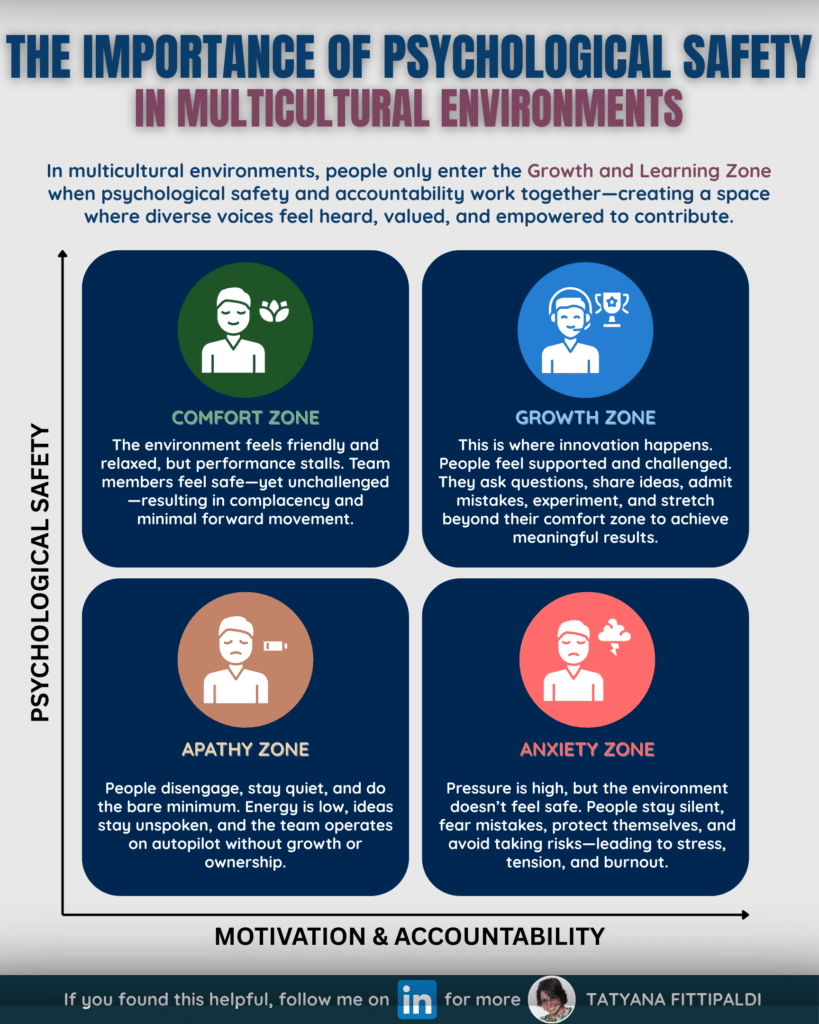
Psychological safety matters because modern work requires:
- Vulnerability in leadership
- Idea-sharing across hierarchies
- Cross-functional debates
- Interpersonal risk-taking
- Emotional Intelligence
- Growth mindset behaviors
- High accountability with high openness
This combination drives Motivation, supports staff wellbeing surveys and Pulse surveys, and underpins every great team psychological safety strategy.
The Four Stages Of Psychological Safety In The Workplace Explained
While Amy Edmondson’s work focuses on team climates, Timothy Clark’s Psychological Safety Framework breaks safety into four progressive stages that teams must move through to reach high performance:
The 4 Stages Of Psychological Safety
1. Inclusion Safety
Team members feel accepted and respected. They belong — regardless of identity, accent, background, or title.
2. Learner Safety
People feel safe to ask questions, try new things, and make mistakes without fear of judgment.
3. Contributor Safety
Individuals feel safe to use their skills, contribute ideas, take initiative, and add value.
4. Challenger Safety
Team members feel safe to challenge norms, disagree, and take interpersonal risks to improve the work environment.
These stages are deeply interdependent. You cannot achieve Challenger Safety without Inclusion Safety. You cannot create Contributor Safety without Learner Safety. And this is where cultural intelligence becomes non-negotiable. Different cultures interpret risk, hierarchy, confrontation, constructive feedback, and initiative very differently. A behavior that feels like “healthy debate” in one culture may feel like “micro-aggression” or “loss of face” in another. That’s why establishing a culture of psychological safety is crucial in our organizations. If we could embed this mindset in people’s minds, we would see a lot less social friction today.
Here’s a cool infographic for you to download and pin in your board:

The Limitations & Criticisms Of The Four Stages Framework
No model is perfect, and the 4 psych safety stages are no exception. Its most common critiques include:
1. U.S.-Centric Workplace Assumptions
The framework assumes:
- low hierarchy
- direct communication
- comfort with challenging authority
Many countries don’t operate this way.
2. Overemphasis on Leader Responsibility
Leaders are important. But psychological safety needs shared responsibility. This is especially true in cultures that value groups or have strong power perception differences.
3. Ambiguity in Implementation
Terms like “welcoming” or “inclusion” feel intuitive… until you try to measure them across cultures.
4. Lack of Empirical Evidence Globally
The model is growing in popularity, but still needs stronger peer-reviewed research across different cultural contexts.
5. Misinterpretation: Safety Doesn’t Mean Comfort
Some workplaces mistakenly treat psychological safety as “avoiding discomfort,” which leads to micro management, lack of accountability, or avoidance of difficult conversations.
Psychological Safety & Tuckman’s Model: Why Team Performance Depends On Both
Not often do I see people connecting the theory around psychological safety and team development, but I believe making this connection is crucial for better multicultural communication and leadership. Tuckman’s Model (Forming, Storming, Norming, Performing) describes how teams and team dynamics evolve over time, while psychological safety refers to the environment that enables everyone to feel at ease and perform well together. Here’s the connection leaders often miss:
Tuckman's 4 Stages Of Team Development
Forming → requires Inclusion Safety + CQ
- People observe before they speak.
- Cultural norms are unclear.
- Power distance is high.
Storming → requires Learner Safety + CQ
- Conflict emerges.
- Different communication styles collide.
- This stage lasts longer in multicultural teams without or low CQ.
Norming → requires Contributor Safety + CQ
- Shared working and cultural norms are established.
- Roles become clearer.
- Trust starts forming.
Performing → requires Challenger Safety + CQ
- This is where innovation finally happens.
- Only teams that reach Stage 4 with Challenger Safety can achieve real creativity, problem-solving, and high-quality decision-making.

In global teams, open communication and psychological safety alone are not enough to reach the “performing” stage. They need another important capacity: Cultural Intelligence (CQ). We’ll talk about it in just a bit. Before, I’d like to explore a few limitations of this framework that you should consider when having it in mind.
What Is Cultural Intelligence (CQ)? And How Is It Related To Multiple Intelligences?
Long before we talked about Cultural Intelligence (CQ) in today’s corporate world, scholars were already wrestling with one big question: Why do some people thrive in unfamiliar cultural settings while others struggle, even when they’re equally smart, kind, or emotionally intelligent?
The earliest clues came from the broader field of cross-cultural studies. Starting in the mid-20th century, pioneers like Edward T. Hall began unpacking how culture shapes communication, space, time, and meaning. This brought to the world the theories of High and Low Context Culture communication. Works like these opened the door for us to understand why diverse teams interpret the same behavior in completely different ways.
But as globalization accelerated, researchers noticed something intriguing: Emotional Intelligence (EQ) alone wasn’t enough to explain success in intercultural work. Many professionals with high EQ still stumbled when navigating cultural differences—not because they lacked empathy, but because they lacked a framework for interpreting cultural cues.
This realization inspired P. Christopher Earley and Soon Ang to propose a new model of intelligence tailored specifically for cross-cultural contexts. In 2003, they formally introduced Cultural Intelligence in their book, Cultural Intelligence: Individual Interactions Across Cultures. Their work drew on the theory of multiple intelligences and reframed CQ as a measurable capability that predicts whether someone will adapt effectively in new and unfamiliar cultural situations.
From there, the field accelerated. Researchers identified four key factors—metacognitive, cognitive, motivational, and behavioral—and developed the 20-item Cultural Intelligence Scale (CQS), which validated CQ as a reliable, predictive construct. By 2004, CQ had its first dedicated symposium, followed by a special academic issue and the first Global Conference on Cultural Intelligence in 2006.
Early studies consistently showed that CQ predicted performance and adaptability above and beyond other established predictors—EQ, personality traits, and language ability included.
Cultural Intelligence as we know it today—with its four validated capabilities and practical tools—came later in this research journey. The modern CQ framework was developed by the Cultural Intelligence Center, building on the foundational work of Earley and Ang. Today, CQ is defined as the ability to relate and work effectively across cultures, whether those cultures are national, functional, organizational, generational, or even shaped by hybrid and remote work environments. Unlike EQ, which focuses on emotions, CQ helps leaders recognize cultural patterns, interpret behaviors accurately, and adjust their approach in ways that build trust rather than tension.
CQ is built on four scientifically validated capabilities. Each capability answers a different question leaders must navigate in a multicultural work environment.
The 4 Cultural Intelligence Capabilities
1. CQ Motivation — “Do I want to work with cultural differences?”
CQ Motivation refers to the impulse or drive behind intercultural work. It includes your personal interest, confidence, and persistence when facing cultural challenges. For example, Leaders with strong CQ Motivation:
- Stay engaged even when interactions feel confusing
- Recover quickly after misunderstandings or miscommunications
- Show genuine curiosity about other people’s norms and behaviors
Without CQ Motivation, everything else falls apart. Curiosity is the spark that ignites inclusion.
2. CQ Awareness — “What cultural differences should I be aware of?”
CQ Awareness is the understanding of how cultures vary—and how those variations show up in real behaviors. This includes:
- how people give constructive feedback (direct vs. indirect)
- how they view hierarchy (egalitarian vs. hierarchical)
- how they approach time (flexible vs. rigid)
- how they communicate disagreement (open debate vs. subtle signals)
This is not about memorizing facts about countries. It is about recognizing patterns that help you anticipate and interpret behavior more accurately.
3. CQ Approach— “How do I plan for intercultural situations?”
CQ Approach is the ability to mentally prepare and strategize for multicultural interactions. Leaders with high CQ Approach:
- reflect before entering a meeting
- anticipate possible misunderstandings
- adjust their communication plan for the audience
- pause and re-evaluate assumptions during conversations
CQ Approach is the bridge between knowledge and action. It helps leaders avoid emotional reactivity and shift into intentional, culturally mindful decisions.
4. CQ Behavior— “How do I adapt my behavior effectively in real time?”
CQ Behavior is the behavioral execution of cultural intelligence. It is the observable adjustment people see in meetings, emails, presentations, and negotiations. High CQ Behavior shows up as:
- adjusting communication style depending on the audience
- managing tone and pace during virtual meetings
- modifying decision-making speed when collaborating across time zones
- choosing words that reduce ambiguity for diverse listeners

This is not about being inauthentic. It is about being versatile and flexible — someone who can meet people where they are without losing who you are.
Why CQ Is Essential For Psychological Safety
Cultural Intelligence allows leaders to interpret behaviors with more accuracy rather than assumptions, which is essential for creating a safe work environment. When leaders lack CQ, they often misjudge silence, enthusiasm, confrontation, or hesitation. These misinterpretations can unintentionally weaken Inclusion Safety, especially in multicultural or Remote teams.
Put simply:
- You cannot create Inclusion Safety if you misread cultural cues.
- You cannot build Learner Safety if people fear judgment based on cultural misunderstandings.
- You cannot reach Contributor or Challenger Safety without CQ, because people won’t take interpersonal risks if they feel culturally misunderstood.
CQ gives leaders the lens they need to create psychological safety that is real, equitable, and culturally adaptive, not just well-intended.
Why Diverse Teams Need Psychological Safety + Cultural Intelligence + Business Storytelling
A team can have every diverse perspective imaginable, but without psychological safety and cultural intelligence, that diversity won’t translate into innovation. Instead of unlocking potential, it creates friction, hesitation, and misalignment. The real unlock happens when you combine all three — psychological safety, CQ, and business storytelling skills — so people can understand each other, feel safe enough to contribute, and communicate in ways that inspire action.
➡️ Psychological Safety Without CQ → Misinterpretations
People may intend to include others, but without cultural intelligence, even well-meaning behaviors land poorly. Leaders misread silence as disengagement when it’s actually respect. Direct feedback sounds abrasive to someone from a harmony-driven culture. Power questions meant to encourage participation accidentally trigger stereotype threats. The result? Tension rises, trust falls, and people start tiptoeing around each other instead of building momentum together.
➡️ CQ Without Psychological Safety → Silence
Understanding cultural norms doesn’t automatically create a space where people feel safe speaking up. When psychological safety is missing, individuals hold back — not because they lack insight, but because they fear consequences, judgment, or misinterpretation. They stay quiet even when they fully grasp the cultural dynamics in the room. This silence is costly. It prevents teams from surfacing risks early, sharing bold ideas, and stepping into healthy debate. Cultural intelligence can open the door, but psychological safety is what invites people to walk through it.
➡️ CQ And Psychological Safety Without Business Storytelling → Confusion
If your team has both psychological safety and cultural intelligence, you’re already far ahead of most organizations. But without business storytelling, communication remains functional — not transformative. Storytelling is the bridge that turns understanding into alignment, alignment into clarity, and clarity into coordinated action. It’s how teams make meaning together. When leaders add business storytelling into their communication style, they stop relying on chance interpretations and start shaping messages that resonate across cultures. It’s the difference between a group that understands the goal and a group that feels compelled to move toward it.
✨The Magic Happens When You Combine Them
I often see people on LinkedIn claim that “diversity creates innovation.” They’re not wrong, but it’s incomplete — like saying, “If you know the alphabet, you can write like Shakespeare.” This is jumping from 0 to 100 too fast, right? Same thing happens with the concept of diverse teams and innovation. There is a clear path from A to B, but it’s not as simple as it looks. So, let me elaborate.
Diverse teams do have greater innovation potential, but they also take longer to reach the “performing” stage of team dynamics because they must build psychological safety and cultural understanding along the way. And because that journey is unavoidable, diverse teams often end up stronger — they’ve had to grow the muscles that innovation demands.
But here’s the real accelerator:
Once a team has psychological safety and cultural intelligence, business storytelling turns eventual innovation into inevitable innovation. Story-driven communication helps people connect the dots faster, understand the “why” behind decisions, and align their contributions toward a shared outcome. It removes ambiguity, fuels collaboration, and reduces the friction that normally slows diverse teams down.
Innovation needs three elements at its core:
- Deeper relational connections and alignment, created through business storytelling
- Diverse, cognitively rich thinking, promoted by high cultural intelligence
- Safe interpersonal risk-taking, supported by psychological safety
When these three forces work together, teams stop operating at surface level and start functioning as high-performance engines capable of navigating complexity and creating meaningful breakthroughs. In simple terms, your teams become an oven for innovation — consistent, reliable, and built to produce extraordinary results.
Now, let’s talk a bit about what could get in your way (or your team’s way), even if you have all these 3 things in place.
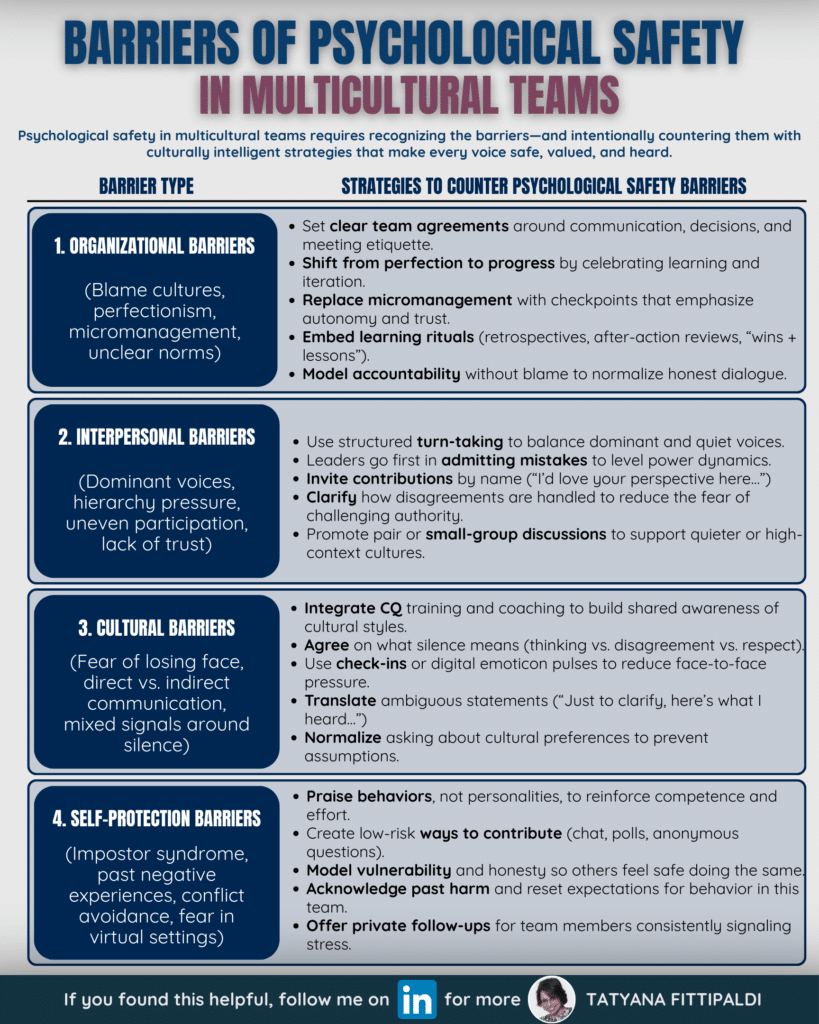
Barriers To Psychological Safety In Global Teams
I recently came across a fantastic article on psychsafety.com that offered fresh insights into psychological safety, especially around the most common barriers teams face. Drawing from their research and layering it with my own experience working with multicultural teams, I’ve adapted their barriers to psychological safety framework to reflect the realities of global, multicultural, diverse workplaces:
🚧Organizational Barriers To Psychological Safety
- Blame cultures — Mistakes are punished rather than examined, making team members afraid to take interpersonal risks or share early ideas.
- Excessive focus on perfection — When only flawless work is acceptable, people avoid experimentation and honest conversation.
- Micro management that signals mistrust — Over-controlling behaviors communicate doubt in employees’ abilities, shutting down initiative and open dialogue.
🚧Interpersonal Barriers To Psychological Safety
- Dominant voices — A few assertive individuals steer conversations, unintentionally silencing quieter or culturally reserved team members.
- Hierarchical dynamics — Strong power distance makes people self-censor, especially when disagreeing with leaders feels unsafe.
- Lack of trust — Without trust in intentions or competence, team members hold back questions, concerns, and ideas.
🚧Cultural Barriers To Psychological Safety
- Fear of losing face — In some cultures, mistakes or public disagreement cause embarrassment, discouraging open participation.
- High vs. low-context communication — Direct and indirect styles clash easily, creating misunderstandings and hesitation to speak. Often, indirect styles are labeled as “less assertive,” while direct styles are labeled as “rude.”
- Silence as respect vs. silence as resistance — Cultural interpretations of silence vary, often causing confusion about engagement or agreement. This topic alone is an entire field of study in multicultural communication, actually.
🚧Self-Protection Barriers To Psychological Safety
- Impostor syndrome — Self-doubt leads individuals to hold back, fearing judgment or exposure.
- Past negative experiences — Previous punishment or dismissal for speaking up makes team members cautious in new environments.
- Avoidance of confrontation — Some people avoid conflict to maintain harmony, even at the cost of sharing critical ideas. In many cultures, confrontation avoidance is taught since birth. The Chinese saying, “Harmony Brings Wealth,” translates local cultural practices quite precisely. (Tip: learn cultural idioms, and you’ll learn a lot about a culture!)
- Fear of judgment in virtual settings — Being on camera or speaking in video calls heightens anxiety, especially when nonverbal cues are harder to read.
These barriers are more pronounced in Remote teams where body language and nonverbal cues are limited. And for readers who operate in low-context cultures, you might be asking: “What exactly do you mean by interpersonal risks?”
A Word On Interpersonal Risks
Interpersonal risks are the small but meaningful vulnerabilities we take when interacting with others at work. They include things like asking a “basic” question, challenging a colleague’s idea, giving feedback upward, sharing a half-formed thought, admitting a mistake, offering a different cultural perspective, or simply saying, “I don’t understand.” These moments feel risky because they expose us to potential judgment, misunderstanding, or loss of credibility — especially in diverse, multicultural or remote environments.
When people feel safe to take these interpersonal risks, psychological safety grows. When they don’t, silence takes over. Want a story?
I recently got a client who came to work with me to increase Leadership Presence. When inquiring to understand what about her leadership presence stakeholders wanted her to improve, she told me that her bosses thought she “provided too much context.” There’s a clear interpersonal barrier here at play: her bosses come from Low-context Cultures and want directness, while she comes from a high-context culture, where providing context and explanation not only helps verbal processing but also creates a sense of self-satisfaction in showing everything that has been done or researched.
Because of this barrier, she stopped taking interpersonal risks and became fearful of judgment and self-embarassment. Dominant voices (from her bosses) made her believe that “her way” was the wrong way.
Don’t get me wrong, I’m not saying that she does not need to change her ways. High CQ means we understand what’s going on and adapt. But that’s what it is. We understand that these are two different ways, there’s no right way, and we consciously choose to adapt into a new way to achieve something. In this case, to achieve greater executive presence, as perceived by and demanded from her top stakeholders.
Strategies To Improve Psychological Safety In Diverse Teams
Here are actionable ways leaders can create a Fearless organization:
💡1. Establish Shared Norms (Not Assumed Norms)
Create explicit team agreements for:
- Communication — Define how the team communicates so expectations are clear for everyone.
- Feedback — Set shared rules for receiving and giving feedback across cultures.
- Decision-making — Agree on how decisions are made to avoid confusion or a hidden hierarchy. Consider using the RAPID decision-making methodology or other structures for decision-making.
- Meeting etiquette — Clarify participation norms, turn-taking, cameras-on expectations, and how silence should be interpreted.
💡2. Encourage Learning Behaviors
- Normalize questions — Treat questions as a sign of engagement, not incompetence.
- Celebrate experimentation — Reinforce that progress matters more than perfection.
- Model curiosity — Leaders show openness by asking thoughtful questions themselves.
💡3. Practice Leader Humility & Vulnerability
- Admit mistakes first — When leaders go first, it signals that imperfection is allowed.
- Ask for input — Invite perspectives proactively to level power dynamics.
- Model interpersonal risk-taking — Demonstrate the behaviors you want the team to feel safe practicing.
💡4. Build Psychological Safety Rituals
- Structured speaking rounds — Ensures every voice has space during meetings and interactions, not just the dominant ones.
- “Red/Yellow/Green” check-in — In multicultural teams, this check-in works best as an anonymous digital pulse using emoticons in Teams or Slack. This avoids cultural pressure, prevents over-questioning, and gives leaders a safe read on the team’s state without requiring personal disclosure.
- Learning-focused retrospectives — Shift from blame to insights by reviewing what worked and why. In my teams, I used to call this “Post-Mortem Reviews,” because it’s a review of the after-the-fact with a curiosity-driven, learning objective.
- Open space for questions — Create predictable moments and spaces for asking without judgment. This works both for introverts and extroverts communication. Introverts will be able to plan and prepare, while extroverts will look forward to share. You can even pair this with the “structured speaking rounds” strategy from above.
💡5. Use Storytelling To Normalize Vulnerability
- Share “learning stories” — Highlight setbacks, lessons, and growth, not just polished wins. I used to call in, “Who has a cool “resilience” story this week to share?”
- Reduce fear and inspire risks — Stories make vulnerability relatable and help others speak up.
If you want to learn more about business storytelling used in multicultural contexts, you can give my book a try, Mastering Business Storytelling.

Tools To Start Improving Cultural Intelligence (CQ)
Here are a few options for you to explore to improve your cultural intelligence and cultural competence skills.
1. Take A Cultural Intelligence Assessment
These tools measure strengths and blind spots, giving teams a baseline to improve. Corporate versions like the Fearless Organization Scan or the Team Survey can complement these assessments. I love to pair this with my proprietary Advanced Communication Skills assessment, because it gives very precise spots to work on both on the cultural aspect and communication fronts.
2. Engage In CQ Coaching
A certified CQ coach (like me) helps team members interpret their results, navigate conflict more effectively, and put the CQ 4 pillars into daily practice with experiments, brainstorming, and empathy. It’s funny how good coaching is like a mind-blowing kiss. The first time you have one, you never forget what’s possible.
3. Build Curiosity As A Habit
Replace assumptions with exploration. Ask, “Tell me more about how this works in your culture.” Circling back to the story from the beginning of the article, a much more effective way to engage me in a conversation (in that context) would have been if the colleague had simply said, “I’m curious to learn how the process of deciding to move overseas was, if you don’t mind sharing.” This would establish psychological safety and show high motivational CQ.
4. Learn The 4 Pillars Of CQ Through Training Programmes
Training programmes and workshops designed for leadership teams, Remote teams, and cross-cultural environments accelerate learning and adoption. I provide a fantastic virtual workshop on the topic, by the way, if you and your teams are interested.
5. Learn Behavioral Preferences Across Cultures
Invite leaders to reflect on differences such as:
- Cooperative vs. competitive approaches
- Direct vs. indirect communication
- Short-term vs. long-term orientation
- High vs. low power distance
- Expressive vs. reserved emotional displays
When leaders understand behavioral preferences, they stop misinterpreting or labeling behaviors — and start creating Inclusion Safety intentionally.
Books To Expand Your Understanding Of Psychological Safety, Cultural Intelligence, And Business Storytelling
As usual, I curated a few books on the topics I discuss, so you can take a next step and learn futher.
Disclaimer: This section contains product affiliate links. I may receive a tiny commission if you purchase after clicking on one of these links at no additional cost to you. They sponsor my time in researching, vetting and curating, and sharing valuable thought-leadership content. This allows me to provide it without any added expense on your part. Thanks for your support! ❤️️
This is the foundational book on psychological safety. Edmondson explains the research behind the concept, shows how it impacts learning, error reporting, and innovation, and gives very practical guidance on how leaders can create “fearless” environments where people speak up. It’s ideal if you want both theory and actionable strategies to build psychological safety in teams, especially in complex, high-stakes environments.
I mentioned his work and theory in this article, but his book goes into much more detail if you are interested. Clark breaks psychological safety into four progressive stages: inclusion, learner, contributor, and challenger safety. The framework is simple, but not simplistic, and it gives leaders a practical roadmap to diagnose where their culture is stuck and what to do next. This book is especially helpful if you want concrete language and step-by-step strategies you can apply in real teams that need both inclusion and innovation.
3. Cultural Intelligence: Individual Interactions Across Cultures (2003)
By P. Christopher Earley & Soon Ang
This is a more academic, theory-rich book that introduced cultural intelligence (CQ) as a measurable capability. It explores how people interpret, adapt, and behave across cultures, and why some professionals thrive in multicultural settings while others struggle. It’s a great read if you want a solid conceptual foundation for CQ and a deeper understanding of what actually drives effective cross-cultural interactions.
I wrote an extensive article on The Culture Map, if you want to tiptoe first, but essentially, Meyer gives you an accessible, highly practical framework to understand how different cultures communicate, give feedback, build trust, and make decisions. With real corporate stories and eight cultural dimensions, this book helps you decode misunderstandings in global teams and adjust your leadership and communication style accordingly. It’s especially valuable for leaders managing multicultural teams or working across regions.
Written by this truly yours, this book closes the loop between psychological safety, cultural intelligence, and advanced communication. It teaches global executives how to use story as a strategic tool to connect across cultures, align stakeholders, and drive action in complex corporate environments. With frameworks, real client cases, and practical prompts, it’s particularly helpful if you want to turn culturally aware, psychologically safe teams into story-driven teams that can inspire, influence, and deliver results consistently.
There you go. 5 great books that you won’t regret putting in your next list of readings. Especially if you seek to go deeper into psychological safety, cultural intelligence, or business storytelling for global environments.
Final Thoughts: Are Your Teams Truly Safe and Culturally Intelligent?
Teams today are global, diverse, remote, hybrid, multicultural, and constantly navigating complexity. No wonder the old rulebook doesn’t work anymore. So, here’s a recap of what we need to have in these kinds of contexts:
☑️ Psychological safety is essential.
☑️ Cultural intelligence is non-negotiable.
☑️ Business storytelling is integrating.
Together, they create the Fearless Organization every leader wants and the innovation all Fortune 500 companies desire.
If you want your leadership teams, multicultural teams, or global workforce to thrive, the path is simple:
➡ Start with psychological safety.
➡ Strengthen cultural intelligence.
➡ Promote a story-driven communication culture.
➡ Build systems that make everything integrated and sustainable.
And if you want personalized guidance:
👉 Book a strategy call with me to explore CQ coaching, the CQ Assessments, or Business Storytelling coaching and training.
I’ll help you understand your behavioral preferences, interpret your results, and transform your team into a story-driven, culturally intelligent, psychologically safe environment where people thrive and companies achieve their bottom-line goals.
If you enjoyed the content of this post, make sure to subscribe to my weekly newsletter using the form below. Every week, I bring bite-sized thoughts, reflections, and information to keep you sharp in your global or regional role.