In the corporate executive world, it’s impossible to avoid those moments when critical dialogue determines the trajectory of relationships, trust, and results. These high-stakes conversations are often unplanned, emotionally charged, and filled with uncertainty. And yet, they define leadership effectiveness more than any strategy or spreadsheet.
That’s why, after several requests from clients, subscribers, and followers, I’m sharing the crucial conversations tools for talking when stakes are high. This is a practical, research-based approach to navigate pressure, protect relationships, and achieve progress even in emotionally complex scenarios.
This article draws on insights from Crucial Conversations: Tools for Talking When Stakes Are High by Kerry Patterson, Joseph Grenny, Ron McMillan, and Al Switzler, and connects them to the mindset and communication mastery required for today’s leaders, especially those in Fortune 500 and multicultural environments where influence and clarity can shape entire organizational outcomes.
If the video is not showing for any reason, you can use this link to watch it.
Grace Under High Pressure
When the stakes are high, our physiology often works against us. Under stress, the brain’s amygdala floods the body with cortisol and adrenaline — chemicals that prepare us to fight, freeze, or flee. While that response is useful in physical danger, it undermines our ability to communicate thoughtfully during emotional or interpersonal conflict.
To perform well in high-impact situations, leaders must learn how to manage this biological storm. Emotional regulation is not innate — it’s a skill that can be cultivated through preparation, mindset, and leadership presence. The most effective communicators maintain what I call grace under high pressure — the ability to stay calm, think clearly, and communicate intentionally even when emotions surge.
Once you’ve decided to engage in a difficult conversation, remember that while you cannot control the outcome, you can control how you show up. By focusing on composure, clarity, and empathy, you create a psychological climate where progress becomes possible.
And as the authors of Crucial Conversations emphasize, grace under pressure is not about suppressing emotion — it’s about creating the mental clarity to manage it.
Defining Crucial Conversations And Their Key Conditions
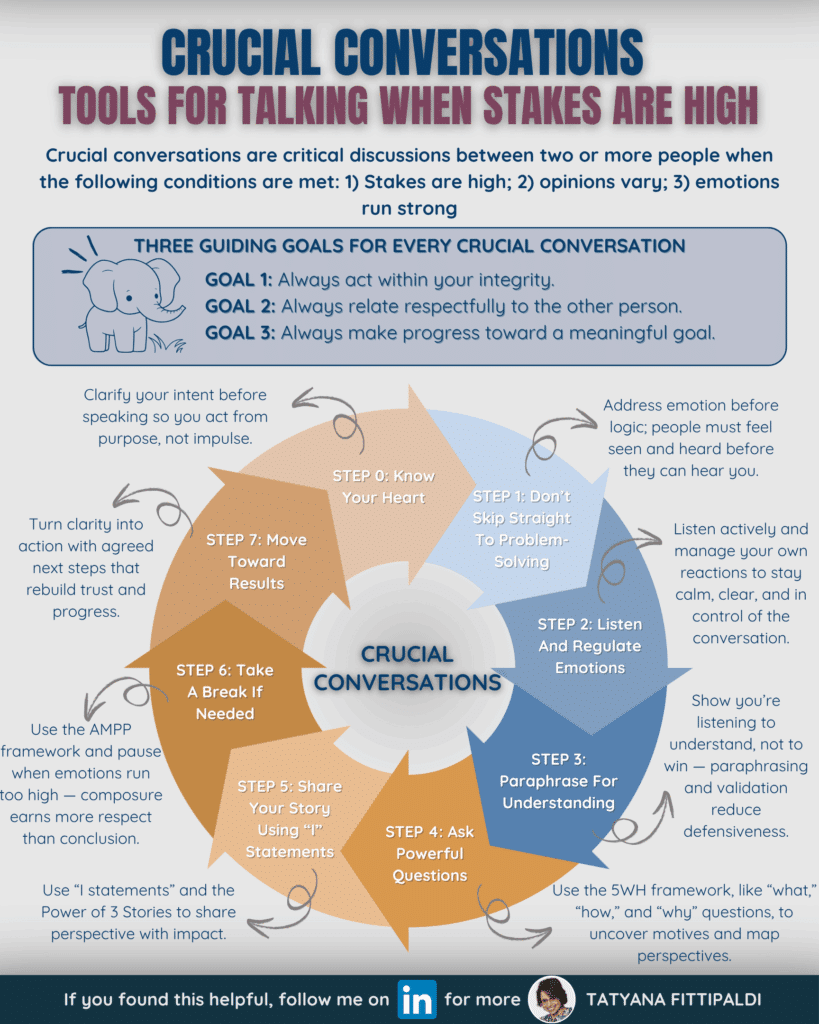
According to the original social-science research behind Crucial Conversations, three conditions define these moments:
- Stakes are high
- Opinions vary
- Emotions run strong
They can occur anywhere — during feedback discussions, project debriefs, or personal relationships. In organizations, they’re often the conversations no one wants to have: the delayed performance review, the conversation about a misaligned decision, or the conflict between departments.
I once had a client who proposed an entirely new process in her department just to avoid the crucial conversation about why nobody was engaging with or complying with their current process. Yes, I get it. It’s much easier sometimes to change an entire process than to have a crucial discussion. What I call “talking about the white elephant in the room.” I totally get it.

But avoiding these discussions doesn’t make them disappear — it makes them worse. Problems left unspoken grow into resentment or confusion, eventually affecting organizational performance and team morale.
Handled correctly, though, these conversations can strengthen trust, deepen relationships, and realign teams around shared goals.
➡️ Why Timing Is Critical For Effective Crucial Conversations
A crucial conversation is most effective when it happens soon after the triggering event — when memories are fresh and emotional alignment still exists. Waiting too long allows stories, assumptions, and biases to harden.
Yet timing is not only about speed; it’s about readiness. As a leader, you must know when you’re calm enough to think clearly. Addressing a problem too early, while still emotionally reactive, can cause more harm than good.
These conversations are not about winning. In fact, “winning” can often mean losing a relationship — and in leadership, relationships are capital. Enter the discussion with the goal of restoring clarity, trust, and progress, not asserting dominance.
➡️ Creating A Safe Environment
Every effective conversation begins with psychological safety. When people feel safe, they open up; when they feel threatened, they shut down or attack.
Whenever possible, have crucial conversations in person — so tone, posture, and facial expressions help you read and be read accurately. If in-person isn’t possible, choose video over audio, and audio over text. The richer the communication channel, the higher your chances of connection.
The Crucial Accountability framework teaches that both content (what is being discussed) and conditions (how it’s being discussed) must feel safe. To achieve this, clarify mutual purpose — the shared goal that connects both sides — and maintain mutual respect throughout. When purpose or respect breaks down, so does dialogue.
➡️Three Guiding Goals For Every Difficult Conversation
GOAL 1: Always act within your integrity.
GOAL 2: Always relate respectfully to the other person.
GOAL 3: Always make progress toward a meaningful goal.
These three intentions serve as an internal compass. Or, what I like to call, “personal primer or blueprint.” They turn tense dialogue into communication mastery, transforming chaos into alignment — a hallmark of leaders who thrive in high-stakes environments.
Fred Kofman calls this the “I,” the “we,” and the “it.” He called this triad the 3 domains of intention: “I” want to feel good and be proud of myself. “We” will relate to each other openly and respectfully. And, finally, how are we going to solve “it,” our problem?
If you are unable to watch the video above on this site due to your cookie settings, use this link to watch it directly on YouTube.
How To Communicate When The Stakes Are High?
The following process is an adaptation from what you can read in the book, Crucial Conversations, as well as my own personal suggestions based on the work I’ve been doing for years with multiple global executives. It comes from a place where you intend to enter the interaction with your defined intentions, as I mentioned above.
STEP 0: Know Your Heart
Before entering any high-stakes conversation, gain clarity on your intentions using a methodology like the 5 Powers of Clarity or simply ask yourself:
- What outcome do I want?
- What message must I communicate?
- What is the other person’s role — are they deciding, supporting, or simply being informed?
This pre-conversation reflection anchors your behavior. It prevents defensiveness and helps you act from purpose, not impulse.
If you’re able, take time to reflect before engaging. But leadership rarely gives us that luxury. That’s why I call this STEP 0 — because sometimes you have to find clarity in the moment. Even in impromptu discussions, mentally scan these three questions quickly. Doing so transforms reactivity into responsiveness — a key distinction between average and exceptional communicators.
STEP 1: Don’t Skip Straight To Problem-Solving
One of the biggest mistakes leaders make is rushing to solutions before addressing emotion. When people don’t feel heard, logic doesn’t land. Unacknowledged feelings become invisible barriers to understanding.
Instead, begin by creating space to air emotions. And make sure to make it safe. Start with curiosity, not correction:
“I wonder how you felt about what happened.”
“I felt surprised when priorities shifted last minute — what’s your perspective?”
This simple shift establishes empathy and diffuses tension. It communicates: I’m here to understand, not accuse. When emotions are acknowledged, the prefrontal cortex — the part of the brain responsible for reasoning — reactivates, allowing both parties to think more clearly.
STEP 2: Listen And Regulate Emotions
Listening well under stress is an advanced communication skill. It requires separating what you hear from what you interpret.
Avoid interrupting. Resist the urge to defend. Let the other person complete their thoughts before responding. When you feel triggered, pause and breathe. Emotional self-regulation restores mental clarity and helps prevent reactive speech.
As the Style Under Stress model explains, our physiological arousal can hijack reason during high-impact situations. Recognizing that you’re in this state is the first step, and it allows you to slow down and regain control.
Remember: others don’t “make” us angry — our internal stories about what’s happenening that do. When you challenge those stories, your emotional balance returns, giving you influence over the conversation’s tone.
STEP 3: Paraphrase For Understanding
Clarifying understanding is not the same as agreement. Paraphrasing shows that you’re listening to understand, not to win.
“If I’m hearing you right, you feel your recent review didn’t reflect your overall contribution. Is that correct?”
This simple reflection reduces defensiveness because people feel acknowledged. It’s a small act of validation that opens the door for constructive dialogue.
In social-science research on conflict resolution, paraphrasing has been shown to extrinsically regulate negative emotion, reducing vocal intensity and emotional arousal in high-stakes dialogues (Seehausen et al., 2012). Moreover, experimental work on active listening reveals that message paraphrase increases perceived understanding, trust, and relational connection between parties (Weger et al., 2010). In other words, paraphrasing signals empathy — a foundational element of influence.
STEP 4: Ask Powerful Questions
Powerful questions are the tools of great communicators and influential leaders. They invite reflection, not resistance. Ask questions that begin with what, how, or why. Examples:
“What do you think would improve this situation?”
“How do you feel about the impact this had?”
“Given what we’ve discussed, what would success look like to you?”
These questions encourage others to examine their perspective and reveal their motives, which helps you understand the real issue. Using the 5WH model (who, what, where, when, why, how) ensures a complete picture. In professional coaching and leadership psychology, this process is called mental mapping — you’re mapping the other person’s cognitive and emotional landscape. You can’t bridge gaps you don’t understand.
STEP 5: Share Your Story Using “I” Statements
Now it’s time to show your wonderful storytelling skills and share your story and your perspective. This is the moment when you bring your voice, your reasoning, and your authenticity to the conversation. But how you share your perspective matters as much as what you say.
When you lead with facts alone, your words inform. When you lead with a narrative, your words influence. People remember stories, not spreadsheets. This is why business storytelling has become one of the most vital communication skills in leadership — especially in high-stakes conversations where emotions are high and alignment is critical.
When presenting your point of view, focus on framing your message as a story rather than a monologue. A clear structure provides direction, coherence, and purpose. One simple and powerful storytelling formula you can use — which I call the Power of 3 — includes:
- The Challenge – What happened, or what problem are you trying to address?
- The Solution – What action did you (or others) take to address it?
- The Result or Benefit – What positive outcome followed from that action?
You can insert a story at the “Challenge” stage (for instance, to illustrate the situation’s complexity), at the “Solution” stage (to showcase a previous success, either by you, your team, or another organization), or even both. The more your story helps your listener see and feel the problem and solution, the more engaging and persuasive your narrative becomes. Like the power of 3, you have numerous other storytelling approaches you can use to make your case.
However, in leadership storytelling, purpose always comes first. After telling your story, close the loop by clearly linking it back to your message: explain how the story connects to the challenge or the proposed solution. This alignment between story and intent ensures that your narrative isn’t just entertaining — it’s strategic and relevant to the conversation’s goal.
Alongside your narrative, it’s essential to express your views through “I” statements instead of “you” statements. For example, replace:
“You’re not being fair.”
with
“I felt frustrated when priorities were changed without clarity.”
Research in psychology and communication consistently shows that ‘I statements’ tend to lower defensiveness because they express ownership rather than blame. For instance, in controlled studies where participants rated conflict-opening statements, those containing I-language received significantly lower defensiveness scores than equivalent you-language statements (Rogers SL, Howieson J, Neame C. 2018).
When someone hears “you,” their brain perceives threat; when they hear “I,” their brain perceives sharing. In other words, when you use “I,” you invite dialogue; when you use “you,” you trigger defense.
This small linguistic shift reflects emotional intelligence and strengthens influence skills — it keeps both sides focused on understanding, not accusation. And when combined with storytelling, it makes your message resonate longer and deeper, because the listener doesn’t just hear your logic — they feel your reasoning.
In short, the most persuasive executives don’t just explain — they narrate. They weave empathy, logic, and purpose into stories that transform tension into connection and high-stakes conversations into moments of meaningful influence.
STEP 6: Take A Break If Needed
Even the most seasoned leaders can feel emotionally flooded. Recognizing this is not weakness; it’s self-awareness.
If tension rises, take a pause:
“I’ve just heard a lot that I’d like to process. Can we pause and revisit this tomorrow?”
A short break helps the brain reset, restoring mental clarity and reducing impulsive reactions. It also shows respect — to yourself and to the other person. By prioritizing composure over conclusion, you demonstrate mastery under stress.
In 2003, I attended a negotiation training where the instructors introduced something I had never heard of before — the pause — as an actual skill. I remember thinking, “How could taking a pause possibly be a skill?” It completely puzzled me. That is, until we tried it. During our first simulation, the trainers gave us a tense scenario with two opposing sides that were bound to clash. As the discussion reached its peak, they said, “Now it’s time for every group to use the new skill.” At first, it felt awkward — almost forced. But here’s the truth: when we stepped away, took a breath, and then came back to the table, something shifted. The tension had softened. We could actually listen. Reaching an agreement suddenly felt easier, almost natural. A simple time-out went a very long way.
STEP 7: Move Toward Results
A crucial conversation without closure can feel incomplete. Once emotions settle and perspectives are shared, guide the discussion toward action and accountability.
Ask:
“Is there anything else you’d like to address before we define next steps?”
Then summarize what was agreed upon — who will do what, by when, and how follow-up will happen. This clarity converts conversation into progress. It’s also an excellent moment to reaffirm shared purpose, strengthening trust after tension. When dialogue ends with clarity, collaboration improves, and relationships emerge stronger than before — a pattern validated by years of Crucial Conversations and Crucial Accountability research.
When Dialogue Stalls: How To Use The Priming Technique
Even when you apply every communication tool in your arsenal — asking open-ended questions, mirroring emotions, paraphrasing for clarity — sometimes the conversation still hits a wall. The other person stays silent, defensive, or withdrawn.
That’s when a powerful “last-resort” listening skill comes in handy: the Priming Technique.
What The Priming Technique Is — And Why It Works
The term priming comes from the old practice of “priming the pump.” In the past, if a water pump wasn’t producing flow, people would pour in a small amount of water to get it started.
In conversation, you do something similar: you offer a small, thoughtful “guess” about what the other person might be thinking or feeling to help get dialogue flowing again.
It’s not about putting words in their mouth — it’s about creating safety. You’re signaling that it’s okay to speak up, even if what they have to say is uncomfortable. This gentle act of empathy often reignites engagement because it shows that you see the person, not just the problem.
When To Use Priming
Priming is part of the AMPP framework — Ask, Mirror, Paraphrase, and Prime — used in high-stakes communication training. It should only come into play after the first three steps fail to unlock dialogue. Use it when you sense emotional withdrawal, avoidance, or hesitation despite your best efforts to invite openness. In short, it’s the tool you reach for when silence becomes the loudest voice in the room.
How To Apply The Priming Technique
1. Recognize the stall.
You’ve already asked, mirrored, and paraphrased, but the other person still won’t open up. That’s your cue.
2. Make an empathetic guess.
Offer your best, good-faith interpretation of what might be happening for them. This is not about accuracy — it’s about empathy.
3. Phrase it tentatively.
Your tone should be gentle and curious, not declarative. Use soft openers like:
- “Could it be that you’re worried about…?”
- “Are you concerned that I might think…?”
- “It seems like you feel this is unfair.”
4. Confirm and clarify.
If your guess is wrong, they’ll often correct you — and that’s the breakthrough. Keep paraphrasing or refining your prime until they feel fully understood.
The beauty of this approach lies in psychological permission: when people see you trying to understand, they instinctively want to help you get it right.
5. Connect with a purposeful story.
Once the person feels heard, bridge understanding through a short, meaningful story or analogy. The right story reinforces empathy, illustrates perspective, and invites connection. It helps move the conversation from emotion to meaning — from “how we feel” to “what we can do about it.”
Choose a story that mirrors what they’re experiencing and gently links it to your own perspective. The goal isn’t to shift attention back to you, but to build common ground — a shared mental space where both of you can think more clearly and collaborate productively.

A Classic Example: How Priming Reopens Dialogue
Let’s look at a classic example — one used widely in communication training — because it’s simple and relatable enough for anyone to visualize the process.
You: “You’ve been quiet this week. What’s on your mind?” (Ask)
Coworker: Shrugs. “Nothing.”
You: “You’re saying you’re fine, but you seem frustrated.” (Mirror)
Coworker: “I’m just busy.”
You: “I see. It sounds like you have a lot on your plate.” (Paraphrase)
Coworker: Still quiet.
You: “I’m just going to guess because I might be missing it. Are you thinking that the rest of us aren’t pulling our weight?” (Prime)
That gentle guess does the trick. It breaks the silence, lowers tension, and often encourages the other person to open up — even if just to correct you. Either way, dialogue resumes, and that’s the goal.
You (continuing): “You know, this reminds me of a story I told my son just yesterday — The Parable of the Blind Horse. It’s about a farmer who owned a strong old horse named Dusty. Dusty was blind, but the farmer had a clever way to get him to pull heavy loads. He would shout several names — ‘Pull, Nellie, pull! Pull, Buster, pull!’ — and Dusty would stand still. Only when he heard his own name, ‘Pull, Dusty, pull!’ would he dig in and move the load with all his strength. A man watching asked why the farmer bothered with the other names. The farmer smiled and said, ‘Dusty’s blind. He believes he’s doing all the work alone. If I didn’t make him think he had help, he wouldn’t even try.’ I told my son that the story reminds us how sometimes we carry the load thinking we’re alone, when in fact others are pushing quietly beside us. Maybe this project feels like that — like you’ve been Dusty lately, pulling hard and not seeing who’s helping. If that’s how it feels, let’s talk about how we can make that visible again.”
This kind of story does more than soothe; it invites reflection. It reframes the emotion in a way that feels safe and relatable. Instead of telling someone they’re mistaken or overwhelmed, you offer a mirror through narrative — and the person often steps into it willingly.
Why It Matters For Global Leaders
In high-stakes conversations, especially with multicultural teams, silence is rarely neutral. It usually hides fear, frustration, avoidance, or fatigue. Priming helps leaders surface what’s unspoken without confrontation — a skill that transforms conflict into collaboration.
When you prime with empathy, you’re not just reviving a stalled conversation; you’re rebuilding psychological safety. And when paired with a purposeful story, its impact compounds. Storytelling connects logic with emotion. It helps others feel understood and see the path forward simultaneously.
By sharing a story that reflects both perspectives — theirs and yours — you turn empathy into alignment. You move the dialogue from tension to trust, from defense to discovery.
When you prime with empathy and follow with story, you’re not just reviving a stalled conversation; you’re shaping a shared narrative. And that’s where lasting influence truly begins.
Books For Further Mastery
If you want to deep dive into this topic of crucial conversations with even more solid, practical tools and strategies, consider reading one (or all) of the following books I’ve curated for you. They are all leadership skills classics that you should read as a thoughtful, inspiring executive.
Disclaimer: This section contains product affiliate links. I may receive a tiny commission if you purchase after clicking on one of these links at no additional cost to you. They sponsor my time in researching, vetting, curating, and sharing valuable thought-leadership content. This allows me to provide it without any added expense on your part. Thanks for your support! ❤️️
Crucial Conversations: Tools for Talking When Stakes Are High
By Kerry Patterson, Joseph Grenny, Ron McMillan, and Al Switzler
This book is the foundation for mastering effective conversations in high-stakes environments. It breaks down the psychology of dialogue, offering concrete tools to turn disagreement into mutual understanding — an essential read for any leader seeking to strengthen influence and communication skills.
Crucial Accountability
By Kerry Patterson, Joseph Grenny, David Maxfield, Ron McMillan, and Al Switzler
A practical extension of Crucial Conversations, this book explores how to ensure follow-through after difficult talks. It’s particularly useful for leaders managing teams, reinforcing accountability without damaging trust — a vital aspect of organizational performance.
Crucial Influence
By Kerry Patterson, Joseph Grenny, David Maxfield, Ron McMillan, and Al Switzler
This work examines how influence drives change. It provides frameworks for shaping behavior across individuals and systems — applicable from Fortune 500 companies to startups. It expands your toolkit for leadership and communication mastery.
The Power of Habit
By Charles Duhigg
Though not directly about dialogue, this book shows how habits shape both personal and organizational behavior. Understanding habit loops helps leaders identify and reshape communication patterns — a foundation for lasting improvement in influence skills.
You’re Not Listening
By Kate Murphy
A powerful reminder that genuine listening is a strategic skill. This book explains the neuroscience of attention and empathy — crucial for anyone aspiring to have effective conversations that build trust and reduce misunderstanding.
Master Your Emotions
By Thibaut Meurisse
Emotional intelligence lies at the heart of every high-stakes conversation. This book provides practical frameworks to manage emotions before they manage you, enabling leaders to maintain composure and clarity under stress.
Mastering Business Storytelling
By Taty Fittipaldi
This book by this truly yours bridges communication mastery and leadership influence. It demonstrates how storytelling transforms information into inspiration — helping leaders articulate purpose, align teams, and drive meaningful action even in complex situations and leadership interactions.
Final Thoughts On Crucial Conversations Tools For Talking When Stakes Are High
Mastering crucial conversations isn’t about learning scripts — it’s about cultivating self-awareness, emotional intelligence, and strategic empathy. The leaders who thrive in high-stakes conversations are those who pause before reacting, listen before asserting, and connect before convincing.
In a world that rewards speed, they choose presence. In moments of conflict, they choose curiosity. What do you want to choose as your new communication tool during crucial conversations when the stakes are high?
Whether you lead a small team or a global organization, your ability to hold productive dialogue under pressure defines your leadership legacy. These conversations — when approached with skill and purpose — don’t just resolve issues; they reshape relationships, strengthen culture, and elevate performance.
💼 Elevate Your Leadership Through Coaching
If you’re ready to strengthen your ability to navigate complex, emotionally charged conversations, explore my Executive Coaching for Global Leaders program. It’s designed to enhance influence skills, cultural agility, and communication impact across diverse teams.
And if you enjoyed this article, subscribe to my weekly leadership newsletter for reflective insights, actionable strategies, and tools to help you lead with clarity and confidence in every conversation.