True or False? Facts and figures alone rarely move successful global executives to act. From my experience with sharing financial data month after month, it’s true. Leaders who truly inspire change do something different: they connect through story. That’s where a storytelling framework becomes essential. It turns instinct into structure, helping leaders translate complexity into clarity, alignment, and meaning. This article explores corporate storytelling as a leadership skill, not a performance art. It guides you through a practical 12-step framework. This framework helps you communicate with impact, align your teams, and change how your organization leads through stories.
Why Every Great Leader Needs A Leadership Storytelling Framework
Why do some leaders inspire movements while others struggle to move a meeting?
That question haunted me early in my corporate career.
When I first became a CFO, I thought my job in front of a company town hall was to deliver numbers — clean, accurate, and filled with the kind of detail that proved I was in control. No smile, no warmth, just facts. So, I did exactly that. Slide after slide, I shared graphs, figures, and facts from the quarter’s financial results. I spoke with precision, checking my notes, making sure to hit every detail.
And yet… I lost the room.
I still remember my first time, the blank faces staring back at me. “Are they understanding what I’m saying?” Still staring at me, polite, silent, and entirely disengaged. “Should I improve their financial acumen through training?” It crossed my problem-solving mind. Despite all my preparation, I forgot to mention several key points as I became increasingly nervous with the low response. I walked off that stage frustrated and embarrassed. I had spent hours perfecting my facts, but I failed to connect with people.
A few quarters later, the communications manager suggested I open the next presentation differently:
“Instead of walking us through the report,” she said, “why not tell us what surprised you most this quarter and how it affected the company?”
That single question changed everything.
So, I told them a story.
I shared how two of our trucks, carrying high-value goods, were hijacked that quarter — and how that event sparked an internal investigation and internal process improvement across multiple departments. I described how teams from Sales, Logistics, IT, HR, PR, Transportation, EHS, and Facilities all came together to strengthen our processes. I admitted how tough it was to see the loss on our P&L, but also how proud I felt watching an entire organization unite to turn the situation around.
It wasn’t just a finance issue anymore — it was our issue.
When I finished, the room was alive, to my surprise. People smiled. Heads nodded. Colleagues approached me afterward, some to thank me for my transparency, others to offer ideas on how they could contribute. That was the first time I truly understood the difference between presenting information and communicating through story.
That day, I saw why storytelling can transform a quarterly review into a moment of collective ownership. I didn’t have to tell them that we would need to tighten our belts this quarter to cover our losses. They brought up their own ideas. They were raising their hands; they were engaged. After all, they were part of the story.

The Science Behind Why Storytelling Works
Neuroscience has caught up with what great communicators have always known: stories don’t just inform; they synchronize. They turn complex ideas into something palatable. And it’s not just about brand storytelling; any form of storytelling for business can achieve this, like data storytelling, leadership storytelling, and communication storytelling.
Cognitive research from Princeton University shows that when people hear a good story, their brains sync up with the storyteller’s brain activity. This is called neural coupling. In simpler terms, stories align minds.
The Nielsen Consumer Neuroscience Division found that communication in an emotional context leads to higher engagement. Stories naturally create or provide this communication context. This also results in stronger memory retention and a deeper emotional connection. This isn’t fluffy theory. It’s measurable, predictable, and incredibly powerful in corporate settings.
That’s why in boardrooms, conference calls, and leadership retreats across industries, stories outperform slide decks. They build understanding faster, drive trust deeper, and turn abstract goals into relatable missions.
From Data To Connection: The Evolution Of Leadership Communication
In my 20 years as a corporate executive leading big operations, I have seen many leaders use only logic and data to influence decisions. They often fail. The leaders who succeeded were those who could translate numbers into narratives that moved people to action.
I shared this at the Organization Development Network Conference. I presented “The Story-Driven Organization: A Human-Centered Approach on How to Inspire, Align, and Drive Action.” The audience’s response showed what I have seen for years. Effective storytelling is not about charm or acting. It is about structure. A story framework makes your communication intentional, repeatable, and scalable. Leaders who master story structure don’t just communicate; they create alignment. They help teams see themselves inside the company’s journey. They connect employee stories to corporate narratives, transforming everyday updates into shared moments of purpose.
What You’ll Learn In This Article
In the sections that follow, we’ll explore:
- Why corporate storytelling enhances communication — and how it transforms communication from transactional to transformational.
- The 12-Step Corporate Storytelling Framework — a practical blueprint to craft and deliver stories that inspire action and clarity.
- Real-world examples and case studies that illustrate how leaders use storytelling to navigate corporate transformations and cultural change.
- How to build a storytelling culture within your organization — so every meeting, presentation, and message reinforces the right narrative.
By the end, you’ll have a complete storytelling framework that helps you move not just meetings, but people — across time zones, cultures, and organizational levels. Because in business, leadership isn’t about how well you present data. It’s about how powerfully you tell the story behind it.
Why Corporate Storytelling Enhances Leadership Communication
Every leadership interaction — whether it’s a quick sync, a quarterly town hall, or a one-on-one performance review — has a purpose. Or at least, it should. When leaders connect that interaction to a clear purpose and communicate it with authentic connection, something powerful happens. Trust grows, rapport strengthens, and clarity replaces confusion. That’s the foundation of corporate storytelling — using structured communication to help people see themselves in the company’s mission.
➡️ Why Stories Reveal Leadership Impact
In business, data tells you what happened; stories show you why it matters.
Storytelling allows leaders to inspire, align, and drive results by creating an emotional bridge between information and meaning. A well-crafted leadership story has the following characteristics:
- Sparks curiosity, pulling people into the narrative.
- Builds common ground, showing shared challenges and values.
- Provides clarity of purpose and expectations, helping people understand how their work connects to the bigger picture.
This connection transforms passive listeners into active participants. In a storytelling collective, employees become co-authors of the company’s future rather than mere recipients of directives.
➡️ Behind Storytelling’s Impact
Neuroscience explains why storytelling outperforms pure data. Neuroscience suggests that when we observe a story — seeing someone perform an action or express emotion — some of the same neural circuits in our brain activate as if we were doing or feeling it ourselves. This mirroring mechanism is thought to underlie empathy and connection.
In human studies, mirror-neuron activity or similar brain activities correlate with self-reported empathy and emotional resonance. While the research is still evolving, this isn’t just a metaphor — it gives us a window into how stories help listeners feel with the teller, creating a deeper connection and intuitive alignment.
Research also shows that stories trigger the emotion-memory link, a mechanism in the limbic system that makes emotionally charged messages easier to recall and act upon. In contrast, data-only communication activates fewer regions of the brain, often fading before behavior can change.
That’s why storytelling consistently improves audience engagement, clarity, alignment, and retention — the metrics that define effective leadership communication.

When Leaders Use Storytelling Effectively, Teams…
- Feel more connected to purpose
- Retain messages longer
- Take faster, better-aligned action
- Strengthen cross-functional collaboration
➡️ Storytelling As A Teachable Leadership Skill
Leaders who turn company stories or personal anecdotes into meaningful talks create unity, momentum, and trust. This happens across their leader platforms, like conference calls and corporate town halls. That’s why investing in corporate storytelling training pays off. It turns communication from a soft skill into a strategic capability.
In the next section, I’ll share my 12-Step Corporate Storytelling Framework. It’s a repeatable, evidence-based process that turns storytelling into a teachable leadership skill. This isn’t art. It’s leadership science — one story at a time.
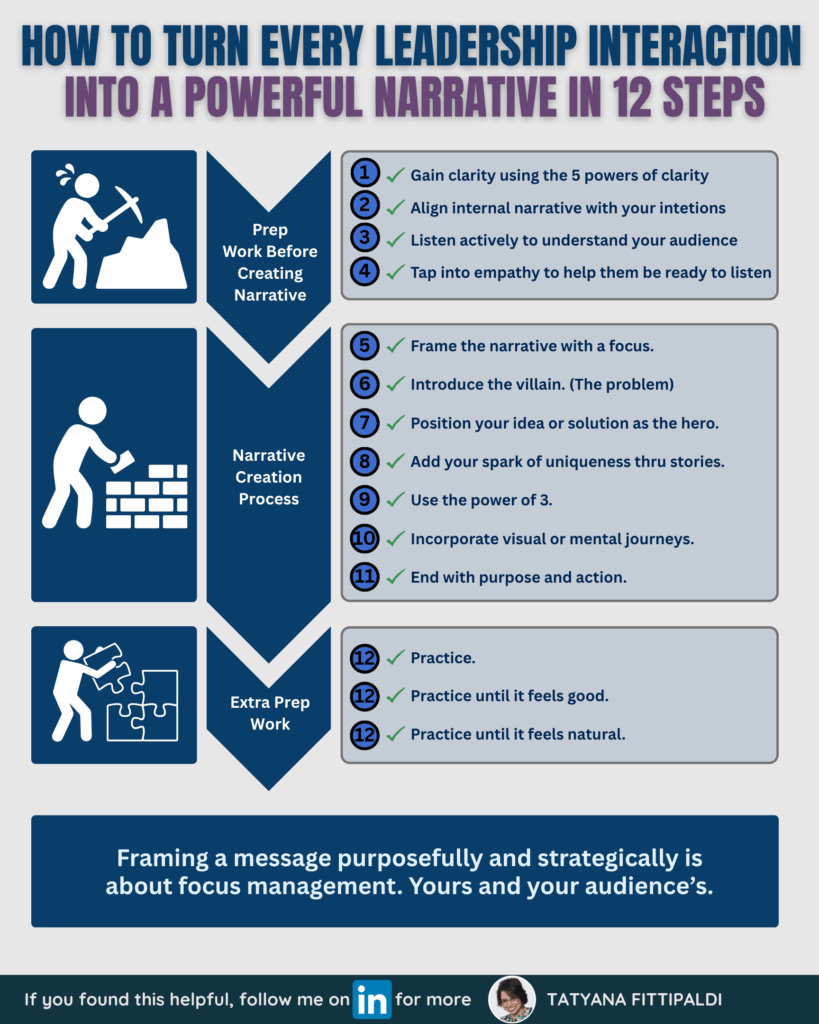
The 12-Step Corporate Storytelling Framework
In my first years as a professional — not long after graduating from business school — I became an auditor. An auditor’s mission is simple on paper: find what’s wrong. But you can’t point out issues without evidence, and despite my sharp analytical skills, I often struggled to find it.
One day, an executive audit manager shared what he called “the top secret.” “Follow the money,” he said.
I laughed. “That’s no secret — Hollywood already revealed that.”
He smiled. “Yes, but here’s what the movies never tell you: every money trail has a story worth telling.”
That line changed the way I worked.
He explained that what separates auditors who find evidence from those who merely raise issues is structure — the ability to think in stories, to understand the “why” behind the numbers. Once I started looking for the story behind the money trail, everything shifted. My work moved from aimless and anxious searching to focused, purposeful investigation. I learned early on that, paradoxically, structure brings freedom. In leadership, as in auditing, structure helps us use our time and energy with clarity and intention.
And that’s exactly why I created the 12-Step Corporate Storytelling Framework — a blueprint to help executives craft narratives with stories that engage, align, and move people to act. In other words, it’s a framework build for leadership development. Because when you improve storytelling skills and combine structure with purpose, your message doesn’t just inform — it transforms.
Whether you prepare a town hall, create a brand story, present data in a PowerPoint deck, or record messages for teams worldwide, this storytelling method provides a clear and repeatable way to transform ideas into impactful influence.

Let’s walk through each step of my proprietary storytelling framework.
👣 STEP 1: Gain Clarity First
Before you say anything to anyone, you must be clear with yourself. Clarity is where it all begins. Ask yourself:
- What’s really going on?
- What’s the core challenge?
- What do I want people to feel, know, or do after hearing this story?
I call this reflection The 5 Powers of Clarity: clarity of purpose, context, ideas, emotions, and resources. For example: What’s the purpose of your message? What’s the context you’re navigating? What’s the main idea your message needs to convey? What emotions are being triggered — both in you and in others? What resources are available to move forward, financially or otherwise?
Skipping this step is like building a skyscraper on quicksand. Your story might sound smart, but it won’t land. Clarity anchors the entire narrative arc (spoiler to step 5).
👣 STEP 2: Set Your Internal Narrative
The most overlooked type in leadership storytelling is your inner story. The truth is that before you influence others, you must align your own internal narrative. What is it that you are thinking? Ask yourself: “What story am I telling myself right now about this situation?”
Maybe it’s: “They never listen to me,” or “This won’t matter,” or “I don’t have time for this.”
That inner script dictates your energy, your tone, and even your body language. Your inner voice shapes all your actions. Simple as that.
That’s why, for this step, pause. Revisit your goal and intention. Understand your inner story. Then rewrite your internal narrative to support your purpose through reframing techniques. I explored several of them in my book. When your inner voice aligns with your mission, your message becomes magnetic. This is emotional alignment — the unspoken language behind influence.
👣 STEP 3: Listen Actively To Understand
Clarity and inner narrative are about you. Listening is about them — your audience.
Use focus groups, surveys, sentiment analysis, or simple check-ins to discover:
- What are they struggling with?
- What are they afraid of?
- What results make them look successful?
Listening gives you the raw material to build a relevant narrative. It’s where stakeholder identification begins — understanding who’s in the room, what they care about, and how they’ll connect to your Big Idea.
And if you can’t listen directly, use proxies. Ask people who know your audience. Observation and curiosity are underrated storytelling tools.
👣 STEP 4: Tap Into Contextual Empathy
Listening gives you information; contextual empathy gives you wisdom.
Empathy in leadership storytelling isn’t about emotion alone — it’s about context awareness. What are the pressures your audience faces? What expectations do they hold? What cultural or organizational dynamics shape their reactions or ways of thinking?
When you gain contextual awareness, you start to understand what’s going on and how people are feeling about it. You’ll tap into empathy in ways you can’t avoid. Because it’s like listening to a story. But it’s their story. Their perspective. When people feel seen and understood, they open up. Only then are they ready to listen, reflect, and act. Empathy transforms communication from one-way messaging into a storytelling collective, where everyone feels part of the same chapter.
👣 STEP 5: Frame Your Narrative With Focus
This is where you start painting your story canvas. Start to think about your message strategy.
Framing a message is nothing more than focus management. You decide where the audience’s focus and attention go. Every corporate narrative you deliver — from crisis communication to brand perception campaigns — depends on how well you frame it and what type of focus you give it. Ask: What’s my goal for this message? Is it to inspire, align, encourage, take action, or reflect?
I learned this early at GE, during a Hiring & Interviewing training program. The instructor said they’d rather hire someone with integrity and no skills than someone highly skilled but untrustworthy. Then they told a story of a hiring gone wrong — the ripple effects of lost trust. The line that followed stayed with me for life:
“Skills can be learned. But Integrity can only be lived.”
That single narrative reframed my entire leadership philosophy.
When framing your own stories, use this simple 4-step narrative approach:
- Hook: Capture attention.
- Why it matters: Create relevance.
- What: Deliver your key message or Big Idea.
- How: Show what action or reflection should follow.
Let me give you a fun example of how this works. Let’s take the story (spoiler to step 8) around The Lord Of The Rings, which is quite well known, and spin it for leadership with 2 different frames or focus messages.
Frame 1: “The Limits of Willpower”
Hook – Capture Attention:
Did you know? Frodo, the ring-bearer, actually failed his mission. At the very edge of Mount Doom, he couldn’t let go of the Ring’s power. It was Gollum’s obsession, not Frodo’s strength, that ultimately destroyed it.
Why It Matters – Create Relevance:
We often celebrate willpower as the ultimate leadership trait — the ability to push through, resist temptation, and persevere against all odds. But sometimes, even the strongest determination collapses under the weight of exhaustion, fear, or obsession.
What – Deliver the Key Message or Big Idea:
No one has infinite willpower. Every human — even the bravest leader — has limits. Ignoring that truth can lead to burnout, poor judgment, or dependency on luck rather than foresight.
How – Show What Action or Reflection Should Follow:
Instead of over-relying on sheer discipline, leaders should design systems, rituals, and environments that reduce friction and prevent failure before it happens. The story reminds us that strength alone doesn’t guarantee success — structure, awareness, and humility do.
→ Focus Message: No one has the willpower to do the hardest things alone.
Frame 2: “The Power of Support and Collaboration”
Hook – Capture Attention:
Did Frodo complete his mission? Yes. The One Ring was destroyed, and Middle-earth was freed from darkness — but not by Frodo’s willpower alone. He succeeded because of Sam’s loyalty, Gandalf’s wisdom, Aragorn’s courage, and the unwavering faith of his many friends.
Why It Matters – Create Relevance:
Even the most capable leaders can’t succeed in isolation. Every major victory is the result of aligned support — from mentors, peers, and teams who carry part of the load when challenges grow heavy.
What – Deliver the Key Message or Big Idea:
When we surround ourselves with the right allies and build trust, collaboration becomes the real source of endurance. Success isn’t an individual act — it’s a collective journey.
How – Show What Action or Reflection Should Follow:
Ask yourself: Who is my Samwise? Who keeps me grounded when the path feels impossible? In leadership, that means cultivating environments where support systems are visible, trusted, and celebrated. Because when everyone plays their part, even the hardest missions can be accomplished.
→ Focus Message: With good friends and the right support, even the hardest tasks can be achieved.
As you can see, you are painting your communication canvas with four strategic “colors.” You begin with the Hook to capture attention, move into Why It Matters to establish relevance, present your Big Idea (What) as the key point you want your audience to remember, and then guide them on How to act or reflect on it.
Even when the story remains the same, your focus determines the emotional tone and impact. In the two examples above, the first frame had a more somber tone that emphasized limits, struggle, and what we do not have. The second shifted the spotlight toward what we should have around us and highlighted what we can build and achieve together.
That is the real art of framing. You are not changing the facts or the story; you are changing the focus. This focus shapes how people feel, interpret, and ultimately respond to your message. And, since we are talking about focus, as a side note, if your canvas is stained with an outdated or unhelpful narrative (not exactly the focus you want to give), reframe it. You’re the artist. Change the colors.
👣 STEP 6: Introduce The Villain
Every story needs a villain — but in leadership, it’s never a person. In business storytelling, the villain is often a problem, a mindset, or a system flaw. Think of Snow White. Who’s the villain? We often say it’s the evil queen, right? But if we consider the perspective of never being a person, who is the real villain? The real villain isn’t the queen herself; it’s envy, her distorted self-perception.
In your corporate storytelling, the villain could be miscommunication, silos, low engagement, or even complacency. Define that tension clearly. The villain represents the shared challenge your team can relate to and rally against. Without conflict, there’s no reason to change or act. The villain gives your narrative purpose. You can’t fully explain the purpose if you don’t explain the conflict or challenge.
👣 STEP 7: Position Your Idea Or Solution As The Hero
Once the challenge is clear, you reveal the hero — the idea, mindset, or decision that creates transformation. In business, the hero isn’t you. It’s the path forward. It’s what you enable people to accomplish with your ideas or solutions. It might be a new system, a bold decision, a cultural shift, or a team effort.
The Hero’s Journey is a timeless structure for a reason — every audience instinctively feels attracted to a journey and seeks resolution and hope. Your role as a leader is to illuminate the path from chaos to clarity. Frame your solution as the collective triumph that moves everyone forward.
👣 STEP 8: Add The Spark Of Your Uniqueness
This is where storytelling becomes powerful. Add your spark. Share a real story — a moment that reveals who you are, what you value, or how you lead. Authenticity builds trust faster than authority ever could. Your spark could come from:
- A personal anecdote from your own leadership experience.
- A team story that highlights collaboration or resilience.
- A third-party tale or parable that illustrates the same principle, like I did in the examples of step 5.
The key to this step is to create a connection and relatability. Something that comes naturally with stories. But not just any story; you need to select the right stories for your occasion that match the purpose of your message and the goal you want to achieve as a leader. So, here is the rule of thumb. Every story you choose must:
- Serve a purpose tied to your message.
- Fit your audience’s level of context and interest.
This is where your story library or corporate archive becomes invaluable. Build a catalog of stories to draw from, just as a company maintains case studies, wins, and lessons learned. The more you collect, the easier it becomes to communicate with authenticity. If you are interested in learning how to do this, I suggest reading my book, Mastering Business Storytelling. It has a dedicated chapter on creating your own story catalog for leadership interactions.
👣 STEP 9: Use The Power Of 3
In this past millennium (yes, I’m that old), I used to love the TV series Charmed. The power of 3 and its magic were a common thread in the show. And because I loved it so much, I decided to leverage that terminology to frame my own way of thinking about narratives. Well, also because it’s been shown that when things come in 3, it’s easier to understand and remember.
So, no, it’s not magic — but it works like magic. The Power of 3 simplifies your narrative and strengthens recall. Structure your message around three pillars:
- The Problem (villain)
- The Solution (hero)
- The Result (transformation)
This triad provides rhythm and balance. People can remember three points, repeat them, and even retell your story later. That’s why some of the best speeches, campaigns, and digital storytelling pieces follow this rule. The Power of 3 isn’t just aesthetic; it’s neuroscience-backed for user engagement and retention.
For example, in frame 1 illustration from step 5, the villain is to be over-reliant on willpower. The hero is “design systems, rituals, and environments that reduce friction and prevent failure before it happens.” And the result is “even the hardest missions can be accomplished.”
👣 STEP 10: Create Visual Or Mental Journeys
Visuals turn information into experience. But you don’t need PowerPoint templates or animations to be visual. The best storytellers use mental imagery. Paint pictures with words. Use metaphors, contrasts, and analogies that allow people to see what you mean.
For instance, when I said the villain in Snow White was “envy,” that image instantly became tangible. You might have even seen the evil queen in front of a mirror asking her famous question, in your mind’s eye. That’s visual storytelling — your ability to make people visualize your message through words. You can enhance this effect in digital media too — through infographics, videos, and animations. Whether on stage or online, visuals guide the emotional flow of your narrative. Because when people can see it, they can believe it.
👣 STEP 11: End With Purpose And Action
In leadership, a story alone does nothing. A story without purpose is just entertainment. Business storytelling aims to achieve an objective. Corporate storytelling must lead to insight or action. So, always connect your story to a key message or next step:
- What do you want your audience to reflect on?
- What should they do next?
- How does this story relate to their work or the company’s mission?
This means you need to consider ending your frame with clarity and conviction. Anchor the journey and transformation with a key takeaway and what your audience should do next. This is where brand origin stories evolve into corporate transformations — because people see how their individual role contributes to the collective mission. Purpose turns storytelling into leadership. Whink, whink tip.
Most global executives who come to my professional coaching practice start their communication strategies from step 11. They start by sharing what they want people to do, by telling them what to do, how to do it, and by when. The problem with this is that it’s like telling the end of the story as if it were the entire story. In my private newsletter, I often share leadership storytelling tips, and one of them is exactly this: if you want to start from the end, it’s ok. So long as you make sure to loop back to the beginning and then spell out the entire story.
Many stories and movies start from the end, a technique called reverse chronology, which reveals the conclusion of the plot first. Popular examples include the films Memento, which is told in reverse order, and Fight Club, which starts with its final moments. Other movies, like Pulp Fiction and Saving Private Ryan, show the end and then work backward to explain how the characters arrived there.
So, if you, too, want to start from the end, it’s ok. But do it as a conscious, strategic choice, knowing that you need to then work backward to explain how you got there. Don’t tell people what to do. Show them. Through a narrative with great stories.
👣 STEP 12: Rehearse Until It Feels Natural
Some people fear that rehearsal kills authenticity. I argue the opposite.
Studies from Toastmasters International show that practice increases confidence — and confidence allows authenticity to shine. When you’re comfortable with your narrative, your focus shifts from remembering words to connecting with people. That’s the magic moment when communication becomes leadership.
Try digital tools to rehearse your stories or improve your speaking skills:
- Orai
- Yoodli
- Speeko
Or go old-school: practice aloud, record yourself, or gather peer feedback.
The more you practice, the more confident — and therefore more authentic — you become.
Because the truth is: practice makes you sound perfect to others long before it feels perfect to you. By the time it feels natural, it has become second nature.
Key Takeaways From The 12-Step Leadership Storytelling Framework
Storytelling isn’t magic — but it works like magic. It’s a skill, and like all leadership skills, it can be taught, practiced, and refined. At its core, this framework helps you:
- Craft thoughtful, purposeful narratives.
- Select stories that fit the message and the audience.
- Structure ideas so they’re relatable and repeatable.
- Deliver messages that inspire clarity, confidence, and action.
Over time, you’ll build your own story library — a collection of experiences, lessons, and case studies ready to draw from for any situation.
And here’s the best part: you don’t have to invent a single story from scratch. You already have powerful stories within yourself or your organization — stories of resilience, innovation, and collaboration just waiting to be told. Your role as a leader is to bring them to life. To connect data stories with human stories. To turn meetings into moments — and presentations into purpose. That’s what great corporate storytelling does. And that’s why leadership storytelling isn’t art. It’s leadership science — powered by empathy, structure, and practice.
Case Study – Storytelling In Action
One of my favorite examples of corporate storytelling in action comes from a global HR executive I coached during a major transformation project.
The company was rolling out a worldwide HR transformation — a new system, new SOPs, and new people processes meant to simplify global operations and create a unified employee experience. On paper, it was an exciting milestone. In practice, it was… chaos.
Before: The Misalignment
The leadership team had set an ambitious implementation deadline. But as the date approached, it became painfully clear that the systems, processes, and people were not ready. The transformation team was highly accountable and deeply committed, yet morale was sinking fast.
They didn’t believe the implementation could succeed within the proposed timeline. Tension grew between the leaders who wanted to move forward and the implementation team, which felt trapped between loyalty and reality.
Everyone wanted the same goal — but trust had eroded. Communication broke down. And no one knew how to raise the alarm without sounding negative or resistant.
That’s when the HR executive turned to storytelling.
During: Applying The Framework
In our coaching session, we applied several steps from the 12-Step Corporate Storytelling Framework:
- Clarity (Step 1): We defined the real challenge — not the deadline, but the lack of shared understanding and alignment.
- Internal Narrative (Step 2): The client realized her inner story was “I can’t speak up without being seen as a blocker.” We reframed it to “I’m tactful to help this team see the bigger picture.” As a tactful, empathetic, and articulate person, she could easily do that, indeed.
- Listening & Contextual Empathy (Steps 3 and 4): She recognized the executives’ fear of breaking promises to the board, to the investor pitch, and the implementation team’s fear of failure — both valid but conflicting.
- Villain Definition (Step 6): The villain wasn’t leadership; it was misalignment.
Then came the turning point — Step 8: Add the Spark of Uniqueness.
She came up with a simple but powerful analogy to use a the anchor story (step 8) in her next meeting (step 5 framing):
“Imagine we’ve all decided to travel to China — a different place with new rules and expectations. We’ve planned, packed, and prepared for the trip. But halfway through, we find ourselves already mid-air — without any of our bags. We have two choices (step 7):
- Ask the pilot to turn back, delaying our arrival but ensuring we’re equipped.
- Keep flying and improvise when we land, accepting the struggle that comes with it.
We’re mid-air right now — without training, processes, or systems ready.Right now, we’re in a similar situaiton. Do we want to go back, or move forward knowing what that means?”
The room went silent — not with resistance, but with reflection.
After: Alignment Restored
The analogy worked. It created a shared image that everyone could relate to — no blame, just clarity. Clarity of their options and the consequences each brought.
Within an hour, the group reached consensus: they would continue the rollout but redefine success for this phase, shifting focus from perfect implementation to learning implementation. They also defined to align this in their communication rollout to all employees, as well as the public relations communication with the board and investors.
The tension eased. Leaders stopped pointing fingers. The implementation team stopped fearing failure. They started collaborating again — trusting that everyone was on the same page and side of the story.
It wasn’t just faster decision-making. It was alignment and renewed collaboration and psychological safety — the true ROI of storytelling.
How Corporate Storytelling Drives Organizational Change
This is the kind of transformation corporate storytelling can bring — not just in presentations, but in organizational behavior.
When leaders use stories to connect perspectives, they create alignment faster than any meeting agenda or slide deck could. Stories cut through defensiveness, spark empathy, and rebuild trust.
That’s why storytelling is not only powerful in boardrooms but also across storytelling in social media platforms, company meetings, and customer testimonials. It humanizes leadership — and when communication becomes human, organizations move forward faster.

How To Build A Storytelling Culture Inside Your Organization
My advocacy is that storytelling isn’t a one-time skill; it’s a cultural competency.
When practiced intentionally and collectively, it becomes part of how an organization thinks, decides, and leads. It’s the difference between a few inspired communicators and a workforce that knows how to translate data into meaning, goals into narratives, and messages into momentum. In other words, storytelling moves beyond individual charisma. It becomes a shared language — one that connects strategy to action, people to purpose, and brand to behavior.
From Individual Skill To Collective Habit
Leaders can multiply the impact of storytelling when they treat it as a system, not as a single event. Like when creating any new healthy habit, focus on creating a solid, structured routine instead of making it a laborious task. Here are five proven ways to embed it across your organization:
- Coaching and Training Programs That Leverage Business Storytelling
Equip leaders and managers with a storytelling framework that helps them communicate decisions, feedback, and vision with greater clarity and confidence. Training builds skill consistency while preserving individual authenticity, while coaching provides a safe space for leaders to gain clarity on their message, experiment with new approaches, and strengthen the way they communicate and lead through stories. - Peer-to-Peer Story Exchanges
Encourage cross-departmental story sharing. When teams exchange success stories, lessons learned, and customer anecdotes, it fosters empathy and mutual understanding — key ingredients of a healthy corporate culture. - Internal Leadership Communication Workshops
Transform traditional leadership workshops into storytelling labs. These sessions help teams practice framing challenges, reframing setbacks, and turning strategic updates into engaging corporate narratives that resonate. - Story Libraries or “Story Banks”
Build an internal story library within HR or Communications to capture and preserve the company’s defining moments — from brand origin stories to transformation milestones. These archives become the foundation for speeches, onboarding, and internal campaigns. - Stories Behind Rewards
Collect a database of recognition stories using the Power of 3 — challenge, solution, and results — to provide meaningful context behind every award or acknowledgment. This practice ensures that rewards communicate values in action and reinforce what success looks like through real, human examples.
The Role Of Storytelling Consulting
Building a storytelling culture takes structure, guidance, and practice. That’s where strategic storytelling consulting and leadership coaching come in — to turn communication into a core capability, not a side skill.
When leaders lead and coach using stories, HR collects story banks, and communication professionals align messages around one story, storytelling becomes the invisible thread that holds a winning culture together.
It’s not just a leadership advantage. It’s the heartbeat of a story-driven organization — one conversation, one shared narrative, and one transformation at a time.
Summary Points From The Storytelling Framework
If there’s one thing to remember, it’s that storytelling in business isn’t a “nice-to-have.” It’s a leadership superpower grounded in structure, empathy, and focused purpose.
Here are the biggest lessons to carry forward:
- Storytelling is not entertainment — it’s alignment.
Every corporate story must be connected to a goal, a purpose, and a clear outcome. - The 12 Steps turn inspiration into repeatable influence.
With a consistent storytelling framework, leaders can move from spontaneous charisma to deliberate, scalable impact. - Great leaders don’t just communicate — they connect through narrative.
Storytelling builds emotional bridges that data alone can’t cross. - Every message can be structured for clarity, emotion, and action.
Use micro-stories, anecdotes, and even short analogies — like the “China trip” case study — to make meaning tangible and memorable.
When mastered, storytelling transforms information into inspiration — and that’s what drives action across global teams, looping back to my initial question at the beginning of this article.
Final Thoughts: The Future Of Corporate Storytelling
Leadership today isn’t defined by authority — it’s defined by connection. Organizations are becoming more complex. They have multicultural teams, hybrid work models, and AI-driven communication channels. Being able to create and share real stories gives them a competitive edge. As I said, it moves from being a soft skill into a strategic capability.
Corporate storytelling is the bridge between data and humanity. It’s what keeps culture alive in a digital world. It helps leaders bring empathy to data, meaning to strategy, and clarity to complexity.
In a world overflowing with information, people don’t need more content — they need context. And stories are how we deliver it. In the future, the most successful organizations will be those whose leaders master the language of stories.

Work With Me – Bring The Power Of Storytelling Into Your Organization 🚀
If your teams are communicating but not connecting, it’s time for a different approach.
My storytelling programs help leaders turn communication into clarity — and clarity into results.
Two Ways To Start:
- Corporate Storytelling Training for Leaders & Teams
A fully customized program designed to align your storytelling practices with your organizational goals, culture, and leadership priorities. - Executive Storytelling Coaching
Personalized coaching for global leaders who need to master high-stakes communication — from small one-on-one interactions to board presentations to company-wide addresses.
✨ Book a Free Strategy Call to explore how we can design a storytelling training for your organization and help your leaders connect, inspire, and drive meaningful change.