Every society runs on invisible rules most of us never stop to think about. The elements of culture shape how people greet each other, how decisions are made, and what “respect” looks like in daily interactions. When you step into the world of global leadership, those elements suddenly matter a lot more. The ability to read cultural competence and understand cultural context becomes the difference between creating trust or creating confusion, between collaboration or polite resistance.
Culture is not abstract theory. It is present in symbols, stories, rituals, language, and the unspoken expectations that guide behavior at work. These cultural norms explain why one team values direct feedback while another sees the same behavior as rude. They also explain why the exact same corporate policy succeeds in one region and struggles in another. This is cultural variation in action.
In global business, leaders do not manage tasks. They shape meaning. They influence how people see the organization, how they interpret change, and how safe they feel to contribute. Organizational culture is simply culture at work, powered by the same human mechanisms that exist in families, communities, and nations.
Understanding the specific components of culture helps leaders answer practical questions. How should I communicate this decision? Why did this meeting feel tense? Why is one group engaged while another is silent? Once leaders understand what drives behavior, they stop guessing and start leading with intention.
This article walks through the core cognitive elements of culture and shows how they connect to daily leadership, multicultural teamwork, and business storytelling. The goal is simple. By the end, you will see culture not as something soft or abstract, but as a real operating system that influences performance, trust, and results in every global organization.

What Are The Core Elements Of Culture?
When people talk about culture, they often think of food, music, or national identity. Those are part of it, but culture goes much deeper. Culture is the system of shared meanings that tells people what is normal, what is admired, what is “out of line,” and what success looks like. A cultural system is the network of these meanings expressed through behavior, language, symbols, values, and daily habits within a group.
Every society, community, and organization is built upon the same core elements of culture. They show up in families, sports teams, start-ups, and multinationals. What changes is not the elements themselves but how they are expressed. That is why different cultural groups can look so different on the surface, yet run on similar invisible rules underneath. These different cultural traits are what we call cultural variation.
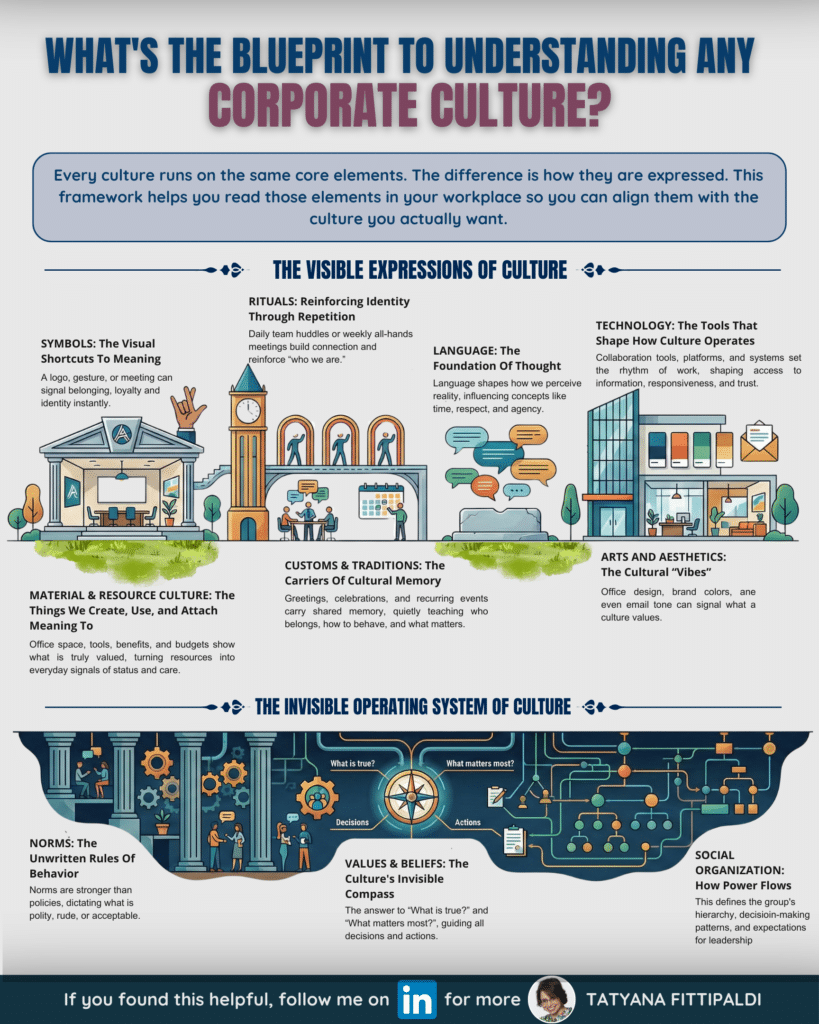
In this section, we look at ten classic elements of culture. You will recognize them right away: symbols, language, arts and aesthetics, norms, rituals, customs and traditions, values and beliefs, social organization, technology, and material aspects of a culture. Once you start seeing these patterns, it becomes much easier to understand behavior and make sense of cultural practices and cultural norms anywhere in the world, including inside organizations.
🪧 Symbols: The Visual Language Of Meaning
Symbols are shortcuts to meaning. A flag, a wedding ring, a color, a gesture, even traffic signs or a company logo can carry powerful emotional weight without a single word being spoken. In social interactions, they belong to both material culture and non-material cultural elements because they are physical material things that represent ideas, emotions, or beliefs.
Think about a corporate logo on a laptop sticker or building façade. It is not just graphic design. It signals belonging, loyalty, and identity. In organizations, rituals like an “all-hands meeting” or a town hall act as symbolic events that send messages such as “we are one team” or “leadership is visible.”
The same is true in societies. Religious symbols teach reverence and transmit values across generations. In corporate life, symbolic elements teach brand loyalty, commitment, and pride. If you want to understand a culture quickly, look first at its nonverbal symbols. They usually tell the truth much faster than the mission statement.
🪧 Arts And Aesthetics: The Cultural “Vibes”
Arts and aesthetics answer a deceptively simple question in human society: what feels “beautiful” here? They include music, dance, style, architecture, visual design, clothing, and even the sense of humor that feels “right” in a group. These choices are not random. They express identity, emotion, and status.
Across societies, arts and aesthetics are expressed through cultural expression, visual culture, and the performing arts. One culture may value minimalism, while another celebrates ornament and color. One work culture may design quiet spaces and calm colors, while another features bold visuals and open-plan energy.
In corporate environments, this shows up as brand design, office layout, slide aesthetics, and even email tone. All of these communicate “how we do things around here.” Leaders often forget that aesthetics are not decoration. They signal identity. They tell employees whether creativity, precision, boldness, or formality is valued.
🪧 Language: The Foundation Of Thought And Communication
Language is more than vocabulary. It shapes how people think. The Sapir-Whorf hypothesis suggests that language influences how we perceive reality. Different languages divide time, emotions, and relationships in unique ways, which affects how people reason and communicate.
For example, did you know that the way the Chinese express “please” is not exactly the same as in Western languages? You see, I’m learning Chinese, and I was a bit surprised that after 5 months of daily study, I still hadn’t learned how to use the word “please”. Upon asking the question of why that is, the answer was, “Why would you need this word for? You are in no position to use it.” I was a bit surprised that “please” was considered as something I shouldn’t choose as “choice of words.” And this video was able to further clarify my confusion and explain alternatives. If you want to see Sapir-Whorf’s theory in practice, I highly recommend watching it if you are a Western like me.
In multicultural teams, this matters a lot. A leader’s choice of words can calm a tense situation or accidentally escalate it. Phrasing is not cosmetic. It guides meaning. That is why written language, sign language, and spoken language all play important roles in work environments, along with bilingual education in global companies.
A well-documented example involves how English and Mandarin speakers talk about time:
- English uses spatial metaphors like “ahead of schedule” or “looking back at the past,” treating time as if it moves horizontally.
- Mandarin often uses vertical terms for time — for example, the characters 上 (up) and 下 (down) to indicate earlier or later events.
In experiments, like the one performed by Lera Boroditsky, speakers of these languages are faster at processing temporal information that matches their language’s habitual metaphors, suggesting that language shapes habitual ways of thinking about time relations. You can learn more about time perception in different cultures by reading my article on Chronemics.
Language can also cause exclusion. Sexist language or biased expressions quietly transmit who is seen as “default” and who is “other.” When organizations focus intentionally on inclusive language, they strengthen belonging, trust, and participation. Simply put, language is the main tool leaders use to build or break culture.
In multilingual societies, the Sapir-Whorf hypothesis becomes even more visible. People do not simply translate words from one language to another; they often switch thinking patterns, according to studies. A concept that feels obvious or precise in one language may feel vague, indirect, or emotionally charged in another. This means multilingual professionals constantly navigate multiple ways of interpreting intent, hierarchy, urgency, and emotion. Far from being a disadvantage, this cognitive flexibility can be a strength, but only when leaders recognize that differences in expression are differences in perception, not competence or commitment.
🪧 Norms: The Rules Of Social Living
Norms are the unwritten instructions about how to behave. They tell people what is polite, what is rude, what is rewarded, and what will get you in trouble. Some are explicit formal norms, like laws, dress codes, and company policies. Others are informal norms, such as “do not interrupt the boss” or “do not send emails after 8 pm, even though nobody wrote that rule.”
Norms support social living by making behavior predictable. They also form systems of social control that keep a group aligned. If you want to see values and norms clearly, walk into a meeting in a culture you do not know. Should you interrupt? Should you wait for your turn? Should you speak directly or hint? These expectations define psychological safety and communication style.
Inside organizations, norms are often stronger than policies. You can write “we value feedback,” but the real norm might be silence. Culture always wins over posters on the wall.
🪧 Rituals: Reinforcing Identity Through Repetition
Rituals are repeated activities that carry meaning beyond the action itself. They can involve cultural practices like food preparation, holiday celebrations, prayer, or family gatherings. They reinforce belonging because repeating something together creates emotional connection.
Workplaces also run on rituals. Think about onboarding lunches, Friday wrap-ups, award ceremonies, or morning team huddles. These routines build identity and strengthen work ethic, because they remind people “this is who we are.”
I still remember my first weeks working in a life sciences business in Latin America. I would arrive at the office at 9 a.m. and walk past rows of empty desks in the finance department. Day after day, the same scene. Finally, I asked, “Where is everybody?”
The answer surprised me, and to be honest, it annoyed me at first.
“They’re in the cafeteria having breakfast, of course.”
Breakfast? During work hours? My first reaction was judgment. Why didn’t they arrive earlier, eat before work, and start sharp at 9 a.m. like “professionals” do?
Then I saw what was really happening.
Breakfast was not a delay. It was a ritual. They gathered around tables, shared food, laughed, updated each other, and talked through the challenges of the day ahead. It was their daily alignment meeting without calling it a meeting. They were not wasting time. They were getting mentally ready together.
I have never worked anywhere else in the world where the team bond was that strong. They looked out for each other. They protected and supported one another in tough moments. Collaboration came naturally, not because it was written on a poster, but because it was lived every morning.
Our slogan at the time was “Imagination at work.” What I witnessed was actually “Imagination at work, together.”
That is the quiet power of rituals. They do not always look “efficient” on the surface, but they build trust, identity, and belonging in ways that no formal policy ever will.
Just like religious symbols, rituals teach what is sacred in a group. When organizations intentionally design healthy rituals, they create connection. When rituals disappear, so does belonging.
🪧 Customs And Traditions: The Carriers Of Cultural Memory
Customs are the habits of daily life. They answer questions like: How do we greet each other? How do we show respect? How do we celebrate milestones? Traditions go a step further. They are practices passed across generations that hold emotional and historical meaning.
Across the world, customs and traditions shape dress, greetings, hospitality, celebrations, and mourning practices. In corporate settings, they influence how people welcome new colleagues, mark anniversaries, or celebrate wins.
These are the cultural heritage of a group. Social heritages preserve identity. They also create friction when people with different expectations meet, because what seems “obvious” to one person is completely invisible to another. Leaders who recognize customs and traditions read the social environment with far more accuracy.
🪧 Beliefs And Values: The Invisible Compass
Recent data from the World Values Survey, the largest global study of beliefs and values covering more than 90 countries, shows that value systems vary widely across societies in ways that matter for work and cooperation. For example, some cultures emphasize self-expression and personal autonomy, while others prioritize survival security, traditional authority, and social cohesion — differences that shape expectations about teamwork, leadership, risk-taking, and fairness. This variation underscores how deeply held values influence not just individual attitudes but organizational norms and cross-cultural interactions in the workplace.
Beliefs answer the question “What is true?” Values answer “What matters most?” Together, they form the moral and cognitive center of culture. They live in nonmaterial culture, yet they influence every visible behavior.
Values shape cultural norms, ethics, and work ethic. They guide decisions about reward, punishment, fairness, and success. In organizations, you often see values written on posters. The real values, however, show up in budget decisions, promotions, and what gets tolerated.
For example, a company that claims to value transparency but punishes people who speak up does not actually value transparency. A company that truly believes in learning encourages questions, experimentation, and constructive failure. Values are not slogans. They are operating instructions. And the result of these instructions later becomes stories being told amongst employees.
🪧 Social Organization: How People Are Arranged To Work And Live Together
Social organization describes how people are grouped and how power flows. It includes family systems, classes, roles, leadership models, and networks. In some societies, hierarchy is expected and comforting. In others, equality and informality feel natural.
In companies, this translates into organizational structure. It shows up in reporting lines, decision-making patterns, and who has real influence compared to who only has a title on paper. It also shapes whether teams work collectively or individually.
Understanding whether a culture leans toward collectivism or individualism helps leaders communicate expectations realistically. Social organization explains why some teams wait for direction while others expect autonomy and initiative.
I once met a woman from an ethnic group, who I assumed was simply a respected elder in a community of Traditional Chinese Medicine practitioners. Only later did I understand she actually held the highest rank in the group. They affectionately called her the “Grand Matriarch.”
One afternoon, I watched an interesting moment unfold. The Matriarch, the current operational leader, gave an instruction to one of her closest assistants. Instead of responding immediately, the assistant briefly looked toward the Grand Matriarch, as if asking a silent question. The Grand Matriarch gave a small nod. Only then did the assistant accept the instruction and go carry it out.
Later, in private, I asked her, “Aren’t you undermining the Matriarch when people look to you for approval?”
She smiled gently and said, “No. My role is to help her become the leader the group will need when I am gone. I am not here to control decisions. I am here to teach judgment.” She explained that the final authority technically already belonged to the Matriarch. The Grand Matriarch’s job was to guide, coach, and protect her during the transition. Her presence signaled continuity of wisdom while the next generation learned to carry the weight of leadership.
In other words, what I was seeing was not hesitation. It was succession planning embedded in social structure. Their hierarchy was intentional, supportive, and long-term. Mentorship, lineage, and respect were not side notes. They were part of the group’s formal social organization.
That day, I was reminded that titles do not always tell the whole story. Power, influence, and responsibility often flow through relationships that are shaped by culture. And in some cultures, preparing the next leader is not a project. It is a duty.
🪧 Technology: The Tools That Shape How Culture Operates
Technology is not just hardware. It includes methods, systems, and routines that help people get things done. Technology influences how fast a culture moves, how it communicates, and how decisions are made.
A classic example comes from Japan. The development of visual workflow boards and just-in-time systems in the 1940s influenced how people coordinated tasks. Over time, that tool became part of the broader digital culture of efficiency and continuous improvement.
Today, workplace technology includes remote platforms, collaboration tools, AI systems, and automation. These tools do not simply support culture. They reshape it and traslate mindset. They influence availability expectations, speed of response, and even how trust is built when people rarely meet face to face.
🪧 Material And Resource Culture: The Things We Create, Use, and Attach Meaning To
Material culture is the world of physical objects that carry meaning. It includes clothing, architecture, tools, furniture, vehicles, art, and consumer goods. These are not just things people own. They tell stories about identity, aspiration, and belonging.
In another article, I shared one of my office anecdotes, where I told about “The Ride,” where a corporate bus was more than transportation. It represented connection, fun, and emotion. That is material culture at work. Objects become symbols of who we believe we are becoming.
In organizations, material culture shows up in building design, uniforms, laptop choices, office layout, and even the quality of coffee machines. These objects communicate hierarchy, inclusion, or care for employees. Physical environments constantly transmit messages about value and respect.
Bringing It Together
Once you see these ten elements of culture, you start seeing them everywhere: in families, nations, and boardrooms. They operate together as a system. Change one, and the others shift. That is why cultural change at work is more than a policy update. It requires attention to symbols, language, stories, values, and the physical environment all at once.
Understanding the elements of culture helps leaders step out of guesswork and into clarity. It gives them a practical map to read behavior, understand misunderstanding, and design healthier organizational cultures that support trust, performance, and human connection.
Sociologist Harold Garfinkel used what he called breaching experiments to make everyday, unseen cultural norms visible. By deliberately violating small social rules — like acting like a stranger in one’s own home or subtly breaking rules in a simple game — Garfinkel showed how deeply people depend on unspoken expectations to create shared meaning and social order. When these background rules are breached, bystanders become confused, annoyed, or even defensive because the implicit “operating instructions” of everyday interaction are suddenly exposed. This insight maps directly onto organizational culture: just as social order in everyday life depends on shared, often invisible norms, so too does healthy organizational behavior depend on unanalyzed assumptions about communication, hierarchy, and teamwork. Changing culture, then, requires surfacing and realigning these background expectations, not just updating formal policies.
Storytelling: The Cultural Thread That Connects Symbols, Language, And Values
If culture is the operating system of a group, then storytelling is the Wi-Fi. It connects everything without being seen. Stories move silently through conversations, meetings, family dinners, corporate town halls, social media posts, and even in the way we explain our own past to ourselves. They carry meaning from one person to another and from one generation to the next.
Storytelling sits inside nonmaterial culture. It is made of ideas, dreams, identity, belief, humor, and memory. Yet it also shapes material culture because the stories people hold influence what they build, what they buy, what they protect, and what they celebrate. A story about national pride builds monuments. A story about innovation builds research labs. A story about fear builds walls.
Every group on earth tells stories. Families, nations, and organizations all do it. A family tells the story of “how we survived that difficult year.” A company tells the story of “how we started in a garage and grew.” A country tells the story of “who we are as a people.” These are not innocent narratives. They shape identity, loyalty, behavior, and ambition.
Now, let’s look at how storytelling acts inside culture.
Storytelling As A Mirror Of Nonmaterial Culture
Storytelling is both a cultural product and a transmitter of culture at the same time. It is created by the culture, and then it goes back and reshapes the culture again. Stories reveal what people admire, what they fear, what they find funny, and what they see as fair or unfair. They reflect the deepest layer of nonmaterial culture, where beliefs, values, ethics, and worldviews live.
When a community keeps retelling the same stories, they are not simply remembering the past. They are reinforcing “this is who we are” and “this is how people like us behave.” That is why stories are so effective at preserving lessons, norms, and wisdom. A child does not need a full lecture on honesty if they grew up listening to stories where the honest character is respected, and the dishonest one faces consequences. The story has already done the teaching.
This is equally true in companies. A corporate origin story often shapes identity more than strategy documents ever could. If the story is “we are fighters who make things happen with limited resources,” employees behave one way. If the story is “we are guardians of quality and reputation,” they behave another way. A story does not sit in the background. It quietly sets expectations.
Founding myths at the national level work the same way. They tell citizens what kind of people they come from and what type of future is acceptable for them. Which heroes are chosen, which events are highlighted, which voices are remembered or forgotten, all of this signals values.
In short, storytelling does not just entertain. One of the storytelling secrets is that it mirrors the invisible part of culture, then sends it forward so the next person can carry it.
Storytelling As The Bridge Between Language, Symbols, And Rituals
Storytelling brings together several elements of culture into one single activity. It uses language, of course, but also symbols, gestures, imagery, and emotional cues. It connects with rituals, since many stories are told again and again on specific dates, in specific places, and for specific purposes.
The Sapir-Whorf hypothesis reminds us that the language we use influences how we think. If your language has many words for “respect,” you probably see more nuance in hierarchical relationships. If your language does not distinguish between “leader” and “boss,” those roles may blend more easily in practice.
For example, take the Chinese word for “teacher,” lǎoshī (老师). It does not only refer to a person standing in front of a classroom. The word carries deep respect for anyone who passes on knowledge, wisdom, or skill. It reflects a long tradition influenced by Confucian thinking, where learning and teaching are central social responsibilities.
That is why the term is often used for bosses, senior leaders, respected masters in the arts, or anyone seen as a guide for others. Calling someone lǎoshī is not about their job title. It is about honoring their role in helping others grow.
This small linguistic detail reveals something important. Language is showing us what the culture values. In this case, there is an invisible thread that connects authority with teaching. Leadership is expected to include guidance, mentorship, and the transmission of knowledge, not only formal power.
Now imagine storytelling using that language over and over. It does not just describe reality. It shapes it.
In organizations, stories are wrapped in material culture as well. Logos, buildings, awards, and photos become symbols that carry meaning when the story is told. Think about the classic story of “the time our founder took a risk and won.” The retelling itself becomes a ritual. It appears at annual meetings, onboarding sessions, and leadership trainings. People can repeat it almost word for word. At that point, it is no longer just a story. It is a cultural instruction manual.
Stories also explain rituals. Why do we ring a bell when a big sale closes? Why do we celebrate certain dates? Why do we observe silence after particular events? Because there is a story behind it. Remove the story, and the ritual becomes mechanical. Keep the story alive, and the ritual keeps its emotional force.
So storytelling sits right in the middle of language, symbols, and rituals. It uses all three to keep culture alive and recognizable.
Internal, External, And Collective Narratives In Organizations
Inside organizations, storytelling happens at three main levels. The first is internal narratives. These are the stories individuals tell themselves about their worth, capability, identity, and future. Internal narratives sound like, “People like me do not make it into senior leadership,” or “I am the person others can depend on.” They directly affect confidence, risk-taking, and voice.
The second level is external narratives. These are the stories the organization tells the world. Brand messages, marketing campaigns, employer branding, public speeches, annual reports, all of these communicate “who we are.” Sometimes the external story is aspirational. Sometimes it is grounded in reality. The most powerful organizations work hard to keep both aligned.
The third level is collective narratives. This is the shared story teams or entire organizations believe together. It lives in informal conversations more than in official documents. It sounds like, “This company really cares about people,” or “No one listens here, so do not bother speaking up.” These narratives shape loyalty, motivation, and behavior at scale.
High-impact leaders understand that all three levels matter. They shape internal narratives through coaching and feedback. They shape external narratives by communicating authentically with the world. They shape collective narratives by modeling behavior, making fair decisions, and reinforcing what the organization truly values.

For a deeper view, I explore these three narrative circles in my article “Circles Of Control In Leadership: How Storytelling Expands Influence Beyond What You Control,” where I connect storytelling with different levels of leadership influence and responsibility.
The Power Of Corporate Storytelling In Shaping Organizational Culture
Storytelling in business is not just a communication technique. It is how organizational culture breathes. Through stories, people learn what behavior is admired, what crosses the line, and what success really looks like here.
Values become real when they are illustrated through stories. Work ethic becomes visible when leaders tell honest accounts of effort, resilience, and teamwork. Cultural norms are reinforced every time a new employee hears, “Around here, we do things this way,” followed by a concrete example.
You can see storytelling at work in many small ways:
- Symbols gain power through stories, such as the origin of a logo or product name
- Core Values come alive through moments where someone chooses ethics over convenience
- Norms are transmitted through onboarding stories that show “how we do things here.”
Stories turn nonmaterial culture into something people can see and feel. They make the invisible visible. They help people connect their personal identity to the identity of the organization. That is why storytelling is one of the most powerful tools any leader has. It does not require a special budget. It requires awareness, intention, and respect for the impact words can have on human behavior.
When leaders pay attention to the stories being told, they are not only listening. They are reading the culture in real time.
From Societies To Systems: How Cultural Elements Shape Corporate Cultures
Don’t be a fool like I was for many years, to think that companies are just legal entities or income statements. No. They are micro-societies. People join them, learn the rules, adapt their behavior, find mentors, tell stories, and figure out who has influence. The same elements that shape nations and communities also shape organizational culture at work.
The parallels are easy to see once you start looking.
- Symbols show up as logos, office décor, dress code, and status markers, such as office size or parking spots
- Language appears through jargon, acronyms, email tone, and how “respectful disagreement” is actually expressed
- Norms come to life in unwritten rules, such as who speaks first, how feedback is given, and what happens after mistakes
- Rituals include recurring meetings, award events, off-sites, and onboarding routines
- Beliefs and values live in mission statements, leadership speeches, strategic priorities, and the stories people tell about “what really matters here”
When leaders talk about culture, they often think about values written on a poster. In reality, culture is visible in daily behavior. You can read it in how decisions are made, who gets promoted, what people joke about, and what people stay silent about. That is nonmaterial culture in action: values, ethics, assumptions, and communication tone.
At the same time, organizations also have material culture. This includes the office layout, furniture, meeting room names, uniforms, technology platforms, laptops, collaboration tools, and digital artifacts. These are not neutral objects. An open office invites one type of behavior, a closed-door office another. A company that equips teams with digital collaboration tools is sending a message about agility and connection. What a company invests in tells a story about what it really values.
Cultural Variation Inside The Same Company
Here is where it gets interesting. Culture is not only different across countries. It also varies inside the same organization. Headquarters may operate with one style, while regional offices live another daily reality. Different departments can feel like different countries. Finance may value caution and accuracy. Marketing may value creativity and experimentation. Manufacturing may value discipline and safety. All of that is cultural variation.
None of this is right or wrong. It simply reflects different priorities, contexts, and histories. Problems arise only when people assume everyone plays by the same cultural rulebook, then judge others for not following “the obvious way” of doing things.
This is why leaders need cultural awareness inside their own organizations, not only across borders. Reading culture accurately helps them interpret silence, enthusiasm, resistance, and disagreement with much more clarity.
The Middle East Example: A Lesson In Cultural Variation
When working with teams in the Middle East, many global leaders notice that what works smoothly in one region lands very differently there. This is a great example of how cultural variation shapes cultural norms inside business life.
In some Middle Eastern contexts, relationships come before tasks. In Reacher, season 3, Quinn (the bad guy) invites Yemen businessmen to a party to finalize a big deal. He presses the businessmen to get it over with, but they respond that they want to enjoy the party first and have the business talk later.
Trust is built through conversation, hospitality, and personal connection. A leader who rushes straight to agenda items without greeting people properly may be seen as cold or disrespectful, even if they believe they are just being efficient. Greetings, tone, and the pace of conversation matter, because they signal respect and inclusion.
Communication style can also differ. Indirect communication is common in certain settings. People might avoid saying “no” directly, especially to a senior person, in order to preserve harmony. A Western leader who expects blunt disagreement may completely miss the many subtle signs that something is off. Meetings may seem to show agreement, while body language and follow-up behavior reveal hesitation.
Let me share a real case that illustrates this, even though it did not happen in the Middle East.
I once coached a German CEO who had been assigned to lead a company in Chile. When she arrived in coaching, she was upset, frustrated, and deeply disappointed. After her first year in Chile, the business suddenly faced serious problems. Only then did she realize that many people around her had seen the warning signs months earlier. No one had raised the flag directly. No one had told her, “We are heading in the wrong direction.” Yet once the crisis happened, many people openly discussed how predictable it had been.
She felt betrayed. In her mind, teams were supposed to collaborate, surface risks early, and be transparent about problems. Instead, she felt that she had been left alone to face the storm while everyone else quietly prepared for it.
What she slowly discovered was not betrayal, but a different cultural rulebook.
She came from a context where direct correction, strong disagreement, and immediate problem escalation are normal signs of professionalism. In her new environment, relationships and harmony carried more weight in daily interaction. People avoided confronting a senior leader directly in public because they saw it as disrespectful or embarrassing. Silence was not agreement. It was protection. They wanted to preserve her authority and avoid putting her in a difficult position.
The turning point in coaching came when she realized something important. In that cultural context, it was not the team’s job to challenge openly. It was her job as the leader to invite candid feedback, ask deeper questions, and create spaces where people felt genuinely safe telling the truth.

Nothing was “wrong” with either culture. They were simply operating according to different norms about respect, hierarchy, and communication.
This is why understanding how cultures operate is not optional for global leaders. It is a leadership skill. When you read culture well, you stop misinterpreting silence as agreement, disagreement as disrespect, or indirect speech as lack of courage. Instead, you understand what people are actually trying to do, which in many cases is to protect the relationship, the leader, and the collective.
Leadership hierarchies also tend to be clearer in many Middle Eastern organizations. Titles carry social meaning, not just functional description. It is common for junior employees to wait for direction from seniors rather than challenge decisions publicly. This is not passivity. It is respect within an accepted hierarchy in social living.
Work ethic is often misunderstood as well. Long breaks for prayer or extended meals may be misread by outsiders as lack of urgency. In reality, workdays can extend late into the evening, and there is strong dedication to fulfilling commitments. The rhythm is simply different.
Now imagine a multinational project team where half the group expects flat hierarchy, quick debate, and direct answers, while the other half expects structured authority, relational warmth, and indirect language. Without cultural awareness, frustration grows on both sides. With cultural awareness, collaboration improves almost instantly.
Understanding cultural norms helps leaders:
- read behavior accurately instead of misjudging it
- choose communication strategies that actually work
- create psychological safety without forcing everyone to copy one style
Culture does not disappear at the office door. It travels with people. Leaders who learn to see it gain an enormous advantage in building cohesive, respectful, and high-performing global teams.
Avoiding Misunderstandings In Multicultural Interactions
Most misunderstandings in multicultural work do not come from bad intentions. They come from people interpreting the same signal in different ways. A lot of that happens through nonverbal communication. Eye contact, silence, personal space, hand gestures, tone of voice, pacing, and even how fast someone replies to a message carry meaning inside each culture.
For example, strong eye contact can be read as confidence and honesty in some regions. In others, it can be seen as aggression or disrespect toward authority. Standing very close while speaking may be interpreted as warmth and connection in one culture, while another person experiences the same behavior as intrusive or inappropriate. Silence, too, is not universal. To some people it signals reflection. To others it signals disagreement or lack of engagement.
Now add the workplace context.
Virtual meetings complicate this even more. Cameras off, delayed reactions, lagging sound, multitasking, and cultural norms on interrupting versus waiting to be invited will all shape how people read each other. An email written in a brief and direct tone might be seen as efficient by one person and hostile by another. Decision-making styles also differ. Some cultures move quickly once a senior person speaks. Others expect long consultation and collective input before any decision is final.
This is where cultural empathy becomes essential. Cultural empathy means assuming there is meaning behind behavior instead of immediately judging it. It is the habit of asking, “What could this mean in their cultural context?” instead of “Why are they behaving incorrectly?”
I experienced this myself years ago. I was a young CFO in a virtual meeting with the general manager whose P&L I was supporting. We were presenting a budget to the Americas CEO for a new project. Partway through the discussion, he suddenly raised his voice and said, “You are making this up.”
I remember the feeling clearly. Not just anger, but deep frustration and discouragement. It was not even about being called a liar. What hurt most was realizing that he had almost no understanding of how things actually worked in that country. Local constraints, regulations, and market dynamics were invisible to him, yet he felt completely confident judging the proposal as impossible or exaggerated.
I do not remember the numbers or even the project itself from that meeting anymore. What stayed with me was the emotional weight of that moment. It was the realization that cultural ignorance at senior levels does not just cause mistakes on spreadsheets. It can invalidate entire teams, silence local expertise, and crush motivation in seconds.
That is exactly what happens when leaders assume instead of asking. A curious question like “Help me understand why this looks different from our other markets” would have opened a productive conversation. Instead, judgment closed it.
The simplest and most powerful rule is this: ask instead of assuming. Questions such as “How is feedback usually given here?”, “How do you prefer to handle disagreement?”, or “What would respectful communication look like in this situation?” can prevent months of tension.
Organizational culture can either bridge or intensify these misunderstandings. A company that encourages curiosity, listening, and inclusion gives people permission to talk about cultural differences openly. A company that treats one style as “the only professional way” silently tells people to hide who they are. Leaders set the tone. When leaders model curiosity instead of judgment, teams stop walking on eggshells and start understanding each other.
Misunderstandings will still happen. Misunderstandings always happen. They are part of multicultural life. The difference is that skilled leaders recognize them early, repair them quickly, and use them as learning moments instead of allowing resentment to grow.
Fortunately, decades of research suggest that these misunderstandings do not have to harden into lasting tension. Building on contact theory, first formalized by psychologist Gordon Allport, sociologists and social psychologists have shown that meaningful interaction between people from different cultural backgrounds can reduce prejudice and improve mutual understanding. Large-scale studies, including meta-analyses across hundreds of contexts, demonstrate that when contact occurs under the right conditions — equal status, shared goals, cooperation, and institutional support — it reliably increases trust, empathy, and collaboration. In organizational settings, this means that cross-cultural friction is not a sign of failure. When leaders intentionally design environments that encourage dialogue, learning, and joint problem-solving, diversity becomes a source of insight and resilience rather than division.
Building Cultural Intelligence Through Multicultural Communication Awareness
Cultural intelligence does not magically appear with international travel or a global job title. It grows through intentional awareness and practice. One of the fastest ways to build it is by paying attention to communication, both verbal and nonverbal.
Start with active listening. This means listening not only to words, but to pauses, tone, speed, and what is not being said. Many cultures communicate disagreement indirectly. If someone says, “This might be difficult” or “We can explore it,” they may actually be saying “No.” In my YouTube series “Joyride with Expatriates,” I interviewed an American living in Brazil who retells his learning about Brazilian business making. He shared that when Brazilians don’t want your product or service during a sales conversation, they might say “maybe” instead of a blunt “no.”
Active listening helps you hear the real message without forcing people to communicate only in your preferred style.
Next is cultural curiosity. Replace “Why do they do it like that?” with “I wonder what makes this important here.” Curiosity reduces frustration. It also opens doors for respectful questions that increase understanding on both sides.
Language matters too. Bilingual education (second language learning), sign language awareness, and sensitivity to written language help leaders include more people in decision-making. Something as simple as speaking a little slower in mixed-language groups, or avoiding idioms that do not translate well, can dramatically increase clarity. Written summaries after meetings help those who process language differently. Inclusive communication is not about perfection. It is about effort. That’s why language learning can be powerful.
Leaders can also educate themselves through basic cultural frameworks such as high-context and low-context cultures (Edward T. Hall) or the Lewis Model. These tools are not boxes to trap people in. They are lenses that help leaders understand why some cultures value directness and speed, while others value relationship building and harmony before action.
The Sapir-Whorf hypothesis reminds us that language shapes perception. If a language has several different words for one concept, its speakers will often notice distinctions others miss. This is why the same corporate message can feel inspiring in one language and cold in another. Leaders who are aware of this do not copy-paste communication. They adapt it.
Finally, connect these skills back to daily leadership. Before sending an email, ask yourself how it might read in another cultural context.
Here is a simple example from my own career. When I worked for Brother International as an HR Operations Director, the communications team would always send me corporate messages to translate into Portuguese and Spanish for Latin America. At first, I was honestly a little annoyed. It felt like I was being given a small, administrative task that did not match my role.
Later, I realized why they kept coming back.
They were not asking me to “translate.” They were asking me to adapt. My versions did not just convert words. They adjusted tone, examples, humor, and references so they made sense in local cultural context. What sounded inspiring in English sometimes sounded cold or overly formal when translated literally. What sounded casual in one country sounded disrespectful in another.
That was my lesson that communication across cultures is not copy and paste. It is leadership work.
And that leads to a second powerful insight. Before assuming agreement in a meeting, check for understanding. Before labeling someone as “passive,” “aggressive,” or “unclear,” ask what rules of communication they might be following.
Cultural intelligence is not about knowing every culture on earth. It is about staying aware that other valid rulebooks exist, then communicating in a way that respects them. That awareness turns multicultural friction into multicultural collaboration.
Improving Workplace Culture Using The Elements Of Culture
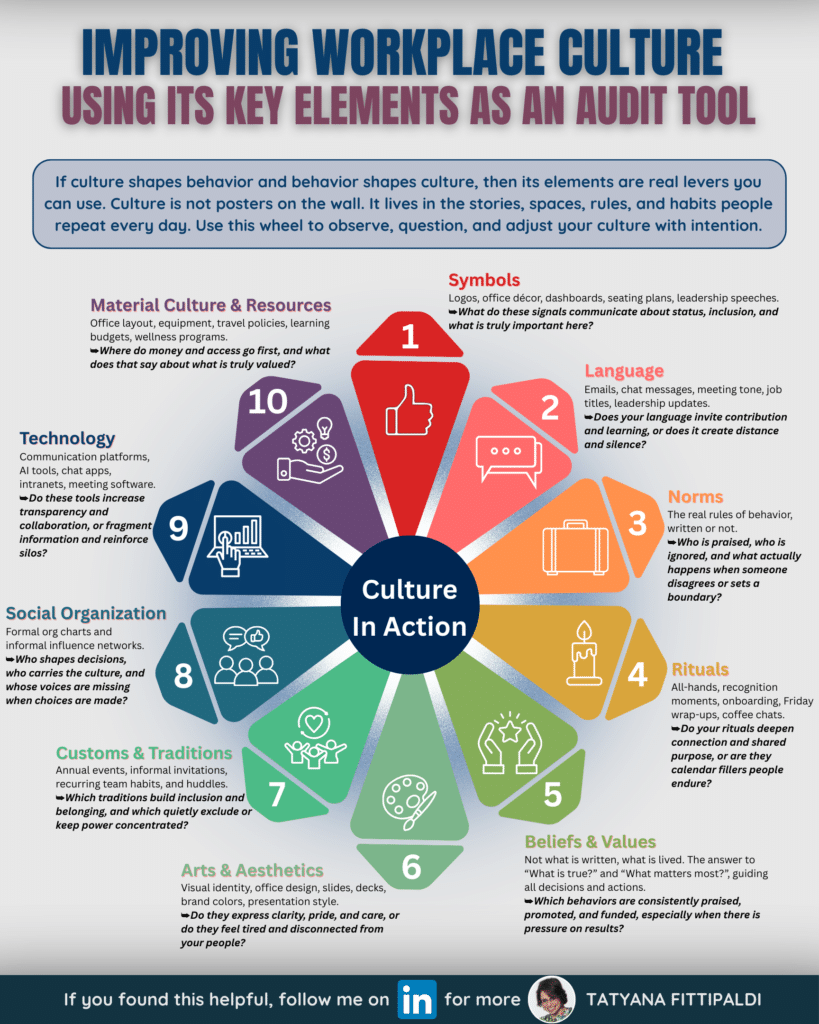
If culture shapes behavior, then understanding the elements of culture gives leaders real levers they can use to improve organizational culture. Culture is not magic. It is not posters on the wall. It is the repeated interaction between people, stories, spaces, rules, and unspoken expectations. When leaders learn to read those elements, they also learn how to influence them with intention.
Think of the list below as a practical audit tool. It is not about criticizing your company. It is about asking better questions.
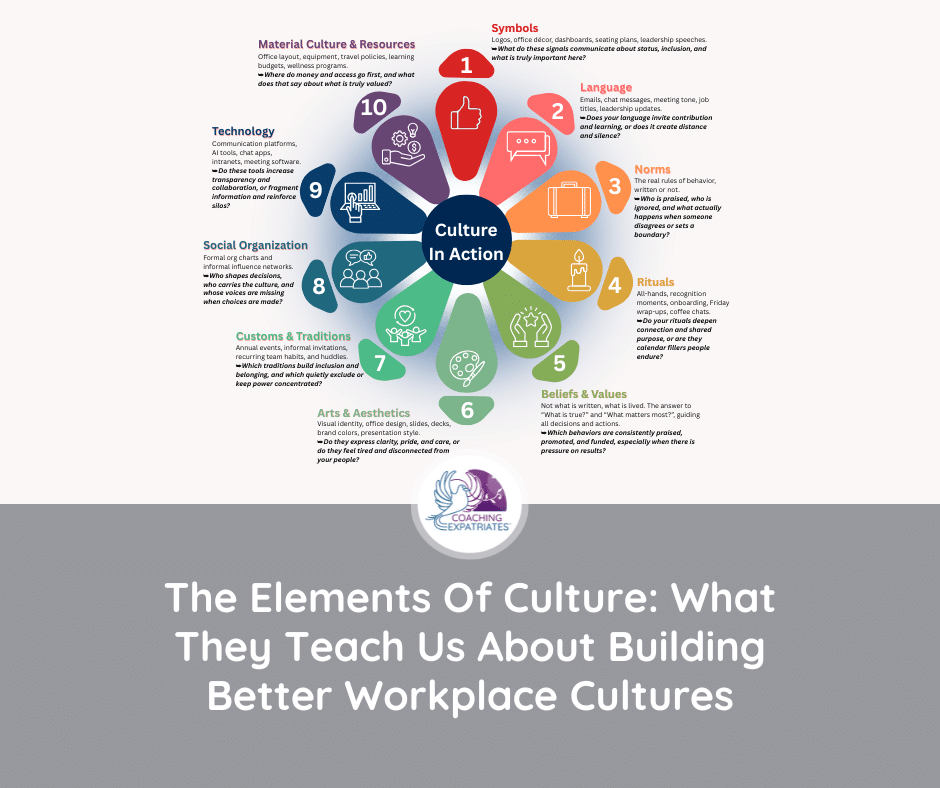
Start with symbols. Look at logos, office décor, leadership speeches, visual dashboards, and even who sits where. Ask yourself what these symbols communicate. Do they reinforce inclusion, innovation, and care for people, or do they quietly communicate distance and hierarchy?
Then examine language. Review internal communication, meeting tone, email style, job titles, and how leaders talk about success or failure. Does your language invite contribution or shut it down? Are corporate messages only written in legal tone, or do they sound human?
Next, review norms. These are not only written policies. They are the real rules of behavior. Do people actually take vacations or are they praised for not resting? Do meetings start on time? Is disagreement welcomed or punished? These unwritten norms shape work ethic far more than any handbook.
Look at rituals. Recognition events, all-hands meetings, Friday wrap-ups, onboarding routines, leadership off-sites, even morning coffee together count as rituals. The question is simple. Are your rituals strengthening connection, meaning, and shared purpose, or are they empty calendar fillers?
Revisit beliefs and values. Not what is written, but what is lived. If a company says it values people but rewards only numbers, people learn the real value system very quickly. Ask yourself, which behaviors are actually praised, promoted, and funded?
Pay attention to arts and aesthetics. The visual identity of the company, office design, presentation style, slide aesthetics, and even brand colors tell a story. Do they express warmth, clarity, and pride, or do they feel tired and disconnected from the people who work there?
Then evaluate customs and traditions. Maybe it is the annual party, Monday breakfast, or who gets invited to lunch with leadership. Some traditions build inclusion. Others exclude and create distance. Identify which ones support your desired culture and which ones quietly block it.
Map social organization. Look beyond the org chart. Who actually influences decisions? Who acts as cultural carriers? Is power concentrated in a few voices or shared through teams? Understanding formal and informal hierarchies is essential if you want change to move beyond PowerPoint.
Assess technology. Collaboration platforms, AI tools, chat systems, intranets, meeting software, and knowledge-sharing systems all shape communication. Technology is not neutral. The tools you encourage people to use will define rhythm, transparency, and connection. Decide which tools reflect the culture you want and support them clearly.
Finally, look at material culture and resources. Office layout, equipment quality, travel budgets, learning platforms, and wellness programs are not just expenses. They communicate what is truly valued. If well-being is talked about but never funded, people notice. Material objects often reveal the real value system behind the speeches.
Improving work culture is not about slogans. It is about aligning these elements with your desired identity. When individual purpose connects with collective goals, work ethic strengthens naturally. People do not work hard because they are forced. They work hard when they feel meaning, safety, and fairness.
Practical Steps For Leaders And HR Professionals
Turning this reflection into action requires consistency, not perfection. Start small, but start intentionally.
Create spaces for listening. Establish cross-cultural committees, employee resource groups, or confidential listening sessions where people can safely talk about cultural norms that support or harm their daily work. You will hear truths that surveys often miss.
Encourage storytelling initiatives. Invite employees to share customer success stories, innovation moments, and lessons learned. Stories are powerful carriers of culture. They make values visible.
Foster psychological safety. Make it clear that disagreement is not disloyalty. Model humility when you make mistakes. Thank people who bring uncomfortable truths. Teams mirror leadership behavior.
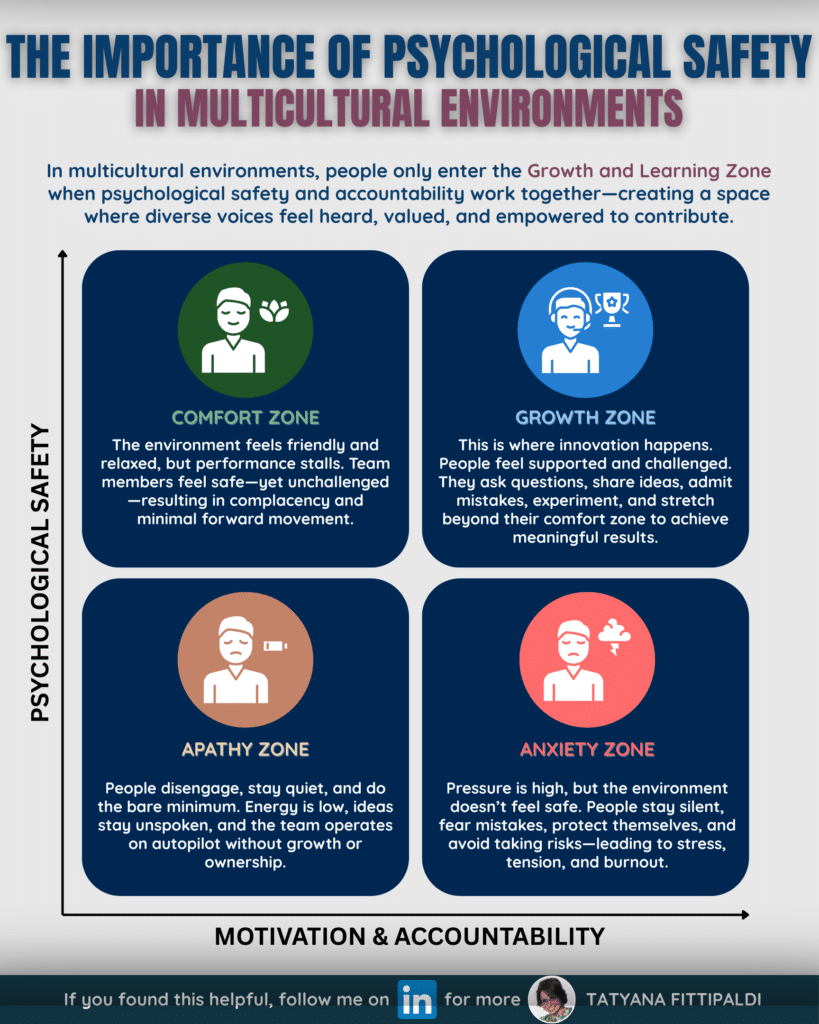
Use social control positively. Recognition programs, transparent decision-making, internal communication about why choices are made, and clear accountability systems guide behavior without fear or humiliation. People do not need to be policed when expectations are clear and fair.
Take a human-centered approach to organizational culture. Look for friction points where processes fight human reality, and adjust what you can. Review promotion criteria, workload expectations, and leadership role modeling. Align what you say with what you do. Culture shifts every time behavior does.
Over time, these actions compound. The workplace becomes more global in awareness, more inclusive in practice, and stronger in performance. Not because of posters, but because the daily experience of working there truly matches the values the company claims to believe in.
This is the real craft of culture.
The Role Of Leaders As Cultural Storytellers And Meaning-Makers
Leadership is not only about plans, metrics, and deliverables. Leaders shape culture through the stories they tell and, more importantly, through the stories their actions create. Every decision sends a message. Every promotion, budget approval, and public recognition tells people what truly matters here. Whether leaders realize it or not, they are always communicating a narrative about value, belonging, and performance.
Leaders tell stories through decisions. When a company chooses safety over speed or long-term trust over a quick contract, it communicates identity. People learn how to act by watching what choices win.
They also tell stories through resource allocation. Budgets are moral documents. What gets funded grows. What is consistently underfunded slowly disappears, no matter how inspiring the slogan sounds. If learning, well-being, and inclusion matter, investment must match the narrative.
Leaders tell stories through what behavior is rewarded. Applause in meetings, performance reviews, bonus criteria, and promotion decisions all tell a cultural story. If collaboration is praised only in speeches but individual heroics get the bonuses, people quickly learn the real rules of success.
At the heart of this is a simple truth. Leaders are not only managers of tasks. They are architects of meaning. They help people answer questions like: Why are we doing this? What kind of company are we building? Where do I belong in this story?
This is why coaching, training, and keynotes matter. They help leaders become aware of the stories they are telling, both intentionally and unintentionally. They help leaders move from accidental culture to intentional culture. Culture is not an accident. It is narrated, modeled, and reinforced every single day.
Books To Help You Leverage Cultural Elements And Lead As A Meaning-Maker
Here are four high-impact books for HR leaders and executives who want to deepen their practice.
Organizational Culture and Leadership
By Edgar H. Schein and Peter Schein, 2016
This is a classic text on how cultures form, evolve, and are shaped by leadership. It explains why culture is both powerful and difficult to change. Leaders will find practical insight into how assumptions, cultural artifacts, and values interact inside organizations. It is useful because it shows culture not as decoration, but as the real operating system of a company.
The Culture Map: Breaking Through the Invisible Boundaries of Global Business
By Erin Meyer, 2014
We have referenced frameworks such as Hall’s cultural context theories and the Lewis Model in this article. This book builds on that foundation and translates those concepts into practical tools leaders can use in global organizations. This book focuses on how cultural differences shape communication, trust, feedback, decision-making, and leadership expectations around the world. It is practical, corporate, and directly relevant to global teams. Leaders can use it to avoid cultural missteps, interpret behavior with greater accuracy, and adapt their leadership style across regions without losing authenticity.
Made to Stick: Why Some Ideas Survive and Others Die
By Chip Heath and Dan Heath, 2007
This book explores why some messages capture attention and others disappear. It offers the SUCCESs framework to make messages simple, unexpected, concrete, credible, emotional, and story-driven. Leaders and HR professionals can use it to design internal communication, change initiatives, and training content that people actually remember and act on.
Mastering Business Storytelling
By Taty Fittipaldi, 2025
This book focuses on storytelling as a core leadership skill for global executives. It connects storytelling to decision-making, team alignment, cultural intelligence, and executive presence. It is especially valuable because it treats storytelling not as theater, but as a structured discipline that supports communication across cultures. Leaders can use it to design narratives that align behaviors, strategy, and culture inside complex global organizations.
Culture As The Blueprint For Collective Success
Culture is not an abstract concept that lives in textbooks. It lives in daily behavior. It lives in jokes, meetings, rituals, silence, decisions, and the stories people tell after work. Understanding the elements of culture helps leaders see what has always been there, both across nations and inside their own companies. The same forces that shape societies also shape organizational culture.
When leaders recognize how cultural practices, symbols, language, norms, and values operate, they stop reacting blindly to behavior. They begin to read it. They see why one team hesitates, why another debates loudly, and why the same message lands differently in different regions. That awareness turns confusion into clarity and cultural variation into an asset instead of a problem.
The role of the modern leader is not only to manage tasks. It is to act as a cultural architect. Leaders build environments where diversity is welcomed, values are lived instead of framed, and shared meaning keeps people aligned when everything around them shifts. When people feel seen and respected, work ethic strengthens naturally. Performance follows belonging.
If you are responsible for developing leaders inside your organization, the stakes are high. Cultural blind spots do not just hurt feelings. They damage trust, decision quality, retention, and business results. Coaching is one of the most effective ways to help business-critical leaders strengthen cultural intelligence, improve leadership communication, and avoid the kind of behavior that shuts people down without intending to.
I partner with organizations that want their leaders to read culture accurately, lead multicultural teams with confidence, and represent the company well in every region where they operate. Coaching gives leaders a confidential space to examine real situations, challenge assumptions, and grow without fear of judgment.
If you are exploring coaching solutions for your leadership team or your high-potential talent pipeline, I would be glad to talk with you about your goals and whether my programs are the right fit for your organization.
If this article resonated with you, consider subscribing to my newsletter. Each week, I share ideas, tools, and reflections to support culturally intelligent leadership and story-driven communication.