What’s the difference between introverts and extroverts? It’s a question that continues to shape how we understand behavior in social environments, relationships, and even the global workplace. At the heart of this distinction is a core dimension of personality—the difference between introverts and extroverts is in the way individuals gain or lose energy in social situations.
Extroverts tend to thrive in dynamic social environments, feeling energized by group interactions, events, and social activities. Introverts, by contrast, often draw strength from quiet environments, preferring reflection, one-on-one conversations, or smaller gatherings where they can think deeply and recharge.
These individual differences are part of a broader model of personality that includes traits like openness, conscientiousness, and emotional stability—often referred to as the Big Five personality factors. Interestingly, while extroverts are commonly associated with higher levels of happiness in outward-facing roles, research also highlights the underestimated power of introverts, especially when it comes to focus management, empathy, and leadership in quieter forms.
In this post, we’ll explore what really separates introverts from extroverts—beyond the common stereotypes—and how understanding this dimension of personality can improve our interactions, foster inclusion, and help everyone thrive, no matter where they fall on the spectrum.
Key Takeaways:
- Introverts and extroverts show different traits in social situations.
- Knowing these differences helps us get along better in social settings.
- Introverts like quiet, while extroverts seek out people.
- Personality shapes our social experiences.
- Valuing these differences strengthens our relationships.
- Introverts and extroverts can learn from each other, leading to personal growth.
Understanding Introversion And Extroversion Through My Personal Journey
Looking back, I’ve come to realize how much my life has been shaped by my introverted personality traits. I’ve always cherished quiet times, deep one-on-one conversations, and long moments of reflection. These preferences drew me toward academic environments and a fascination with observing social behavior rather than always participating in active behavior.
At the same time, I’ve found great joy in sharing ideas and stories, speaking to groups, and connecting with people in meaningful ways—experiences commonly associated with extrovert personality types. But engaging in these moments doesn’t suddenly make me an extrovert. Instead, it’s helped me appreciate the richness and complexity of the personality spectrum.
Over time, I’ve met many extroverted people—those who feel most alive in busy spaces, thrive on spontaneous social activities, and gain energy from being around others. Their enthusiasm, warmth, and drive for lively relationships helped me better understand the nuances of extrovert personalities. In contrast, introverted people often find fulfillment in stillness, reflection, and selective social engagement.

Both groups can experience high life satisfaction, but how they get there varies—often shaped by environmental factors, internal preferences, and their level of extraversion or introversion.
Gaining Awareness And Understanding: A Side Story
Back in college, I had a close friend who often said, “I don’t have any real friends,” even though she had a few people who cared deeply about her. I remember being puzzled by her complaint—we both had what I thought were meaningful connections. But looking back, I realize neither of us had much self-awareness about our own personality traits at the time.
She was an extrovert, craving variety, novelty, and frequent interaction—she needed conversations not just for connection, but as a way to process her thoughts and experiences in real time. I, on the other hand, was an introvert. I was perfectly content with a few close friends I’d see occasionally, where we could share already-formed thoughts and listen deeply to each other’s perspectives.
My go-to advice back then was something like, “It’s better to have a few good friends than a lot of shallow ones.” But in hindsight, that was me talking—the introvert speaking from my own definition of friendship, not hers.
Today, with more self-awareness, I wouldn’t have given advice at all. I would’ve asked her a simple but powerful question: “What does friendship mean to you, and what are you hoping to feel from it?” Because chances are, her version of friendship looked very different from mine—and honoring those individual differences matters more than offering one-size-fits-all advice.
What I’ve learned is this: no one fits perfectly into a box. Our levels of introversion or extraversion ebb and flow depending on the situation. We might seek different things, and we might express them in different ways. Some people lean strongly toward introversion or extroversion, while others display traits from both. It’s not about being one or the other, but about understanding where you are on the personality spectrum, how you desire to express it, and honor it.

| Personality Type | Characteristics |
|---|---|
|
Introvert |
Prefers solitude, enjoys deep conversations, observes human behavior |
|
Extrovert |
Thrives in social situations, outgoing, assertive, enjoys high social skills |
|
Ambivert |
Combines introverted and extroverted traits, adaptable, balanced |
By embracing these individual differences, we build more meaningful relationships, cultivate empathy, and create room for both quiet reflection and vibrant interaction. And for me, that’s the most fascinating part of the human experience.
The Science Behind Personality Types
Understanding the difference between introverts and extroverts isn’t just about preferences for solitude or socializing—it’s grounded in decades of psychological research and biological evidence. Modern psychology classifies these traits through the Five-Factor Model (also known as the Big Five Personality Traits), a widely accepted framework outlined in the Encyclopedia of Personality and supported by numerous peer-reviewed studies. One of the core dimensions of this model is extraversion, which describes a person’s tendency toward sociability, assertiveness, and high energy levels.
Research published in the Journal of Applied Psychology shows a strong correlation between extraversion and job performance in roles requiring high social interaction, while introverted types often excel in tasks involving deep focus and minimal external activity. These behavioral patterns aren’t simply learned—they also have biological differences at their core.
For instance, the American Psychological Association highlights studies showing that introvert traits and extrovert traits differ in cortical arousal, or how alert and stimulated their brains are at rest. Introverts typically have higher baseline arousal, making them more sensitive to external stimulation. This explains why actual introverts often feel drained after prolonged social activity, while extroverts may feel energized. This idea aligns with Eysenck’s classic arousal theory, which continues to influence how we understand the relationship between extraversion and social behavior today.
Additionally, data from the American Journal of Psychiatry explores how introversion and extraversion manifest differently depending on mental health profiles. For example, anxious introverts tend to experience heightened self-awareness and may find certain social situations overwhelming, even when they’re not shy in other contexts. On the other end, introverted extroverts or extroverted introverts (also known as ambiverts) display flexibility, often adapting their behavior based on environmental factors or context—a phenomenon known as person variability.

Interestingly, studies examining measures of extraversion suggest that even a single activity, such as attending a social gathering, can produce different emotional outcomes depending on a person’s level of extraversion. This is the basis for the social activity hypothesis, which posits that engaging in social experiences boosts mood more for highly extraverted individuals than for those low in extraversion.
To further refine these insights, researchers have identified subtypes such as affiliative extraversion—individuals who aren’t just social but specifically seek out nurturing and emotionally warm relationships. These personality traits can be measured using validated assessments of extraversion, which are frequently employed in workplace settings and academic research alike.
Okay, let’s pause for a second. I realize I’ve gone full research-mode here (classic introvert move), and it might sound like a PhD thesis. So let’s bring it back to real life.
In Short: What Should Global Executives Take Away From All This Science?
First, personality isn’t about labels—it’s about energy, behavior, and what drives people in different settings. The behavioral differences between introverts and extroverts aren’t flaws or advantages; they’re just individual differences in how people process the world. And those differences matter in leadership, collaboration, and team environment and dynamics.
Introverts may shine in planning, deep thinking, or handling complexity in quiet environments—but they might need time to process or prefer written over verbal brainstorming. Extroverts, on the other hand, may bring quick ideation, team energy, and presence in social environments—but may miss subtle cues if things aren’t expressed out loud.
Smart leaders create space and social groups for both. Build meeting formats that allow reflection and spontaneous discussion. Design roles that match people’s levels of extraversion, and don’t assume silence means disengagement—or that energy equals insight. When we adapt our leadership to these personality model traits, we make room for more meaningful work, better communication, and teams where everyone brings their best.
Because, really? Understanding people is good business.

Key Areas Where Introverts And Extroverts Show Up Differently And Why It Matters For Leadership
Understanding the difference between introverts and extroverts isn’t just an academic exercise—it’s a practical necessity for leaders, managers, and professionals working in diverse, multicultural, and fast-paced environments. The way people show up in social settings, process information, build relationships, and navigate work dynamics all tie back to their personality traits, and those traits shape how teams function, how decisions are made, and how trust is built (or broken).
In the next four sections, we’ll explore how introversion and extraversion show up in real life—not just in theory—and what that means for how we connect, collaborate, and lead in global and local multicultural contexts alike.
🌟SOCIAL SETTINGS — What’s The Difference Between Introverts And Extroverts In Social Settings?
Let’s face it—social settings can feel completely different depending on your personality style. If you’re more of an introvert, chances are you prefer meaningful one-on-one conversations over mingling in a loud room. Crowded events, networking mixers, or spontaneous group dinners? Not always your thing. These are classic aspects of introvert behavior—where focus, emotional depth, and a preference for small-group connection take center stage.
On the flip side, people with higher levels of extroversion often feel energized by social buzz. For them, chatting with a bunch of people at once or diving into ambiguous situations—like walking into a room full of strangers—can actually feel exciting. That’s where behavioral extroversion really shows up: enthusiasm, verbal ease, and quick engagement.
There’s also a biological and psychological side to this. Research shows a correlation between extroversion and a stronger tendency to seek out reward in time spent with others. Meanwhile, the association with introversion often shows up as a preference for emotional safety, slower pacing, and more control over social energy use.
It’s not about who’s better—it’s about finding the balance between extroversion and introversion that fits your environment, your team, and the goals at hand. Some people sit clearly on one end of the introversion-extroversion dimension, while others—ambiverts—flex between both depending on the context.

Here’s a quick breakdown of how these traits usually show up:
| Personality Type | Preferred Social Interaction | Energy Management |
|---|---|---|
|
Introvert |
Deep, one-on-one conversations |
Draws energy from within |
|
Extrovert |
Group settings, social events |
Recharges through external contact |
In work and life, the sweet spot is understanding how people engage, and then creating space for those different styles. Whether you’re leading a team or planning a get-together, blending introverted depth with extroverted energy can make any social communication experience richer and more rewarding for everyone.
🌟COGNITIVE FUNCTIONS — What’s The Difference Between Introverts And Extroverts When Processing Information And Making Decision
When it comes to how we process the world and make decisions, introverts and extroverts often take very different paths—and it’s fascinating to see how those paths show up in daily life and at work.
Introverts tend to be more attuned to processing stimuli from their environment in a deep, focused way. Because of their higher sensitivity to stimuli, they usually prefer quiet spaces where they can concentrate without being overwhelmed. Whether it’s a strategy session or a personal reflection moment, they often take their time—gathering input, analyzing it from multiple angles, and carefully forming their decisions.
Extroverts, on the other hand, often thrive in environments full of energy and social support and attention. They’re more comfortable multitasking, responding to fast-paced conversations, and thinking on their feet. Their decision-making style tends to be more spontaneous and driven by real-time cues—like group input or gut instinct. They don’t just tolerate stimulation—they seek it.
These preferences and differences in decision approach are also shaped by cultural norms. In many Western cultures, being the center of attention is often praised as a sign of confidence and leadership—traits commonly linked with extroverted behavioral characteristics. In contrast, Eastern cultures tend to value introspection and humility, aligning more naturally with introverted strengths like deep listening and cautious decision-making.
Here’s how this typically plays out:
| Personality Type | Preferred Environment | Decision-Making Style |
|---|---|---|
|
Introvert |
Quiet, low-stimulation |
Reflective, analytical |
|
Extrovert |
Lively, social environments |
Impulsive, action-oriented |
Neither style is superior—they simply reflect different ways of interpreting the world. And while studies show average life satisfaction can look similar for both types, the path to fulfillment often differs. Introverts might feel most satisfied after a meaningful project completed solo, while extroverts may feel happiest after a high-energy brainstorming session with others.
By understanding these behavioral characteristics and respecting both sides of the spectrum, we become better collaborators, better leaders, and better decision-makers. After all, whether you’re building a global team or leading a cultural shift, making space for diverse decision styles isn’t just smart—it’s strategic.
🌟BUILDING CONNECTIONS — What’s The Difference Between Introverts And Extroverts When Building Relationships: Depth vs. Breadth
When it comes to forming connections, introverts and extroverts often take different routes. Introverts typically invest in deep, meaningful relationships with a smaller circle. They prefer trust, consistency, and emotional depth over social variety. Extroverts, meanwhile, enjoy having a wide social network. They thrive on frequent interaction and often gain energy from meeting new people and being part of group dynamics.
But here’s the catch: both can be equally fulfilled in relationships—they just define connection differently, as we saw with my friend’s story. While extroverts might feel happiest surrounded by friends at a lively dinner, introverts often find more reward in time spent in one-on-one conversations or shared quiet moments.
Cultural expectations also play a big role. In Western culture, being outgoing is often celebrated, which can make actual introverts feel like they need to “perform” extroversion to fit in. In contrast, Eastern cultures may honor restraint and introspection, allowing introverts to show up more authentically. These differences in social norms, facial expressions, and body language influence how people connect across the globe.
At the end of the day, meaningful relationships—introverted or extroverted—are built on the same core elements: respect, trust, and communication. The way we express those may differ, but the desire for connection is universal.

I have a friend who works in real estate. She proudly identifies as an extrovert—but interestingly, she loves surrounding herself with introverts. Recently, she joined a book club where a small group of introverts meets once a month to share reflections and dive deep into the books they’ve read. It’s a quiet, focused setting built on connection and thoughtful conversation. And she loves it. So, who says introverts and extroverts are like oil and water? Sometimes, it’s exactly their differences that create the richest experiences.
🌟SOCIAL DYNAMICS — How Personality Affects Work And Team Dynamics
In the workplace, understanding introverted and extroverted behavioral characteristics can be a game-changer. It helps managers structure better teams, set realistic expectations, and play to people’s strengths.
Extroverts often feel energized by brainstorming sessions, collaborative projects, and team meetings. Their center-of-attention comfort makes them great at client-facing roles or fast-moving environments. Introverts, by contrast, bring value through deep focus, listening skills, and thoughtful planning. They often prefer solo tasks or roles that allow for autonomy and concentration.
These preferences influence everything from communication styles to how people handle feedback, multitasking, and meetings. For example, an introvert might prefer written updates or a day to reflect before responding, while an extrovert may jump straight into discussion.
As a manager, you might want to pause before walking over to an introvert’s desk—what feels like a quick question to you might feel like an interruption to them. A thoughtful message on Microsoft Teams could be more respectful of their focus. For extroverts, though, the opposite often applies—they may prefer spontaneous, face-to-face interaction over digital messages.
Here’s a quick snapshot of how that plays out at work:
| Personality Type | Work Preferences | Communication Style |
|---|---|---|
|
Introvert |
Solo work, quiet environments |
Reflective, thoughtful |
|
Extrovert |
Team-based, energetic spaces |
Assertive, spontaneous |
The goal for leaders isn’t to favor one over the other—but to balance between extroversion and introversion within teams. When we acknowledge these individual differences and create room for both styles, we unlock better performance, higher engagement, and higher average life satisfaction across the board.
How Introverts And Extroverts Can Use Business Storytelling For Influence
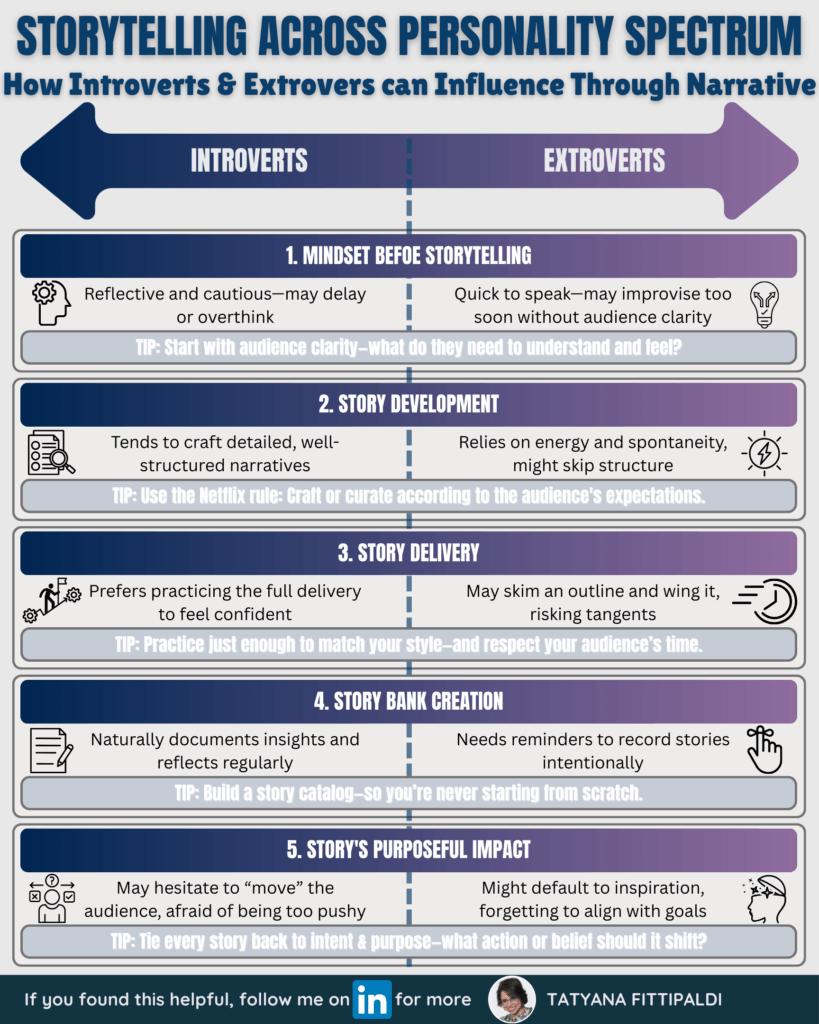
Whether you recharge in solitude or thrive in a buzzing room, one thing is true: storytelling is one of the most powerful tools you can use to influence, inspire, and lead. But how you approach storytelling can vary widely depending on your personality.
Introverts often bring depth, detail, and empathy to their stories—but may spend too much time perfecting every line, overthinking their delivery, or procrastinating sharing the story altogether. They want to get it right and feel authentic—but sometimes the cost is silence.
Extroverts, on the flip side, are usually more comfortable speaking off the cuff. They can create a narrative on the fly and own the room with energy—but they may risk missing the mark if they haven’t taken time to align the story with what the audience truly needs.
So, how do you strike the right balance—no matter your personality type?
Here’s how both introverts and extroverts can level up their business storytelling game:
1. Get Clear On What The Audience Needs To Understand
Before crafting any story, ask yourself two questions:
- What does my audience need to understand?
- What do I need to communicate?
This clarity step is often skipped, especially by extroverts who jump into speaking mode quickly. But without it, your story can feel like an entertaining detour rather than a purposeful tool. For introverts, this step adds confidence—because now the story has direction.
2. Craft A Narrative That Fits The Moment And Purpose
There’s nothing worse than sitting down to watch a feel-good Netflix rom-com… and getting a two-hour action movie with one awkward kiss buried in explosions. Your audience shows up with expectations—meet them.
Craft your story with purpose. Choose structure, tone, and pacing that serve the moment, not just the story. Introverts excel at mapping things out, while extroverts may need to pause and think about fit before jumping in.
3. Practice In A Way That Works For You
Introverts might feel most confident after a full run-through (yes, out loud). It helps with pacing, tone, and feeling grounded. Extroverts may get away with a quick outline review—but be careful: too little prep can lead to wandering stories, storytelling mistakes, or missed punchlines.
Whatever your style, practice with intention. Your delivery should feel real, with your authentic self, not robotic.
4. Build A Story Catalog
Start collecting stories. Seriously—write them down. That time you failed and recovered. A difficult conversation. A surprising success. A leadership moment. These become your catalog of stories—a resource for future presentations, team conversations, or even hallway chats.
Introverts will love this system; it’ll make storytelling feel more accessible when the time comes. Extroverts will find it gives their on-the-fly storytelling more structure and depth.
5. Use Stories To Drive Action
At the end of the day, a story isn’t just a tale—it’s a tool for influence. A well-told story, anchored in meaning and connected to a clear message, can change how people think, act, or feel.
Let me share a story that captures this perfectly.
In ancient China, at the start of a new dynasty, there were rumors that the crown prince might be removed from succession. He was known for being overly benevolent—too soft on punishment, especially when it came to his kin and close allies. The court saw this as a weakness. But one late evening, as the whispers spread, the introverted crown prince quietly went to see the emperor—his father.
The emperor, who was more extroverted and assertive by nature, assumed his son had come to confront him about the rumors.
“Why did you come so late at night?” he stormed.
The prince, unwilling to sound manipulative or inauthentic, simply said:
“Father, I couldn’t sleep. I imagine you might also be as restless with the rumors… so I thought I’d invite you for a game of Go.”
The emperor accepted, assuming the game would become a backdrop for a strategic conversation. But time passed and the game ended—and the prince never once brought up the rumors again.
“You let me win,” the emperor said, reading between the lines.
“Do you think you’ll get away with anything by letting me win?” he challenged.
But the prince stayed calm.
“Father, do you remember when I was a child and learning Go? I always feared losing to you and feeling embarrassed. So you let me win while I was learning—not to deceive me, but to give me confidence. It meant the world to me. Tonight, I sensed you were rattled by the court’s unrest. So I let you win—not to manipulate you, but to offer you the same confidence and solace you once gave me.”
The next morning, the emperor silenced the rumors—publicly granting the prince the tiger tally, the symbol of supreme military command. It was his way of saying: “I trust you.”
The prince never asked for it. He never confronted the emperor directly. But his story—and how he chose to tell it—shifted the emperor’s decision as he realized styles can differ but achieve the same great things.
That’s the power of storytelling. Not just to persuade, but to connect. Not just to perform, but to lead.
Whether you’re quiet and contemplative or bold and spontaneous, you can lead with stories—so long as you know your intent. Influence doesn’t require noise, force, or perfection. It requires purpose, executive presence, and a willingness to meet people where they are.
Communication Books For Introverts And Extroverts
Here are four valuable books to help you foster deeper communication and connection—whether you’re an introvert, an extrovert, or somewhere in between. Each one offers practical insights to improve how you express ideas, build relationships, and lead more effectively across personal, professional, and cultural contexts.
Disclaimer: This section contains product affiliate links. I may receive a tiny commission if you purchase after clicking on one of these links at no additional cost to you. They sponsor my time in researching, vetting and curating, and sharing valuable thought-leadership content. This allows me to provide it without any added expense on your part. Thanks for your support! ❤️️
1. Quiet: The Power of Introverts in a World That Can’t Stop Talking
Author: Susan Cain (2012)
Why it’s valuable:
This modern classic explores the science and cultural framing of introversion, demonstrating how introverts thrive in deep work, thoughtful communication, and impactful contributions. Ideal for introverts looking to understand and leverage their strengths—and for extroverts seeking to appreciate quieter colleagues.
2. How to Work a Room: The Ultimate Guide to Making Lasting
Author: Susan RoAne (1st ed. 1988; updated 2013)
Why it’s valuable:
A timeless resource for extroverts (and anyone) who want to enhance networking confidence and presence in group settings. Packed with step-by-step tactics—from starting conversations to online interaction—it helps refine energetic social behavior into strategic communication.
3. Captivate: The Science of Succeeding with People
Author: Vanessa Van Edwards (2017)
Why it’s valuable:
Grounded in behavioral science, this guide teaches both introverts and extroverts how to decode social cues, build rapport quickly, and become more charismatic and engaging in any context. It bridges behavioral and biological aspects, offering actionable tools to improve conversational impact.
4. Mastering Business Storytelling
Author: Taty Fittipaldi (2025)
Why it’s valuable:
Focused on business influence, this book shows how leaders can craft purposeful narratives, select stories that resonate, and use storytelling to drive action in global and multicultural teams. Introverts will benefit from frameworks and structured approaches, while extroverts will gain tools to ground their energetic storytelling with clear strategy and audience alignment.
Final Thoughts About The Difference Between Introverts And Extroverts
At the core of great leadership lies one powerful truth: the higher you rise, the more adaptable you must become.
In global roles, you’re not just managing people—you’re navigating personality types, cultural contexts and norms, communication styles, and complex expectations that shift across borders and time zones. That requires emotional regulation and intelligence, flexibility, and above all, deep understanding of individual differences. We can’t effectively respond on what we don’t understand.
Whether you’re working with an extroverted manager who thrives on quick brainstorming or an introverted team member who needs space to reflect, influence doesn’t come from speaking louder or faster. It comes from listening actively, recognizing behavioral differences, and adjusting your communication to fit the context—not just the content.
And when it comes to leading those conversations? Stories are your most powerful tool.
They help you bridge differences, clarify purpose, and drive action—when they’re based on clarity and told with intent.
If this article resonated with you, and you’re ready to deepen your leadership through storytelling, communication, and global intelligence—here’s where you can go next:
- 📘 Read my book Mastering Business Storytelling — a field guide for global leaders who want to use stories to influence, connect, and drive success across cultures and industries.
- 📥 Join the 6-Day Business Storytelling Mini-Course — get a powerful storytelling lesson delivered to your inbox each day, with a downloadable PDF including a summary and workbook to help you apply what you learn immediately.
- 🎓 Take the Global Leadership Pillars® — our signature 9-week, self-paced online course designed for emerging leaders who are ready to accelerate their path from first-time manager to global executive.
- 🎙️ Listen to The Leadership Nest Podcast — real stories, real leadership lessons, and deep conversations about what it means to lead across cultures, teams, and continents.
- ✉️ Subscribe to our global leadership newsletter — a weekly dose of bite-sized insights on global leadership, decision-making, cultural competence, and business storytelling—crafted for global executives who want to stay sharp, authentic, and effective.
Wherever you are in your leadership journey, thank you for reading. Let’s keep leading with intention, one story at a time, shall we?