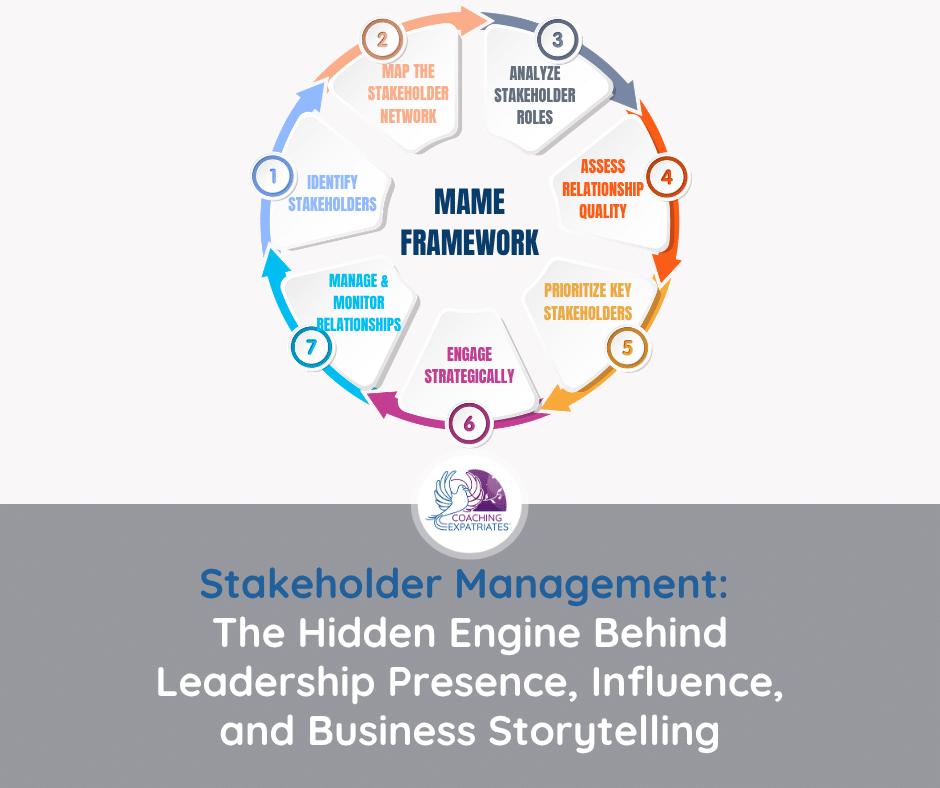
This is a comprehensive guide to stakeholder management and stakeholder mapping for leaders who want to strengthen executive presence, influence, and business storytelling in complex environments.
Stakeholder management is the practice of identifying, mapping, analyzing, engaging, and maintaining relationships with individuals or groups who influence or are affected by a decision or initiative.
This guide explains the most widely used stakeholder mapping models, introduces the MAME Stakeholder Framework, and shows how leaders can strategically map, analyze, engage, and manage stakeholders to accelerate decisions, gain career visibility, and improve executive presence.
Estimated reading time: 60–85 minutes.
Table of Contents
Executive Summary
- Stakeholder management is a core leadership capability that helps increase executive presence.
- Stakeholder mapping reveals influence structures inside organizations.
- Different stakeholder mapping models serve different strategic purposes.
- The MAME framework provides a practical system for applying these models.
- Research shows that leaders who manage stakeholders effectively accelerate decisions, visibility, and career growth.
Why Stakeholder Mapping Is the Backbone of Effective Business Storytelling & Leadership Presence
Effective stakeholder management starts with strong Stakeholder Mapping. Without understanding who your stakeholders are, how they relate to each other, and what they care about, even the best communication and storytelling will fall flat.
In many organizations, stakeholder management is treated as a project management accessory. It lives inside slide decks, project management software, or reporting tools. It shows up during audits, compliance checks, or at the beginning of a change management process. Teams map stakeholders to meet project deadlines, configure stakeholder engagement platforms, or coordinate real-time reporting. Then the map disappears into a shared drive.
I once worked with a client who came to me to develop her executive presence.
Early in the conversation, I asked, “Why do you feel you need more of it?”
She didn’t hesitate. “Because I’m invisible.”
She had been at Deloitte for over a decade, holding the same managerial role. Yet internally, she was the person everyone turned to for guidance, problem-solving, and critical decisions.
So I asked a different question. “Are you familiar with stakeholder management theory?”
She smiled. “Very. I use it all the time.”
I paused, then asked, “How have you been using it to increase your visibility?”
She looked at me, almost surprised. “That’s not what it’s for.”
That moment said everything.
“Tools are not limited by convention,” I told her. “They are defined by how you choose to use them.”
Even pros don’t use stakeholder management tools to their full potential. Using it just for project management is an incomplete approach. What if I tell you that takeholder management can actually be used to achieve multiple other goals? Stakeholder Mapping is not merely a project tool. It is a leadership presence capability.
When leaders treat stakeholder mapping as an operational checkbox, they miss its real value. They reduce it to a diagram instead of recognizing it as a strategic lens. The result is familiar in many corporate environments: great ideas fail to gain traction, strong performers stagnate despite delivering results, initiatives stall in cross-functional friction, and promotions feel opaque or unpredictable.
Often, the issue is not competence. It is calibration.
Leaders communicate clearly. They present strong analyses. They use digital communication tools effectively. They build solid business cases. Yet the impact of their message does not match the quality of their thinking. The root cause is frequently the same: they are communicating well, but to the wrong people, in the wrong way, at the wrong time.
Stakeholder Mapping corrects this misalignment. At its core, Stakeholder Mapping is a structured way to understand the ecosystem around you. It clarifies who your stakeholders are, what they care about, how much influence they hold, how they influence one another, and how your work intersects with their priorities. Stakeholder analysis deepens that understanding by examining motivations, power dynamics, interests, and professional relationships. Stakeholder engagement turns insight into intentional interaction. Stakeholder management sustains alignment over time.
Together, these disciplines form the hidden engine behind leadership presence.
Leadership presence is often described in abstract terms: confidence, gravitas, clarity, executive polish. In reality, leadership presence is deeply situational. It is the ability to read a room, understand what matters to different actors, and speak in ways that resonate across competing interests. It is situational awareness combined with intentional action. That awareness does not emerge from intuition or experience alone. It is strengthened through deliberate stakeholder mapping and analysis.

For global leadership contexts, this becomes even more critical. Different regions, functions, and cultural norms interpret the same message differently. What signals decisiveness in one environment may be perceived as abruptness in another. What demonstrates collaboration in one culture may look like hesitation in another. Stakeholder Mapping supports better cultural intelligence by making those differences visible before they become obstacles.
Stakeholder Mapping also transforms the application of business storytelling skills.
Storytelling in business is not about eloquence. It is about relevance. A compelling narrative is not universally compelling. It becomes effective when it aligns with the interests, concerns, and influence patterns of specific stakeholders. Career advancement storytelling, for example, requires understanding whose perception shapes promotion decisions. Decision-shaping storytelling depends on recognizing who influences approval pathways, not just who signs the final document. Business case storytelling must anticipate both formal authority and informal resistance.
Without stakeholder mapping, storytelling is guesswork. It’s like stopping a random stranger in the middle of the street and sharing a story with them. With stakeholder management skills, though, storytelling becomes precise. It’s like going directly to the U.S. white house to talk to the president of the country.
When leaders map their stakeholders, they can answer critical questions before they speak: Who needs to be persuaded? Who needs to be informed? Who may resist quietly? Who influences the influencer? What objections are likely to surface? Which business goals intersect with each stakeholder’s priorities? These insights shape not only the message but also the sequence and channel of communication, whether through formal presentations, digital communication, or targeted engagement conversations. Ups, I just gave you a billion-dollar secret.
The outcomes are tangible.
Leaders who practice structured stakeholder management and engagement experience higher visibility because their work reaches the right audiences. They achieve faster buy-in because they anticipate concerns instead of reacting to them. They strengthen their executive presence because they demonstrate strategic awareness beyond their immediate function. They gain influence without authority by understanding how networks, not just hierarchies, operate.
In an era of complex organizational structures, cross-functional collaboration, and rapid change, technical expertise is rarely enough. Real-time reporting, sophisticated stakeholder engagement platforms, and detailed project plans support execution. But influence is built on understanding people and systems.
Stakeholder Mapping is the discipline that connects those systems. It is not a political maneuver. It is not manipulation. It is structured influence grounded in awareness.
When leaders treat Stakeholder Mapping as a core strategic thinking capability rather than a compliance exercise, it becomes the backbone of effective stakeholder management, meaningful stakeholder engagement, and sustainable leadership presence. And once stakeholders are mapped, business storytelling stops being a performance skill and becomes a strategic instrument.
In this guide, you will learn how to think about stakeholder mapping as a leadership discipline rather than a project tool. You will understand the distinctions between mapping, analysis, engagement, and management; review the most relevant stakeholder mapping models; and learn how to select and combine them based on real business applications. You will see how stakeholder mapping influences career progression, decision-making, change initiatives, and executive visibility. Finally, you will learn a structured framework to integrate these concepts into action, reinforced by a case study that demonstrates how stakeholder clarity translates into measurable influence.
Stakeholder Mapping, Stakeholder Analysis, Stakeholder Management & Stakeholder Engagement
What’s The Difference And Why Leaders Need All Four
In executive conversations, these four terms are often used interchangeably: Stakeholder Mapping, Stakeholder Analysis, Stakeholder Engagement, and Stakeholder Management. They sound similar, and in practice, they are deeply connected. But they are not the same.
When leaders blur these distinctions, they either overcomplicate simple interactions or oversimplify complex ones. The result is miscalibrated influence. Understanding the difference between these four disciplines is not semantic precision. It is strategic clarity.
Let’s define and separate them.
What Is Stakeholder Management?
Stakeholder management is the structured practice of identifying, mapping, analyzing, engaging, and maintaining relationships with individuals or groups who influence or are affected by a decision, initiative, or organization. The concept of stakeholder management originates from stakeholder theory developed by R. Edward Freeman (1984), which emphasizes that organizations must consider the interests of all parties affected by their decisions.
Effective stakeholder management begins with stakeholder mapping and evolves into continuous engagement and relationship management. To achieve this, let’s learn the 4 key disciplines governing this process.
Discipline 1: Stakeholder Mapping
Definition: Stakeholder Mapping is the structured visualization of your stakeholder ecosystem.
It answers the question: Who is involved, and how are they positioned relative to this initiative, decision, or goal?
Mapping is about making the invisible visible. It typically involves identifying individuals or groups connected to a project, business goal, role transition, or organizational change. It may use tools such as a power–interest grid, influence diagrams, geographic distribution maps, or network-based representations.
The focus management technique here is structural awareness. When you practice Stakeholder Mapping, you are not yet deciding what to say or how to engage. You are clarifying:
- Who holds formal authority
- Who holds informal influence
- Who is directly impacted
- Who can accelerate or slow progress
- How stakeholders relate to one another
Mapping provides the visual architecture of influence. Without it, stakeholder management becomes reactive and fragmented.
Discipline 2: Stakeholder Analysis
Definition: Stakeholder analysis examines motivations, power dynamics, interests, perceptions, and relationships within the mapped ecosystem.
If mapping tells you who is in the system, stakeholder analysis tells you what drives them and how they behave within it.
Stakeholder analysis deepens understanding by asking:
- What does this stakeholder care about?
- What are their incentives?
- How does this initiative intersect with their priorities?
- What risks or benefits do they perceive?
- Who influences their opinion?
This is where leadership presence begins to sharpen. Leaders who engage in stakeholder analysis develop situational awareness beyond job descriptions. They recognize that decisions are shaped not only by data, but by perceived impact, reputation considerations, and power structures.
Mapping without analysis produces a diagram.
Mapping with analysis produces insight.

Discipline 3: Stakeholder Engagement
Definition: Stakeholder engagement is the intentional interaction strategy you design based on mapping and analysis.
If mapping clarifies structure and analysis clarifies motivation, engagement determines action.
Stakeholder engagement answers:
- Who needs proactive conversation?
- Who needs to be informed?
- Who requires persuasion?
- Who should be involved early to reduce resistance?
- Who needs stronger psychological safety before conversations?
- Through which channel — formal presentation, one-on-one meeting, digital communication, informal check-in?
Engagement is not manipulation. It is calibrated communication. It aligns message, timing, and delivery with stakeholder context and preferences.
In environments driven by digital communication, real-time reporting, and distributed teams, engagement must also consider channel selection. Some stakeholders respond best to structured decks. Others respond to short working sessions. Some require early involvement in a change management process. Others need clarity once decisions are formed.
Without stakeholder engagement, insight stays theoretical.
Discipline 4: Stakeholder Management
Definition: Stakeholder management is the ongoing orchestration of relationships, expectations, and alignment over time.
It is not a one-time exercise. It is sustained coordination.
Stakeholder management integrates mapping, analysis, and engagement into a continuous process. It tracks evolving priorities, updates assumptions, monitors relationship quality, and adjusts strategy as projects mature or organizational dynamics shift.

In complex environments, stakeholder management often intersects with project management systems, communication management plans, and reporting structures. But unlike operational tracking, stakeholder management focuses on perception and alignment.
Stakeholders change roles. Influence shifts. New actors enter the ecosystem. Without ongoing management, yesterday’s accurate map becomes today’s blind spot.
Why Leadership Presence Requires All Four
Leadership presence is often reduced to confidence or executive polish. In reality, it is the combination of situational awareness and intentional action.
Situational awareness emerges from mapping and analysis.
Intentional action emerges from engagement and management.
Each discipline supports the other.
- Mapping without managing becomes an intellectual exercise.
- Managing without analysis creates political blindness.
- Engagement without mapping feels random and inconsistent.
- Analysis without engagement stalls progress.
Leaders who excel in stakeholder management are rarely the loudest voices in the room. They are the ones who understand how influence flows. They anticipate concerns before they surface. They align crucial conversations with stakeholder priorities. They adjust strategy as the ecosystem evolves.
In global leadership contexts, this integration becomes even more important. Cultural expectations, reporting lines, informal networks, and geographic distribution complicate stakeholder relationships. A structured approach to Stakeholder Mapping and stakeholder analysis strengthens cultural intelligence and reduces unintended friction.
When these four disciplines work together, communication becomes strategic rather than reactive. Stakeholder engagement becomes purposeful rather than ad hoc. Stakeholder management becomes a capability rather than an administrative task.
And leadership presence stops being performative. It becomes calibrated.
Before we get to the juicy part, let’s give a quick nod to the research aficionados with a few studies and data points worth knowing.
What Research Says About Stakeholder Management
Research does not limit stakeholder management to project execution. Across leadership, strategy, and organizational behavior, evidence shows that understanding, prioritizing, and actively managing relationships with key stakeholders improves leadership effectiveness, decision quality, and career outcomes.
First, research consistently links stakeholder-oriented leadership with stronger organizational outcomes and leadership effectiveness. Foundational work by R. Edward Freeman and subsequent empirical studies show that organizations perform better when leaders consider and balance the interests of multiple stakeholders rather than focusing narrowly on shareholders. For example, the Academy of Management Journal study Does Stakeholder Orientation Matter? found that stakeholder management models are associated with firm performance outcomes. More broadly, stakeholder theory emphasizes that organizational success depends on aligning the interests of multiple parties, not optimizing for one group alone. (This translates into: if you are only focusing on your boss alone, you’re not doing this right.)
Second, research shows that stakeholder prioritization is not just a project tool but a real managerial decision process. Studies on stakeholder theory and decision-making highlight that managers routinely balance competing stakeholder interests when making organizational decisions, both in policy design and day-to-day choices. This reinforces that stakeholder analysis is embedded in leadership judgment, not limited to formal project environments.
Third, adjacent research demonstrates that when individuals enter new roles, proactive relationship-building and information-seeking improve adjustment and performance. A large meta-analysis of newcomer socialization found that behaviors such as seeking information and building relationships significantly improve job satisfaction, commitment, and performance outcomes. While not labeled as stakeholder mapping, these behaviors reflect the same underlying discipline: understanding the people, dynamics, and expectations in a new environment.
Finally, research on social capital, networking, and collaboration shows that managing relationships systematically improves career outcomes and effectiveness across levels. Studies in stakeholder and collaboration networks demonstrate that individuals positioned centrally in networks—those who build and maintain key relationships—achieve higher performance, greater influence, and increased access to opportunities. This aligns with decades of research showing that professional relationships, mentoring, and boundary-spanning capabilities are critical drivers of career progression and leadership impact.
Taken together, the evidence is clear: stakeholder management is not just a project discipline. It is a broader leadership capability grounded in how individuals understand, prioritize, and engage the people who shape outcomes.
In the next section, we will explore how boundary-spanning calibration directly connects to managing up — and why structured stakeholder mapping often accelerates career progression more than technical expertise alone.
Stakeholder Mapping As A Core Component Of “Managing Up”
Few leadership topics generate as much quiet discomfort as “managing up.” For some, the phrase evokes manipulation, politics, or strategic self-promotion. For others, it signals ambition or calculated visibility.
In reality, managing up is neither manipulation nor performance. Managing up is proactive alignment between you and your manager around goals, expectations, and outcomes.
The first time someone reframed it this way, it honestly caught me off guard. How can something so simple feel so different?
To me, managing up always meant “diplomatically dealing with difficult bosses.” That was the working definition in my head. So how does that even come close to proactive alignment?
Here’s the ace in the hole: managing up does not focus on personality traits. It focuses on defining and achieving a clear relationship goal.
And once you shift to that lens, everything changes.
Because now, it has everything to do with proactive alignment—and very little to do with managing personalities.
When practiced with integrity, managing up is the disciplined effort to understand how your work intersects with the goals, priorities, pressures, and perceptions of those who influence your career trajectory. It requires awareness of formal reporting lines, informal influence networks, and the broader leadership pipeline model that shapes advancement within your organization.
And stakeholder mapping sits at the center of that awareness.
What Managing Up Actually Means
Managing up does not mean flattering senior leaders or bypassing authority. It does not mean selectively curating information to protect your image. It is not about politics in the pejorative sense. It is about recognizing that performance exists within an ecosystem.
Every organization operates through layered influence. Decisions about promotions, high-visibility projects, and leadership pipeline progression are rarely made based on output alone. They are shaped by perception, cross-functional trust, and social acceptance within key leadership circles.
Managing up, at its core, is the structured effort to:
- Understand how decision-makers define impact
- Align your contributions with strategic priorities
- Reduce misinterpretation of your intent or results
- Ensure your work is visible to those who matter
This requires more than working hard. It requires mapping influence.
Stakeholder Mapping makes that influence visible.
Why Managing Up Is A Career Accelerator
Strong performers sometimes assume that exceptional output will speak for itself. In reality, output must be interpreted.
Leaders are not promoted only for what they deliver. They are promoted for the perceived impact of what they deliver. Perception shapes reputation. Reputation shapes opportunity. This is where stakeholder prioritisation becomes critical.
If you do not know whose perception influences your progression within the leadership pipeline model, you cannot align your communication effectively. Your direct manager may advocate for you, but their advocacy may depend on how other stakeholders interpret your collaboration, reliability, and strategic thinking.
I once worked with a client who wanted to let go of a chronically underperforming employee. The issue was not minor. At one point, production operations halted for nearly 24 hours due to this individual’s decisions, resulting in significant financial loss in a single day. From a business standpoint, the case seemed clear.
Yet she hesitated.
When I asked what was holding her back, she said, “They don’t want to let him go.”
“Who are ‘they’?” I asked.
She couldn’t answer.
She had no visibility into which stakeholders were influencing the decision, what their concerns were, or how much weight her recommendation carried in the broader system. As a first-time global manager, she assumed her authority alone should be enough. But authority is rarely the only variable.
Once we mapped her stakeholders, analyzed their motivations, and clarified relationship quality, the picture changed. “They” were not protecting poor performance. They were evaluating her. Senior leaders wanted to see whether she could manage and develop a difficult employee before escalating to termination.
The issue was not resistance. It was misalignment of expectations.
After identifying the key decision-makers and understanding what they valued, she reframed her recommendation. She positioned it not as a reaction to frustration, but as a measured conclusion based on structured development attempts, operational risk, and business impact. She engaged the right stakeholders directly, clarified her process, and demonstrated leadership maturity.
The outcome shifted. Not because the facts changed — but because perception was recalibrated with precision.
Managing up accelerates careers because it reduces ambiguity. It’s that simple.
It ensures that:
- Decision-makers understand the value you and your recommendations create
- Influencers reinforce rather than dilute your contributions
- Your work is contextualized within broader business goals
Without Stakeholder Mapping, managing up becomes reactive. With it, managing up becomes structured and intentional.

How Stakeholder Mapping Enables Managing Up
Stakeholder Mapping clarifies three critical dimensions of career influence.
First, it identifies whose perception matters. This includes formal decision-makers, informal influencers, cross-functional partners, and sponsors whose endorsement shapes advancement conversations.
Second, it reveals who influences those perceptions. In many organizations, influence flows laterally as much as vertically. A peer with strong credibility may shape how senior leaders interpret your work. A cross-functional partner may indirectly influence how your manager frames your contributions.
Third, it highlights gaps in relationship quality. You may deliver strong results yet remain unknown to key stakeholders. You may be respected in your function, but invisible in another vertical that influences promotion pathways.
When these insights are mapped, storytelling becomes calibrated.
Career advancement storytelling is not about self-promotion. It is about structured visibility. Let me explain: it involves communicating results in ways that connect to stakeholder priorities, anticipating questions, and sequencing conversations strategically. Stakeholder Mapping supports this by connecting mapping → analysis → engagement → perception shaping.
Instead of hoping your work will be noticed, you design engagement intentionally. You share updates aligned with business objectives. You contribute in forums where influence concentrates. You build credibility with those who shape decision narratives.
In this sense, managing up is not political maneuvering, as mentioned. It is disciplined alignment within your social system.
Leaders who approach managing up through structured stakeholder mapping often experience greater clarity around career movement. They understand which relationships to strengthen, which conversations to initiate, and how to position their contributions in ways that resonate across the organization.
That clarity strengthens not only advancement but leadership presence. When leaders demonstrate awareness of how influence operates — and engage accordingly — they are perceived as strategic rather than reactive.
And in competitive environments, that perception matters.
Why Stakeholder Mapping Matters At Every Career Stage
Stakeholder Mapping is often introduced as a project management discipline. It appears in RACI Matrix discussions, RAPID Decision-Making tools, RACI analysis workshops, project scope meetings, or inside project management software alongside reporting tools and project schedule templates. In those environments, it supports execution clarity.
But I’m proposing here that stakeholder management is not confined to projects. It scales with your career. Whether you are an individual contributor, an entry-level manager, a manager of managers, or a senior executive, the complexity of your stakeholder ecosystem expands as your influence expands. The leadership pipeline model — often referenced by the Leadership Pipeline Institute — suggests that each career transition requires a shift not only in skills, but in perspective. Stakeholder awareness is one of the most underdeveloped perspective shifts across levels.
Let’s examine how it evolves.
💼 Individual Contributor
At the individual contributor level, the most common blind spot is narrow visibility.
Many professionals assume that their direct manager is their primary stakeholder. If they deliver high-quality work on time, manage deadlines effectively, and use reporting tools accurately, they expect recognition to follow. But visibility rarely flows automatically.
Even at this stage, your stakeholders include:
- Cross-functional partners who rely on your output
- Internal clients, such as Customer Care teams, who experience the downstream impact of your work
- Project leads or peers in other departments who interpret your responsiveness and reliability
- Influencers who shape how your manager perceives your contribution
The blind spot is assuming that execution equals recognition. Let me be very clear: it does not.
I often share the following analogy with my clients to help shift this perception. Imagine your son, who is very intelligent, creates a brilliant science project and writes a strong report with his insights. It is, by far, the best project his school has ever seen.
But he does not win the science contest.
Why?
Because he never submitted his project or report for evaluation.
At that point, it doesn’t matter how good the work is. It was never seen, never assessed, never compared. Recognition requires exposure to the people who decide what gets recognized.
The same applies at work.
You cannot be recognized for work that is not visible, understood, and connected to the right stakeholders.
Execution alone does not create recognition. Communicated execution does.
Beyond recognition, stakeholder Mapping at this level clarifies whose perceptions influence access to stretch assignments, lateral moves, or inclusion in high-impact initiatives. It reveals whether your expertise is known beyond your immediate team and whether your contributions are connected to broader business outcomes.
Storytelling implications are significant. As an individual contributor, your stories should not only describe tasks completed, but business value created. When you understand stakeholder priorities, you can position updates in ways that resonate with strategic goals rather than technical detail.
Visibility beyond your direct manager is rarely accidental. It is structured.
💼 Entry-Level Manager
When professionals transition into their first management role, the stakeholder landscape expands quickly. The blind spot here is assuming that authority replaces relationship-building.
New managers often focus heavily on operational performance: meeting project scope, managing budgets, coordinating tasks within project management software, and ensuring deadlines are met. They may use RACI matrices to clarify responsibility and optimize workflow.
But leadership is no longer confined to task coordination.
Stakeholders now include:
- Direct reports with different motivations and expectations
- Peers across functions
- Senior leaders evaluating leadership potential
- Informal influencers within and outside the team
Cross-functional credibility becomes critical. Trust building becomes a performance variable, not a soft skill.
Stakeholder Mapping at this level clarifies who must be aligned for initiatives to move smoothly. It reduces friction between departments and prevents misinterpretation of decisions. It also highlights where relationship quality may be weak, even if operational output is strong.
Storytelling implications shift as well. Entry-level managers must learn to communicate decisions in ways that reflect both team impact and enterprise alignment. Their narratives should demonstrate not only execution competence but awareness of stakeholder interests.
Managing up becomes relevant here, even if informally. Understanding how senior leaders interpret your leadership style shapes how you present progress and frame challenges.
💼 Manager Of Managers
At the manager-of-managers level, complexity multiplies.
The blind spot is underestimating systemic tension.
Leaders at this stage often navigate competing priorities across departments, resource constraints, and overlapping project scopes. They may rely on reporting tools and structured dashboards to maintain oversight. However, dashboards do not reveal influence dynamics.
I once stepped into a regional leadership role where my first assignment from my global boss was direct and data-driven: reduce headcount. According to his dashboard, our region’s revenue per headcount was significantly misaligned with other regions. On paper, we appeared inefficient. The numbers were clear.
But dashboards rarely tell the whole story.
In our region, the finance team was not responsible only for finance. We were also covering legal, HR, IT coordination, sourcing, EHS, and property management. Those responsibilities were embedded in our structure but invisible in the global reporting view. If I had accepted the dashboard at face value, talented employees would have been let go to solve what looked like a cost-efficiency problem.
Instead, I mapped stakeholders.
I identified which global vertical leaders owned each of those functional areas, analyzed how headcount allocation affected their objectives, and assessed who influenced the final decision. Then I initiated targeted conversations — not to resist the directive, but to clarify the structural misalignment.
Through a structured managing-up effort, the conversation shifted. The assignment was reframed from “reduce headcount” to “recast headcount into the appropriate vertical structures.”
Each function recognized the operational benefit of having properly allocated resources, even if it meant adjusting reporting lines and absorbing additional coordination complexity. Ultimately, no high-performing employees were let go. They were repositioned.
The dashboard had not been wrong. It had simply been… incomplete.
That experience reinforced a lasting lesson: oversight tools provide data, but stakeholder management provides context. Without mapping and managing influence, incentives, and structural realities, leaders risk optimizing metrics while misreading systems.
Here’s the bottom line I want to make from this story: stakeholder identification becomes less about identifying names and more about mapping power, influence, and interdependencies.
Stakeholders at the manager of managers level include:
- Other functional leaders with overlapping mandates
- Sponsors of major initiatives
- Senior executives evaluating strategic thinking
- Groups affected by resource allocation decisions
Organizational navigation becomes a core capability. Stakeholder prioritisation is no longer optional; it determines where energy is invested.
At this stage, storytelling becomes narrative shaping. Leaders must articulate how competing initiatives align with enterprise strategy. They must anticipate resistance and address it proactively. They must frame trade-offs transparently while maintaining credibility.
Stakeholder analysis helps them understand not just who holds power, but how influence travels through networks. Without this awareness, leaders may misread silence as agreement or misinterpret pushback as opposition rather than genuine concern.
💼 Senior & Top Leadership
At senior and top leadership levels, Stakeholder Mapping operates at the enterprise scale. The blind spot here is assuming that formal authority ensures alignment. Senior leaders operate within complex political landscapes shaped by boards, regulators, investors, global teams, and cross-functional executives. Stakeholder management intersects with strategy, culture, workforce pipelines, and long-term positioning. Enterprise alignment becomes the priority.
Stakeholders at this level may include:
- Executive peers
- Board members
- External partners
- Global regional leaders
- Influential internal groups
Mapping now involves assessing influence pathways, cultural nuances, geographic distribution, and risk exposure.
Narrative shaping becomes a central responsibility. Senior leaders do not simply report outcomes. They shape how initiatives are interpreted across the organization. They align messaging with business goals while maintaining credibility across diverse stakeholder groups.
At this level, stakeholder engagement supports not only project success but organizational coherence. The ability to anticipate reactions, calibrate communication, and manage evolving relationships strengthens executive presence more than technical expertise alone.
So Say We All
Across all career stages, the pattern is consistent. As responsibility expands, so does stakeholder complexity. Stakeholder Mapping evolves from a tactical visualization tool to a strategic leadership discipline. It strengthens stakeholder management, enhances stakeholder engagement, and deepens situational awareness across the leadership pipeline model.

Whether you are seeking opportunity access as an individual contributor, building cross-functional credibility as a new manager, navigating systemic tension as a manager of managers, or shaping enterprise narrative as a senior leader, your influence depends on understanding the ecosystem around you.
Execution builds output. Stakeholder awareness builds impact. Imagine what you can get by mixing both?
Business & Career Benefits Of Stakeholder Mapping And Management
When Stakeholder Mapping is finally treated as a leadership discipline rather than a project formality, its impact extends far beyond documentation. It strengthens both business outcomes and career progression.
At the business level, structured stakeholder management improves project success across the entire initiative lifecycle. While stakeholder management software and dashboards can track milestones and deadlines, they cannot anticipate resistance, surface hidden concerns, or clarify influence pathways. That work happens through mapping and analysis.
One of the most immediate business benefits is faster decision-making. When stakeholders are mapped and prioritized in advance, leaders know who must be consulted, who must be aligned early, and who simply needs updates. Meetings become more focused. Conversations happen in the right sequence. Approval pathways shorten because objections are addressed before they escalate.
Reduced resistance is another tangible outcome. Resistance rarely appears without warning. It often reflects misalignment, unaddressed concerns, or competing incentives. Stakeholder Mapping helps leaders anticipate these friction points and engage stakeholders proactively. As a result, initiatives experience higher adoption and smoother implementation.
Cross-functional execution also improves. When leaders understand how different teams define success, they tailor communication accordingly. They clarify expectations, align deliverables with shared business goals, and avoid unnecessary conflict. Stakeholder engagement plan becomes intentional rather than reactive.
These business benefits naturally translate into career benefits.
Visibility increases when your work reaches the right audiences. Instead of hoping that results circulate organically, leaders with strong stakeholder awareness ensure their contributions are contextualized for decision-makers. Project approvals come more smoothly because key stakeholders are already aligned. Invitations to strategic conversations increase because peers recognize you as someone who understands the broader system.
Promotions accelerate not only because of output, but because of perceived impact. Leaders who demonstrate awareness of stakeholder dynamics are seen as enterprise-minded. They are viewed as capable of navigating complexity, not just executing tasks.
Sponsorship also becomes more likely. Sponsors invest in individuals whose judgment they trust and whose influence extends beyond a single function. Structured stakeholder management builds stronger professional relationships and allies over time. It clarifies where trust is strong, where it needs reinforcement, and where new connections should be cultivated.
Mobility improves because your reputation travels. When stakeholders across verticals understand your contributions, opportunities surface more organically. Influence expands because more actors see you as aligned with business priorities.
In everyday practice, these benefits show up in concrete ways:
- Meetings where decisions are made instead of deferred
- Project approvals that require fewer escalation cycles
- Promotions that feel coherent rather than opaque
- Invitations to initiatives beyond your formal scope
Stakeholder Mapping does not guarantee outcomes. It strengthens the probability of alignment through strategic stakeholder relationship management. And alignment, over time, compounds into influence.
When Should You Map Your Stakeholders? (Applications Beyond Project Management)
When I first address this topic with my clients, many professionals associate stakeholder management with the beginning of a project lifecycle. They tell me it appears in planning documents, stakeholder management software, and structured communication plans designed to improve project success. Once execution begins, attention often shifts back to dashboards, reporting tools, and delivery milestones.
Then I shake their grounds. “But stakeholder management is not a project phase. It is a leadership discipline beyond projects. Why stop it there?”
While Stakeholder Mapping and stakeholder analysis provide structural clarity, stakeholder management integrates those insights into ongoing alignment, influence, and engagement. It becomes most powerful not inside project templates, but at moments where perception, decision-making, and strategic positioning intersect.
So here’s the billion-dollar secret: stakeholder management should be activated whenever influence matters—not only when a project begins.
Think about something simple. When you are thirsty and want to drink water, what happens? You don’t just think about water. You think, “I need a glass.”
Influence is to water as stakeholder management is to the glass. Without the glass, the water exists, but you can’t actually use it. Without stakeholder management, influence exists, but it doesn’t reach the people who matter.

Below are the most common applications where structured stakeholder communication shifts outcomes.
📍Mapping Stakeholders For: Career Advancement
Trigger moment: You are preparing for a promotion conversation, performance review, or informal advancement opportunity.
Many professionals approach advancement as a performance summary exercise. They focus on deliverables, metrics, and results.
Effective stakeholder management reframes the exercise — beginning with structured Stakeholder Mapping.
Mapping purpose: Identify whose perception influences advancement decisions, who informs those decision-makers, and where your relationship quality stands.
In most organizations, promotions are shaped by more than your direct manager. Sponsors, cross-functional leaders, and informal influencers contribute to advancement conversations. Stakeholder analysis clarifies whose voice carries weight and how alignment is formed.
Business impact: Advancement decisions align more closely with leadership expectations, reducing surprises and misinterpretations.
Career impact: You gain clarity on which relationships to strengthen and how to position your contributions in ways that resonate across the stakeholder ecosystem.
Career storytelling becomes calibrated rather than generic because you tell the same story through the lens that your audience needs to understand and recognize value. You know what to say and why to say it to advance your career.
📍Mapping Stakeholders For: Gaining Visibility
Trigger moment: You want your work to be recognized beyond your immediate team.
Visibility is often assumed to be a byproduct of strong execution. In reality, it is shaped by a structured stakeholder engagement plan that aligns with your leadership branding at every step, in very strategic ways.
Strong stakeholder management begins by identifying which forums, leaders, and cross-functional partners influence reputation and narrative flow.
Mapping purpose: Determine who amplifies others’ work, who sits at the center of informal networks, and where perception is formed.
Stakeholder analysis reveals not just formal authority, but informal influence.
Business impact: Your contributions are contextualized in ways that support enterprise priorities and cross-functional collaboration.
Career impact: Increased invitations to strategic initiatives, stronger positioning for stretch assignments, and greater trust from senior stakeholders.
Visibility becomes intentional, not accidental.
📍Mapping Stakeholders For: Decision Buy-In
Trigger moment: You need alignment on a proposal, recommendation, or strategic direction.
Leaders often concentrate on refining the final presentation. They polish slides, anticipate objections, and perfect their argument. Stakeholder management shifts attention to what happens before the meeting.
In the headcount restructuring story I shared earlier, guess who actually “sold” the idea before it was ever presented in the formal meeting?
It wasn’t me. It was the leaders from the other verticals.
Before asking my global boss to shift the directive from “reduce headcount” to “recast headcount into the appropriate vertical structures,” I mapped the relevant stakeholders and engaged them individually. Each vertical leader had a clear incentive: properly allocated resources would strengthen their function. Once they understood the structural misalignment and saw the benefit, alignment formed naturally.
I then asked several of them to speak informally with my boss ahead of the official discussion.
By the time the formal meeting took place, the idea was no longer new. It had already circulated. It had already been evaluated. It had already gained credibility.
What appeared to be persuasion in the room was, in reality, the final step of structured stakeholder management.
The outcome shifted not because my arguments were eloquent, but because alignment had been built way in advance.
Mapping purpose: Identify who must be aligned in advance, who influences dissent, and whose endorsement signals legitimacy.
Stakeholder engagement in this context involves sequencing conversations strategically rather than delivering a single message in a formal forum.
Business impact: Faster decisions, fewer escalation cycles, and clearer ownership.
Career impact: You are perceived as strategic and proactive rather than reactive.
Buy-in becomes the result of preparation and structured alignment — not persuasion alone.
📍Mapping Stakeholders For: Selling A Business Case
Trigger moment: You are proposing an investment, budget request, or structural adjustment.
Business cases often emphasize financial projections and operational efficiency. Yet stakeholder management recognizes that financial logic alone rarely secures approval.
Mapping purpose: Understand how the proposal affects different stakeholders’ incentives, risk exposure, performance metrics, and perceived impact.
Stakeholder analysis may reveal that while a proposal strengthens long-term project success, it creates short-term tension for certain groups. Mapping these dynamics allows you to address concerns proactively.
Business impact: Higher adoption rates and smoother implementation once approved.
Career impact: Strengthened credibility as a leader who balances analytical rigor with relational awareness.
Business storytelling becomes tailored to stakeholder priorities rather than delivered as a one-size-fits-all pitch.
📍Mapping Stakeholders For: Driving Change / Transformation
Trigger moment: You are leading or contributing to a change management process.
Transformation initiatives often rely on communication plans and structured reporting tools. However, sustainable change depends on stakeholder management quality.
Effective stakeholder management in transformation contexts begins with Stakeholder Mapping and stakeholder analysis — identifying champions, skeptics, informal influencers, and groups most affected by the change.
Mapping purpose: Clarify power, influence, perceived risk, and cultural dynamics across the ecosystem.
Business impact: Reduced resistance, stronger adoption, and fewer implementation delays across the project lifecycle.
Career impact: You are recognized as capable of navigating complexity rather than simply executing directives.
Change becomes structured alignment rather than forced compliance.

📍Mapping Stakeholders For: Entering A New Role
Trigger moment: You assume a new position, whether through promotion, lateral movement, or external hire.
New leaders often begin by reviewing dashboards, financial metrics, and operational performance indicators. These tools provide useful data, but stakeholder management requires more than numerical oversight.
Mapping purpose: Clarify influence pathways, relationship quality, informal networks, and perception gaps. Identify who defines success in your role and how expectations differ across stakeholders.
Entering a role without stakeholder analysis increases the risk of early misalignment. Silence may be misread as agreement. Informal influencers may be overlooked.
Business impact: Faster integration, clearer alignment with business goals, and improved execution stability.
Career impact: Stronger early credibility and smoother transition into leadership authority.
The Key Application Insight
Across these applications, the pattern is consistent. Stakeholder management strengthens “project” success, but its real leverage lies in shaping perception, influence, and alignment across the stakeholder ecosystem. Stakeholder Mapping and stakeholder analysis are foundational steps — but without ongoing engagement and management, insight remains unused.
When stakeholder management becomes part of your leadership discipline rather than a project artifact, it transforms career progression, decision-making, and organizational change from reactive efforts into structured influence. The question is not whether stakeholder management belongs in project documentation. The question is whether it has become embedded in how you lead.
Risks In Stakeholder Mapping (And Their Consequences)
Effective stakeholder management strengthens alignment and influence. But like any leadership discipline, it can be underused, misapplied, or misunderstood. These risks do not usually emerge as dramatic failures. More often, they show up as stalled initiatives, avoidable friction, or erosion of trust.
Understanding stakeholder risk is not about anticipating catastrophe. It is about recognizing where misalignment quietly compounds.
☠️ Risk: Not Mapping At All
The most common risk is not mapping stakeholders at all.
Project managers may rely on structured communication strategies, reporting tools, or stakeholder management software, assuming that formal channels are sufficient. Meetings are scheduled. Updates are shared. Deliverables are tracked. But without a Stakeholder map, influence pathways remain unclear.
Consequences typically include:
- Surprises in approval forums
- Late-stage objections
- Conflicting stakeholder expectations or power struggles
- Delays in project success across the project lifecycle
When stakeholder management begins only after resistance appears, leaders are reacting rather than aligning. Stakeholder engagement becomes defensive instead of proactive.
I once began coaching a client who had just been promoted into a high-visibility Senior Vice President role. She was now responsible for billion-dollar initiatives with global impact.
In our first session, I asked a simple question: “What are your key stakeholders’ top priorities?”
Her response was honest: “It’s confusing.”
It felt confusing because she had no structured Stakeholder map. She sensed political tension. She knew there was conflict between functions. But she could not articulate who wanted what, who stood to gain or lose from each project, or how influence flowed across regions.
The conflict was not irrational. It was just unmapped.
We began with structured stakeholder mapping and analysis. We identified the relevant stakeholders, clarified their positions, examined the financial implications for each vertical, and assessed what each group perceived as risk or opportunity. Once those dynamics were visible, the tension became explainable.
Instead of entering formal decision forums defensively, she began sharing a clear priority narrative in informal conversations with key stakeholders. She acknowledged competing incentives and framed her recommendation in terms of where and how everyone would win. The conflict did not disappear overnight. Of course not. But it shifted from confusion to structured negotiation.
When influence is unmapped, tension feels political and “confusing.” When it is mapped, it becomes manageable because it also becomes negotiable.
☠️ Risk: Wrong Assumptions
A stakeholder matrix or stakeholder analysis tool is only as accurate as the assumptions behind it.
Leaders may misjudge who holds real influence, underestimate informal networks, or assume alignment where tension exists. They may interpret silence as agreement or mistake compliance for commitment.
Consequences include:
- Misaligned communication strategies
- Overconfidence in stakeholder support
- Erosion of trust when concerns surface later
- Decisions shaped by incomplete information
Stakeholder theory reminds us that organizations operate as interconnected systems. Power is not always visible. Influence is not always formal. Human feelings, reputation, and perceived fairness shape behavior as much as reporting lines do.
Stakeholder management requires curiosity, not certainty.
☠️ Risk: Not Updating The Map
Stakeholder ecosystems evolve. Roles change. Priorities shift. New stakeholders emerge. Influence patterns move over time. A stakeholder map that was accurate at the beginning of an initiative may become outdated halfway through. Failing to update stakeholder analysis creates blind spots.
Consequences may include:
- Engaging the wrong decision-makers
- Escalating issues to individuals whose influence has declined
- Overlooking new actors who shape perception
- Reduced project success due to outdated alignment assumptions
Stakeholder management is ongoing orchestration, not a one-time exercise.
☠️ Risk: Mapping But Not Using It
Some leaders create a stakeholder map as part of formal documentation, then never integrate it into actual engagement decisions. The map becomes a slide. The stakeholder matrix becomes a template. The analysis remains theoretical.
Consequences include:
- Engagement that feels generic
- Communication strategies that ignore stakeholder priorities
- Missed opportunities to build sponsorship or alliance partnerships
- Misalignment between stated intentions and stakeholder experience
Mapping without engagement is incomplete. Stakeholder management requires translating insight into calibrated action.
☠️ Risk: Treating It As Political Manipulation
Perhaps the most damaging risk is framing stakeholder management as manipulation.
When leaders treat Stakeholder Mapping as a way to “work the system,” trust erodes. Stakeholders sense when engagement is transactional rather than aligned with shared goals. Ethical stakeholder management is not about controlling outcomes. It is about clarifying expectations, anticipating impact, and reducing misinterpretation.
Consequences of manipulative framing include:
- Damaged relationships
- Reduced credibility
- Resistance masked as agreement
- Long-term reputational risk
Stakeholder engagement grounded in transparency and relational maturity strengthens influence over time. Engagement rooted in short-term advantage weakens it.
Avoiding The Risks
Stakeholder management does not eliminate complexity. It just makes complexity visible.
When leaders approach Stakeholder Mapping and stakeholder engagement with disciplined awareness, that is, updating assumptions, integrating analysis, and engaging ethically, they reduce stakeholder risk not by avoiding tension but by aligning systems. Alignment, when sustained, compounds into durable influence.
Stakeholder Mapping Models: An Overview
Stakeholder Mapping is not a single technique. It is a family of structured approaches within stakeholder management that help leaders visualize, analyze, and prioritize stakeholder relationships.
Across stakeholder theory and practical project stakeholder management disciplines, different models emphasize different dimensions of the stakeholder ecosystem. Some focus on power. Others, on interest. Others, on influence, urgency, cultural dynamics, or behavioral predictability.
No single model fits all situations.
The Power–Interest Grid may be ideal for early-stage prioritization. A Stakeholder Influence Diagram may better reveal indirect persuasion routes. A Power–Dynamism Matrix may surface volatility risk in times of organizational change. Advanced stakeholder management processes often combine models to increase clarity without oversimplifying complexity.
The purpose of this overview is not to overwhelm you with tools. It is to help you understand:
- What each model is
- What dimension does each prioritize
- What it reveals about stakeholder behavior
- When it is most useful
When applied deliberately, these models strengthen stakeholder communication, stakeholder engagement strategy, and overall stakeholder management effectiveness across the initiative lifecycle.
Power–Interest Grid

The Power–Interest Grid, commonly known as the Mendelow Matrix, was introduced by Aubrey L. Mendelow (1991) as one of the most widely used stakeholder mapping models, designed to prioritize stakeholders based on their power and level of interest (Mendelow, A. L., 1991, Stakeholder Mapping, Proceedings of the 2nd International Conference on Information Systems). It remains one of the most widely used stakeholder mapping frameworks due to its simplicity and immediate applicability across leadership, project, and strategic contexts.
This model plots stakeholders on a 2×2 matrix based on their level of power and level of interest in a specific initiative, project, or business objective. The output is a clear power-interest map that categorizes stakeholders into quadrants: manage closely, keep satisfied, keep informed, or monitor with minimal effort. Within stakeholder management processes, this model provides rapid prioritization clarity.
When to use:
The Power–Interest Grid is most effective during early-stage stakeholder identification when speed and clarity are required. It works well for straightforward initiatives with clear decision authority, defined project objectives, and limited ambiguity around formal power structures. It is often used in project management settings to shape communication plans and stakeholder engagement activities quickly.
Influence–Interest Matrix

The Influence–Interest Matrix builds on the Power–Interest Grid but shifts emphasis from formal power to influence. Influence includes informal sway, reputational authority, network reach, and social capital. This model recognizes that stakeholders who lack hierarchical authority may still significantly affect stakeholder buy-in and project performance. It deepens stakeholder analysis by separating formal control from real-world impact.
When to use:
This model is particularly useful in matrix organizations, cross-functional environments, and change management initiatives where informal leaders shape momentum. If your goal is not just approval but adoption, perception shaping, or reducing communication delays, the Influence–Interest Matrix provides a more realistic map of stakeholder relationships.
Power–Dynamism Matrix

The Power–Dynamism Matrix maps stakeholders based on their level of power and their level of dynamism — how active, vocal, reactive, or unpredictable they are. While power identifies authority or influence, dynamism reveals behavioral volatility. This model is especially useful in stakeholder risk assessment and risk management contexts.
It helps leaders anticipate which powerful stakeholders are stable and which are likely to create turbulence. In stakeholder management strategies, this distinction can significantly affect engagement sequencing and monitoring intensity.
When to use:
The Power–Dynamism Matrix is most valuable in highly dynamic environments such as reorganizations, mergers, reputational crises, or politically sensitive transformations. When stakeholder behavior shifts quickly, this model helps leaders monitor volatility rather than assume static alignment.
Salience Model

The Salience Model, developed by Mitchell, Agle, and Wood (1997), is one of the most influential stakeholder prioritization frameworks, classifying stakeholders based on power, legitimacy, and urgency to determine their relative importance (Mitchell, R. K., Agle, B. R., & Wood, D. J., 1997, Toward a Theory of Stakeholder Identification and Salience, Academy of Management Review).
This model is often visualized through overlapping circles, and it expands stakeholder theory beyond simple power-interest dynamics. A stakeholder may lack power but possess legitimacy and urgency, increasing their salience in stakeholder management decisions.
This model refines prioritization by asking not only “Who has power?” but also “Whose claim is legitimate?” and “Whose issue demands immediate attention?” In complex organizational change or conflict management settings, this distinction becomes critical.
When to use:
The Salience Model is particularly useful in initiatives with competing claims, regulatory scrutiny, time pressure, or ethical considerations. It supports structured stakeholder prioritization when importance cannot be defined by authority alone.
Stakeholder Influence Diagram

A Stakeholder Influence Diagram is a visual relationship map that shows how stakeholders influence one another. Rather than plotting stakeholders against abstract dimensions, it maps directional relationships, highlighting gatekeepers, connectors, and indirect influence pathways.
Within Stakeholder Relationship Management, this model reveals how stakeholder communication actually flows. It surfaces who shapes opinion, who amplifies narratives, and where persuasion must be sequenced strategically.
When to use:
This model is especially valuable in politically sensitive environments where indirect influence matters as much as direct authority. It supports planning the sequence of conversations before high-stakes meetings and strengthens stakeholder engagement strategy when perception cascades through networks.
Stakeholder Value Network
The Stakeholder Value Network maps the exchange of value between stakeholder profiles. Value is not limited to financial flows. It includes information, resources, trust, legitimacy, access, expertise, and political support. This model examines what each stakeholder gives and what they receive within the ecosystem. Rather than focusing only on power or influence, it surfaces incentives and mutual dependencies.
Within stakeholder management processes, this model clarifies why stakeholders behave the way they do. Resistance may not reflect opposition to the initiative itself but a perceived imbalance in value exchange. Stakeholder satisfaction, in this framework, becomes linked to whether stakeholders see equitable benefit in the arrangement.
When to use:
The Stakeholder Value Network is particularly useful in partnerships, multi-party programs, cross-functional initiatives, or community-facing projects. It is most effective when alignment depends on perceived value rather than hierarchy. In these contexts, stakeholder management strategies must account for reciprocity and incentive alignment.
Stakeholder Culture Analysis

Stakeholder Culture Analysis examines stakeholder relationships through a cultural context and lens. It analyzes norms, values, communication patterns, decision-making styles, and behavioral expectations across stakeholder groups. While traditional stakeholder matrices focus on structural power and interest, this model surfaces cultural friction points that may otherwise remain invisible.
In global leadership and cross-border environments, stakeholder communication challenges often stem from differing cultural assumptions rather than conflicting objectives. Stakeholder Culture Analysis strengthens stakeholder management by aligning communication strategies with cultural context, reducing misinterpretation and unintended tension.
When to use:
This model is especially relevant in multinational environments, post-merger integration, global rollouts, and cross-cultural transformation initiatives. It is valuable when the same message produces different reactions across regions or functions. In change management settings, cultural awareness significantly improves stakeholder engagement strategy effectiveness.
Issue-Based Stakeholder Mapping
Issue-Based Stakeholder Mapping groups stakeholders according to their position on specific issues rather than solely by power or authority. Instead of asking “Who has influence?” it asks, “Who aligns around which concern?” This approach identifies fault lines within stakeholder relationships and highlights where coalitions may form.
In complex initiatives with multiple trade-offs, impact concerns, or competing priorities, stakeholder expectations often cluster around issues rather than organizational structure. This model supports stakeholder management by helping leaders tailor communication strategies to specific concern groups rather than addressing all stakeholders uniformly.
When to use:
Issue-Based Stakeholder Mapping is most useful when initiatives involve contentious topics, policy implications, regulatory scrutiny, or trade-offs between business goals. It enables targeted stakeholder engagement activities and reduces communication delays caused by generalized messaging.
Stakeholder Mapping By Geographic Distribution

Stakeholder Mapping by Geographic Distribution categorizes stakeholders based on location or regional affiliation. It identifies geographic patterns in influence, impact, and interest. In global organizations, stakeholder relationships often differ significantly across regions due to market conditions, regulatory environments, or cultural expectations.
This model enhances stakeholder management by revealing region-specific risks and localized influencers. It also supports project stakeholder management when initiatives span multiple countries or sites, where communication plans must adapt to regional dynamics.
When to use:
This approach is particularly effective in multi-region initiatives, global rollouts, site-based projects, and cross-border transformations. It is valuable when stakeholder behavior varies by geography and when localized stakeholder engagement strategies are necessary to ensure project success.
Stakeholder Knowledge Base Chart

The Stakeholder Knowledge Base Chart maps stakeholders based on two primary dimensions: their level of knowledge about the initiative and their attitude or level of support. This model highlights whether stakeholders require education, persuasion, reinforcement, or empowerment as champions.
Within stakeholder management processes, knowledge gaps often contribute to resistance. Misunderstanding can drive opposition more than disagreement. By identifying who lacks information and who lacks alignment, this model refines stakeholder communication and strengthens stakeholder engagement strategy design.
When to use:
The Stakeholder Knowledge Base Chart is especially useful during communication planning phases. It is effective when misinformation, incomplete awareness, or uneven understanding creates friction. It supports structured stakeholder engagement activities aligned with education depth and messaging complexity.
Power–Predictability Matrix

The Power–Predictability Matrix plots stakeholders according to their level of power and the predictability of their behavior. While power identifies influence capacity, predictability assesses how consistently stakeholders act or respond. A highly powerful but unpredictable stakeholder represents greater stakeholder risk than a powerful but stable one.
This model strengthens risk management within stakeholder management strategies by distinguishing between stable sponsors and high-power wildcards. It clarifies where monitoring intensity and engagement frequency should increase.
When to use:
The Power–Predictability Matrix is particularly valuable in high-uncertainty environments, leadership transitions, politically volatile contexts, or rapidly evolving organizational change. It is most effective when stakeholder behavior affects project performance and stakeholder buy-in stability.
Multi-Dimensional Stakeholder Mapping

Multi-Dimensional Stakeholder Mapping expands beyond two-axis matrices by scoring stakeholders across multiple attributes. These attributes may include influence, interest, impact, position, effort required, criticality, relationship quality, or risk exposure. Instead of a simple quadrant, stakeholders are evaluated using weighted criteria. Often, when I work with my clients, I use multi-dimensional stakeholder mapping to address different dimensions of what they want to achieve.
This approach strengthens stakeholder management by providing nuanced prioritization and enabling movement tracking over time. It is especially useful in long-running initiatives or career-oriented stakeholder relationship management where leadership presence depends on managing multiple variables simultaneously.
When to use:
Multi-Dimensional Stakeholder Mapping is most appropriate in complex ecosystems, enterprise-level transformations, and leadership visibility strategies. It supports sustained stakeholder engagement and provides clarity when simplified stakeholder matrices fail to capture relational depth.
Pros & Cons Comparison Table (All Models At A Glance)
The models above are not competing frameworks. They highlight different dimensions of stakeholder relationships within broader stakeholder management processes. The table below provides a simplified comparison to reduce cognitive load and support selection clarity.
| Model Name | What It Prioritizes | Best For | Pros | Cons |
|---|---|---|---|---|
|
Power–Interest Grid (Mendelow’s matrix / Power Interest Grid) |
Formal power and interest level |
Early-stage prioritization, structured project management |
Simple, fast, clear engagement intensity guidance |
May overlook informal influence or volatility |
|
Influence–Interest Matrix |
Informal influence and interest |
Matrix organizations, perception shaping, stakeholder buy-in |
Captures social and reputational sway |
Influence can be harder to measure objectively |
|
Power–Dynamism Matrix |
Power and behavioral volatility |
Change management, reorganizations, high-tension environments |
Highlights stakeholder risk and instability |
Does not assess stakeholder motivation depth |
|
Salience Model |
Power, legitimacy, urgency |
Complex initiatives, regulatory scrutiny, ethical trade-offs |
Expands prioritization beyond authority |
Can become subjective without disciplined assessment |
|
Stakeholder Influence Diagram |
Directional influence pathways |
Politically sensitive contexts, sequencing conversations |
Reveals indirect persuasion routes and gatekeepers |
Less effective for prioritization without another model |
|
Stakeholder Value Network |
Value exchange (tangible and intangible) |
Partnerships, cross-functional programs, ecosystem work |
Clarifies incentives and stakeholder satisfaction drivers |
More complex to map accurately without formal assessments and surveys |
|
Stakeholder Culture Analysis |
Cultural norms and communication patterns |
Global leadership, post-merger integration, multinational contexts |
Surfaces friction beyond structural power |
Requires cultural insight and qualitative depth (CQ) |
|
Issue-Based Stakeholder Mapping |
Stakeholder alignment around specific issues |
Contentious initiatives, competing priorities |
Enables targeted stakeholder communication |
May fragment focus if issues multiply |
|
Stakeholder Mapping by Geographic Distribution |
Location-based patterns of influence and impact |
Global rollouts and transformation, or site-based projects |
Identifies regional risk and localized influencers |
Does not address power or motivation alone |
|
Stakeholder Knowledge Base Chart |
Knowledge level and attitude/support |
Communication planning, reducing misinformation |
Sharpens stakeholder engagement strategy and education depth |
Limited without power or influence overlay |
|
Power–Predictability Matrix |
Power and behavioral predictability |
High-uncertainty or politically volatile contexts |
Strengthens risk management awareness |
Does not reveal incentive structure |
|
Multi-Dimensional Stakeholder Mapping |
Multiple weighted criteria |
Enterprise complexity, leadership presence strategy |
Nuanced prioritization, dynamic tracking |
Requires disciplined scoring and ongoing updates |
Focus Highlights:
- Use Power–Interest Grid when you need rapid clarity.
- Use Influence–Interest Matrix when adoption depends on informal leaders.
- Use Power–Dynamism Matrix when volatility affects stakeholder behaviour.
- Use Salience Model when urgency and legitimacy redefine importance.
- Use Stakeholder Influence Diagram when sequencing conversations matters.
- Use Stakeholder Value Network when alignment depends on perceived benefit.
- Use Stakeholder Culture Analysis when friction is cultural rather than structural.
- Use Issue-Based Mapping when conflict centers around competing concerns.
- Use Geographic Mapping when regional dynamics shape outcomes.
- Use Knowledge Base Chart when education and messaging depth vary.
- Use Power–Predictability Matrix when risk exposure is tied to behavior shifts.
- Use Multi-Dimensional Mapping when complexity exceeds two-axis simplicity.
Practical Guidance: How To Combine Models Without Overcomplicating
Advanced stakeholder management rarely relies on a single stakeholder matrix. However, combining models without structure can create unnecessary complexity.
The key is pairing one model that clarifies prioritization with one model that clarifies relationship dynamics.
Below are practical starter combinations:
- Prioritization + Relationship Sequencing:
Power–Interest Grid + Stakeholder Influence Diagram
→ Clarifies who matters and how influence flows between them. - Global Complexity:
Geographic Distribution + Stakeholder Culture Analysis
→ Identifies where regional and cultural dynamics alter stakeholder expectations. - Contentious Initiatives:
Issue-Based Stakeholder Mapping + Salience Model
→ Surfaces competing claims and prioritizes based on urgency and legitimacy. - Messaging Design & Adoption:
Stakeholder Knowledge Base Chart + Influence–Interest Matrix
→ Aligns education depth with informal influence patterns. - High-Uncertainty Environments:
Power–Predictability Matrix + Value Network
→ Assesses volatility while clarifying incentive alignment.
Combination does not mean stacking every model. It means selecting dimensions that clarify decision-making without overwhelming the stakeholder management process.
The goal is not analytical perfection. It is actionable clarity.
In the next section, we will move from model awareness to application-based selection — aligning stakeholder management strategies with specific leadership objectives such as career advancement, decision-making, business cases, and transformation initiatives.
Choosing The Right Model Based On Application Type
Selecting a stakeholder mapping model is not a technical choice. It is a leadership choice.
The way you frame your stakeholder ecosystem determines what you notice, what you prioritize, and how you engage. A leader who maps by power behaves differently from a leader who maps by value exchange. A leader who maps by urgency makes different decisions than one who maps by cultural friction.
Model selection shapes perception. Perception shapes action. Action shapes executive presence. This is why stakeholder management is not only a project management exercise. It is a presence discipline.
If this feels awkward at first, that is normal.
Many leaders are comfortable analyzing financial dashboards, project scope, or performance metrics. Fewer are trained to analyze stakeholder relationships with the same rigor. When you begin mapping influence, legitimacy, incentives, or predictability, you are stepping into a more strategic layer of leadership.
It may initially feel analytical. It may feel unfamiliar. It may even feel political. With practice, it becomes structured awareness. And structured awareness strengthens leadership presence.
Over time, leaders develop pattern recognition. They begin to sense which model is most useful for a given context. They understand that model selection is iterative. You may begin with one lens, gain clarity, and then refine your mapping using another dimension. This is not inconsistency. It is calibration.
Below are strategic starting points for different leadership applications. These are not rigid prescriptions. They are advisory lenses to help you begin.
⛏️ Model Application For: Career Advancement
If your goal is career advancement, consider starting with:
- Influence–Interest Matrix
- Multi-Dimensional Stakeholder Mapping
Career progression depends less on formal power structures and more on perception, sponsorship, and cross-functional visibility. Mapping informal influence patterns clarifies whose perception shapes advancement decisions.
As clarity deepens, you may add a relationship quality overlay to refine prioritization.
⛏️ Model Application For: Gaining Visibility
For increasing visibility beyond your direct reporting line, a useful starting point can be:
- Influence–Interest Matrix
- Stakeholder Influence Diagram
Visibility spreads through networks. Understanding who amplifies narratives and how communication flows strengthens stakeholder engagement strategy.
If knowledge gaps are contributing to invisibility, layering in the Stakeholder Knowledge Base Chart can sharpen messaging depth.
⛏️ Model Application For: Decision-Making & Buy-In
When your objective is decision buy-in, begin with:
- Power–Interest Grid
- Stakeholder Influence Diagram
The Power–Interest Grid clarifies who must be managed closely. The Influence Diagram clarifies how persuasion travels before formal meetings occur.
In more complex or politically sensitive contexts, adding the Salience Model can refine prioritization based on urgency and legitimacy.
⛏️ Model Application For: Selling A Business Case
For business case approval, consider exploring:
- Stakeholder Value Network
- Power–Interest Grid
Business cases are rarely approved on financial logic alone. Understanding value exchange and incentive alignment strengthens stakeholder management processes.
If volatility or leadership transitions affect the approval environment, layering in the Power–Predictability Matrix can reduce stakeholder risk.
⛏️ Model Application For: Driving Change / Transformation
In change management environments, begin with:
- Power–Dynamism Matrix
- Stakeholder Culture Analysis
Change introduces behavioral volatility and cultural friction. Mapping power alongside dynamism highlights stakeholder behavior risk. Cultural analysis clarifies where resistance may stem from norms rather than opposition.
For contentious transformations, Issue-Based Stakeholder Mapping may further clarify competing claims.
⛏️ Model Application For: Entering A New Role
When entering a new leadership position, a useful starting point can be:
- Multi-Dimensional Stakeholder Mapping
- Stakeholder Influence Diagram
New roles require broad ecosystem awareness. Multi-dimensional scoring provides nuanced prioritization. Influence diagrams reveal informal power pathways early.
As you gain clarity, you may simplify into a more focused prioritization grid.
Model Selection Is An Act Of Framing
Before assuming you have identified the right application category, pause.
Sometimes, what we believe we are trying to achieve is not the real leadership task at hand.
For example, in the headcount restructuring example shared earlier, I initially believed I was influencing a single decision. I framed the situation as a decision buy-in challenge in my head. I thought the objective was to persuade a senior leader to reconsider a directive.
In reality, I was leading a structural correction.
Different departments were being measured on different metrics. My region’s finance team appeared inefficient on a global dashboard because it was absorbing responsibilities that, in other regions, belonged to separate verticals such as HR, IT, and legal. The headcount reduction directive was based on incomplete visibility into how work was actually distributed.
The real issue was not persuasion. It was structure.
We were reallocating responsibilities so that performance metrics reflected reality. We were preventing business disruption caused by a decision grounded in partial information. We were redesigning how headcount aligned with functional accountability.
At the time, I did not fully recognize this distinction. The clarity emerged through stakeholder mapping itself.
This is important.
If the application category is misdiagnosed, model selection may also be misaligned. A leader might begin by selecting a model designed for decision buy-in, only to discover that the real challenge is structural tension, cultural friction, or incentive imbalance.
Rigid attachment to “the right model for the right application” can limit growth.
Refinement, not rigidity, strengthens stakeholder management.
Model selection is rarely linear.
You may start with a Power–Interest Grid and discover that influence is informal rather than structural. You may begin with Issue-Based Mapping and realize cultural dynamics are the true friction. You may enter a role assuming power alignment, only to discover predictability is the greater risk.
Each refinement strengthens awareness. And awareness strengthens executive presence.
Stakeholder management is not about choosing the perfect model on the first attempt. It is about practicing structured calibration until reading the stakeholder ecosystem becomes instinctive.
With repetition, what once felt analytical becomes intuitive. What once felt awkward becomes strategic clarity. And what once felt political becomes disciplined leadership.
Integrating Business Storytelling With Stakeholder Management
Stakeholder management clarifies who matters. Business storytelling determines how you engage them.
Without stakeholder mapping, storytelling becomes generic, as I said before. Without storytelling, stakeholder management remains analytical. Integrated, they shape influence.
The structure of your story should change based on application, stakeholder expectations, and ecosystem dynamics. A board evaluating risk requires a different narrative arc than a cross-functional team navigating transformation. A promotion conversation requires a different framing than a capital allocation proposal.
Stakeholder Mapping clarifies the audience. Storytelling calibrates message.
Executive presence strengthens when narrative structure reflects stakeholder priorities rather than personal preference
Why Story Structure Must Change Based On Application
Let’s start from the basics. Forget your 1-1 Essay structuring class. Storytelling in business is not about structuring your rationale or logic. And Story structure is not aesthetic. It is strategic. I’ll give you a 12-step rubric that you can use as checklist in a minute, but the point I want to make is that you need to have a new mindset when thinking about story structuring in business. And it’s based on what you are trying to achieve and your audience.
If you are selling a business case, stakeholders may prioritize financial impact, risk mitigation, and measurable outcomes. If you are driving transformation, stakeholders may prioritize clarity, stability, and shared direction. If you are pursuing career advancement, decision-makers may focus on scope, influence, and enterprise contribution.
When leaders reuse the same storytelling pattern across contexts, misalignment often follows.
For example:
- A transformation narrative framed purely as efficiency improvement may trigger resistance if stakeholders fear job loss.
- A promotion narrative framed as personal ambition may fall flat if decision-makers care about enterprise impact.
- A decision proposal framed only as opportunity may ignore perceived risk.
Stakeholder analysis clarifies what dimension should anchor the story: urgency, impact, stability, growth, or mitigation. Story structure then reflects that anchor.
In this way, storytelling becomes an extension of stakeholder management, not a separate skill.
Your 12-Step Leadership Storytelling Framework (High-Level Reference)
Within my 12-Step Leadership Storytelling Framework, narrative creation begins long before the opening sentence. It starts with context clarity: Who are the stakeholders? What do they value? What are they protecting? What do they stand to gain or lose?
Only after mapping stakeholders does message construction begin.
At a high level, the framework moves from context identification to tension articulation, through structured progression, toward strategic resolution and aligned call to action. It integrates business goals, stakeholder expectations, and relational calibration.
Stakeholder Mapping informs:
- Which tension to emphasize
- Which data to include
- Which risks to acknowledge
- Which benefits to prioritize
- Which objections to pre-empt
Storytelling then translates that insight into narrative form.
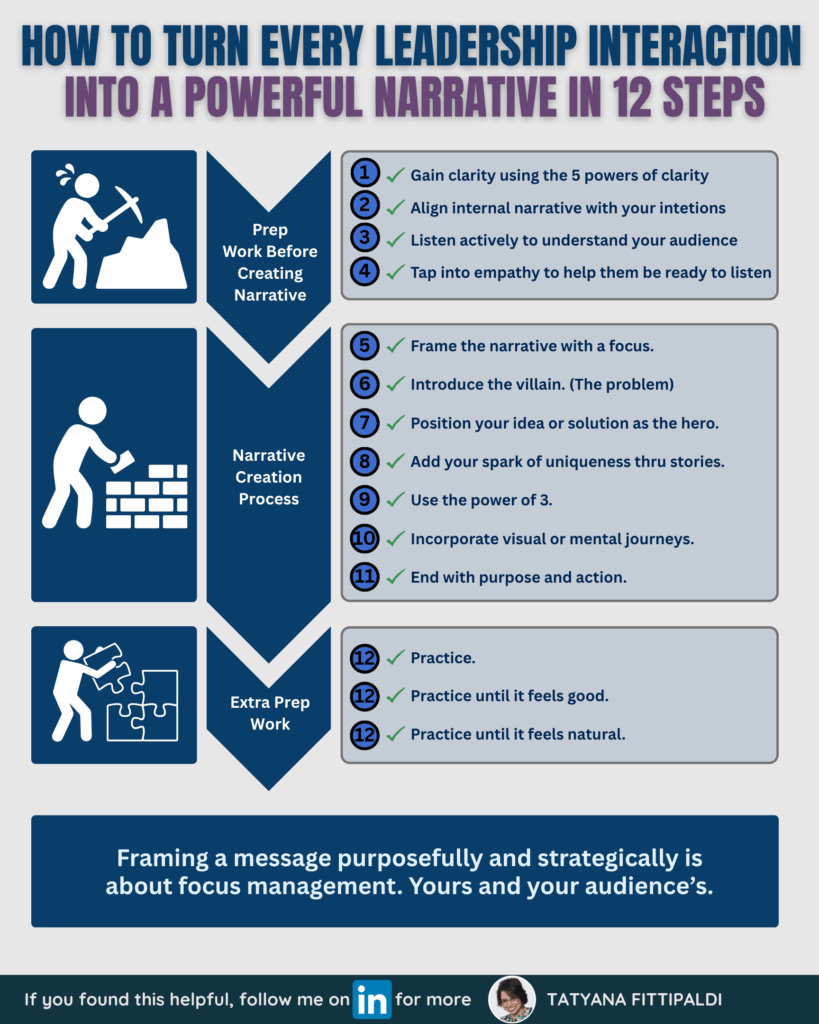
Power-Of-Three Arc Variations
While storytelling possibilities are virtually infinite, certain arc structures provide useful starting points. These are not formulas. They are scaffolding.
Narrative Arc: Challenge–Solution–Result
Best used for business cases and decision-making scenarios.
This arc begins by defining a clear challenge, presents a structured solution, and concludes with measurable results. It is effective when stakeholders prioritize clarity, efficiency, and tangible impact.
Narrative Arc: Past–Present–Future
Well-suited for decision-making and career advancement conversations.
This structure connects historical performance, current positioning, and forward-looking contribution. It helps decision-makers see continuity and trajectory.
Narrative Arc: Problem–Insight–Opportunity
Strong for transformation initiatives and strategic shifts.
This arc reframes tension through insight, then positions change as opportunity. It is useful when stakeholders require cognitive reframing rather than pure data persuasion.
Narrative Arc: Risk–Choice–Outcome
Effective for high-stakes decision-making and transformation contexts.
This structure acknowledges uncertainty, clarifies the strategic choice available, and articulates likely outcomes. It strengthens credibility by integrating risk awareness.
Matching Arcs To Applications
These arc variations align differently depending on application:
- Business Case Approval: Challenge–Solution–Result or Risk–Choice–Outcome
- Career Advancement: Past–Present–Future
- Decision Buy-In: Challenge–Solution–Result or Risk–Choice–Outcome
- Transformation: Problem–Insight–Opportunity or Risk–Choice–Outcome
However, no arc should be treated as universally correct for a specific application. Stakeholders and context determine narrative fit.
In some cases, a transformation may require a Challenge–Solution–Result structure if urgency is operational. In other contexts, a career advancement conversation may benefit from Problem–Insight–Opportunity framing if the role demands strategic reframing capability.
The arc serves the ecosystem. Not the other way around.
Narrative creation is iterative. Stakeholder Mapping may reveal that what you believed was a business case is actually a cultural tension. What you believed was a decision discussion may actually be a risk mitigation exercise.
That is why storytelling is both disciplined and creative. Disciplined because it must align with stakeholder expectations. Creative because no two ecosystems are identical.
As leaders practice aligning narrative structure with stakeholder dynamics, storytelling becomes less performative and more strategic. And when narrative structure reflects ecosystem awareness, executive presence deepens naturally.
Stakeholder Types: Layers vs Categories
Within stakeholder theory, stakeholders are often organized into layers: key, primary, and secondary. This layered view helps leaders prioritize influence and shape communication plans based on proximity and impact. It is widely used in project stakeholder management and stakeholder engagement frameworks.
However, layered classifications alone do not always translate into actionable stakeholder communication strategies.
To strengthen stakeholder management, leaders benefit from distinguishing between layered and categorical views — and understanding when each is useful.
Organizing Stakeholders: Layered View
The layered view categorizes stakeholders according to their relative importance or level of influence over a specific initiative.
- Key stakeholders are those with high power, high interest, or significant decision authority.
- Primary stakeholders are directly affected by the initiative and often play operational or execution roles.
- Secondary stakeholders may have indirect influence, lower involvement, or peripheral interest.
This approach supports prioritization and resource allocation. It clarifies who must be engaged closely and who requires periodic updates. In structured stakeholder engagement planning, layered mapping helps leaders avoid overextending attention.
However, the layered model answers only one dimension: how important someone is.
It does not clarify why they matter or how they should be engaged.
Organizing Stakeholders: Category View
The category view classifies stakeholders by role, function, or decision relevance rather than hierarchical importance. Instead of asking, “How powerful are they?” it asks, “What role do they play in this context?”
Examples include:
- Internal stakeholders versus external clients
- Career decision-makers who influence advancement
- Process decision-makers who control operational execution
- Allies who amplify narrative and reinforce stakeholder communication
This perspective strengthens stakeholder engagement strategy because it aligns communication with function and motivation. A process decision-maker may require detailed operational clarity. A career decision-maker may prioritize enterprise impact. An ally may require shared language to amplify your message effectively.
Categories clarify engagement intent.
Why Categories Are More Actionable
While layered views support prioritization, categorical views support alignment.
Stakeholder engagement becomes more precise when leaders understand not only who holds influence, but what kind of influence they hold. A stakeholder may be secondary in formal hierarchy yet critical as an ally. Another may be primary in execution but irrelevant in promotion decisions.
Categorical framing aligns stakeholder communication with purpose. It reduces generic messaging. It sharpens communication plans. It clarifies which narrative arc is appropriate.
In practice, advanced stakeholder management integrates both views: layers for prioritization and categories for engagement design. Layering tells you where to focus.
Categories tell you how to act. And how you act shapes how you are perceived.
When leaders distinguish between importance and role, stakeholder engagement becomes structured rather than reactive — and executive presence strengthens accordingly.
The Missing Metric: Mapping Relationship Quality
Most stakeholder management models focus on power, influence, urgency, or interest. Few explicitly measure something equally decisive: relationship quality.
➡️You may know who holds authority.
➡️You may understand stakeholder expectations.
➡️You may even have a well-designed communication plan.
But if the quality of the relationship is weak, influence remains limited. This is where a simple 1–10 relationship scale becomes useful.
When mapping stakeholders, add a second layer of analysis: rate the quality of your relationship with each stakeholder on a scale of 1 to 10.
- 1 = The stakeholder does not know you, does not trust you, or may actively distrust or dislike you.
- 5 = The stakeholder knows you and may interact professionally, but trust and affinity are limited or neutral.
- 10 = The stakeholder knows you well, trusts your judgment, respects your competence, and would advocate for you when relevant.
These anchors are not about popularity. They are about credibility and relational strength.

Why does this matter? Because relationship quality predicts influence.
Two leaders may present the same proposal with identical data and narrative structure. The one with higher relational capital often receives greater openness. Stakeholder buy-in is shaped not only by logic, but by trust accumulated over time.
When relationship quality is mapped alongside power or influence, prioritization shifts.
A high-power stakeholder rated at 3 requires a different engagement strategy than a high-power stakeholder rated at 8. Similarly, a mid-level stakeholder rated at 9 may serve as a powerful ally in stakeholder communication and perception shaping.
This metric changes how leaders allocate time when prioritizing stakeholders.
Instead of focusing only on formal authority, they begin strengthening relationships that expand influence capacity. Stakeholder engagement becomes less reactive and more intentional.
The idea of “Relationship quality” also introduces a greater sense of agency and accountability in every leader. For example, if resistance emerges in one specific relationship, leaders can examine not only structural misalignment, but relational depth. Strong stakeholder management does not assume that alignment will occur automatically. It invests in relational maturity.
When leaders consistently monitor and improve relationship quality across their stakeholder ecosystem, influence becomes more stable, decision-making becomes smoother, and executive presence becomes grounded in trust rather than authority alone.
Building rapport is for first-time relationships. Relationship quality is for long-lasting connections. Drop the ‘building rapport mindset’ and focus on improving long-term relationship quality in every interaction.
The MAME Framework: A Practical System For Leaders
Stakeholder management becomes powerful when it moves from theory to structure.
The MAME Framework — Mapping, Analyzing, Managing, and Engaging Stakeholders — translates stakeholder mapping and stakeholder analysis into disciplined action. It is designed not only to support project success, but to help leaders:
- Build strategic alliances
- Improve the quality of professional relationships
- Achieve specific business goals
- Advance personal leadership objectives
These seven steps are sequential but iterative. Leaders often revisit earlier steps as clarity increases. The framework is not rigid. It is structured.
👣 Step 1 — Identify Stakeholders
Objective:
Create visibility into everyone who can influence or be influenced by your initiative, decision, or career objective.
Key Questions:
- Who is directly affected?
- Who has decision authority?
- Who influences those decision-makers?
- Who could accelerate or delay outcomes?
Practical Actions:
List stakeholders broadly at first. Include formal roles, informal influencers, cross-functional partners, and external actors if relevant. Avoid premature filtering.
Common Mistakes:
- Limiting identification to the org chart
- Ignoring informal influencers
- Assuming your direct manager is the only relevant stakeholder
Stakeholder management begins with awareness. You cannot manage what you have not identified.
👣 Step 2 — Map The Stakeholder Network
Objective:
Visualize stakeholder relationships using an appropriate Stakeholder Mapping model.
Key Questions:
- Which model best fits the current application?
- What dimension matters most here — power, influence, urgency, culture, value exchange?
- How are stakeholders positioned relative to one another?
Practical Actions:
Select a model such as a Power–Interest Grid, Influence–Interest Matrix, or Multi-Dimensional Stakeholder Mapping approach. Plot stakeholders visibly. Look for clusters, gaps, and asymmetries.
Common Mistakes:
- Treating mapping as a formality
- Using only one model when complexity requires refinement
- Failing to update the map as context shifts
Mapping provides structural clarity. It makes influence visible.
👣 Step 3 — Analyze Stakeholder Roles
Objective:
Understand stakeholder roles and motivations beyond hierarchy.
Key Questions:
- Is this stakeholder a decision-maker, influencer, ally, or implementer?
- Are they internal or external?
- What are they protecting?
- What do they value most?
Practical Actions:
Categorize stakeholders based on function and influence type. Align categories with engagement intent. Consider incentives, risk exposure, and performance metrics.
Common Mistakes:
- Overreliance on layered importance (key/primary/secondary)
- Ignoring incentives
- Assuming alignment without validation
Stakeholder analysis deepens mapping. It transforms a diagram into insight.
👣 Step 4 — Assess Relationship Quality
Objective:
Assess relational strength to understand influence capacity.
Key Questions:
- On a scale of 1–10, how strong is this relationship?
- Do they know, like, and trust me?
- Would they advocate for my proposal in my absence?
Practical Actions:
Apply the 1–10 relationship quality metric introduced earlier. Identify low-score, high-impact stakeholders as engagement priorities.
Common Mistakes:
- Assuming authority compensates for weak relationships
- Overestimating trust
- Avoiding honest self-assessment
- Underestimating common storytelling mistakes during interactions
Relationship quality often determines whether stakeholder engagement succeeds.
👣 Step 5 — Prioritize Key Stakeholders
Objective:
Allocate attention strategically based on influence, role, and relationship strength.
Key Questions:
- Which stakeholders require immediate engagement?
- Where does misalignment create risk?
- Who can become strategic allies?
- Which engagement sequence creates the best flow of communication and influence?
Practical Actions:
Combine structural position and relationship quality. Identify high-power, low-relationship stakeholders as urgent priorities. Identify high-trust allies as amplification partners. Identify high-quality relationships that can connect you with or introduce you to new high-power, relevant stakeholders.
Common Mistakes:
- Spreading effort evenly
- Prioritizing visibility over influence
- Ignoring volatility or predictability factors
Prioritization prevents reactive stakeholder management.
👣 Step 6 — Engage Strategically
Objective:
Design and execute calibrated stakeholder engagement strategies.
Key Questions:
- What narrative structure best fits this stakeholder?
- What concerns must be acknowledged?
- What outcome are we aligning toward?
Practical Actions:
Sequence conversations intentionally. Adapt communication style based on stakeholder category and expectations. Use business storytelling to frame proposals strategically.
Common Mistakes:
- Delivering one-size-fits-all messaging
- Engaging only in formal meetings
- Confusing persuasion with alignment
The bottom line here is that “Engagement” strategies are what operationalize stakeholder management. It’s how you practically manage the different relationships you have in your map.
👣 Step 7 — Manage & Monitor Relationships
Objective:
Sustain alignment and update the stakeholder ecosystem over time.
K ey Questions:
- Have stakeholder positions shifted?
- Has relationship quality improved or declined?
- Has influence redistributed due to structural or leadership changes?
Practical Actions:
Review stakeholder maps periodically. Adjust engagement strategy. Track relationship development intentionally. Keep engaging!
Common Mistakes:
- Treating stakeholder management as a one-time exercise
- Ignoring early warning signals
- Failing to recalibrate after organizational changes
- Not checking-in with or giving attention to high-scored relationships
Stakeholder management is continuous orchestration.

The MAME Framework is not about control. It is about clarity and awareness. It transforms stakeholder mapping from static diagrams into dynamic strategy. It strengthens stakeholder engagement by aligning structure, incentives, and relationships. And it supports leaders in achieving business goals without relying solely on authority.
Over time, leaders who practice structured stakeholder management build strategic alliances naturally. Professional relationships deepen. Influence expands.
And executive presence becomes less about projection — and more about calibrated awareness within the stakeholder ecosystem.
Case Study — “Brad Pitter” (Name Changed)
Our Hero’s Context
“Brad Pitter” is the pseudonym of a former client who worked for a global mining company for over fifteen years. He had deep institutional knowledge, a strong technical track record, and an exceptional reputation. He was widely liked. Colleagues trusted him. He had built relationships across departments simply through longevity and professionalism.
By most traditional measures, he was successful.
Yet he felt stuck.
For years, he had remained in a role he no longer found challenging. From his perspective, the reason was clear: senior leadership did not see him as having the executive presence required for the next level. That perception frustrated him. He believed he was capable. But he assumed there was an intangible quality he lacked.
When we began working together, we did not start with presentation skills or executive demeanor. We started with stakeholder management.
His Problem
Brad’s assumption was that executive presence was a personal deficit.
My hypothesis was different. He was well-liked, competent, and respected. The issue was unlikely to be personality. It was more likely structural visibility.
He knew people everywhere. But he had never mapped who actually influenced advancement decisions.
He had relationships. He did not have a stakeholder strategy.
Our Mapping Approach
We began with Multi-Dimensional Stakeholder Mapping.
Instead of using only a Power–Interest Grid, we scored stakeholders across four dimensions:
- Influence
- Position
- Impact on his career progression
- Interest in his work
Then we added a fifth dimension: relationship quality on a 1–10 scale.
His initial stakeholder map included over twenty individuals across verticals, including senior leaders and HR representatives. Some relationships were strong — 8s and 9s. Others were neutral. A few key players were at 1–3, meaning they either did not know him or had minimal exposure to his work.
The map made something visible: Brad was highly trusted within his function, but underexposed outside it.
The issue was not presence. It was calibration.
Situational Analysis
We looked for leverage points.
➡️Which stakeholders had high influence and position but low relationship quality?
➡️Which individuals were connected to senior decision-makers yet had limited visibility into Brad’s contributions?
➡️Where could a small relational shift create disproportionate career impact?
We identified one to two individuals in other verticals who had high organizational impact and strong networks, but with whom Brad had little interaction.
Brad had assumed that because he was well-liked, he was well-positioned. The stakeholder analysis showed otherwise.
Engagement Strategy
We did not pursue visibility through self-promotion.
We pursued value.
Brad began requesting introductions where appropriate. He volunteered for short cross-functional assignments. In meetings, he contributed insights that connected operational realities to broader business goals. Instead of speaking only from a technical perspective, he began framing his input in terms of enterprise impact.
Each interaction was intentional. We sequenced interactions very intentionally.
We tracked relationship quality shifts. Several stakeholders moved from 2–3 to 6–7 over a few months. A few reached 8.
As relational capital increased, so did exposure.
Importantly, the engagement had a clear purpose: career advancement. Stakeholder engagement was no longer passive networking. It was structured stakeholder management aligned with a defined objective.
Use Of Storytelling
Storytelling played a pivotal role. Brad did not invent accomplishments. He reframed them. In cross-functional conversations, he used structured narratives to articulate:
- A challenge he and his team had faced and that was similar to the current one
- The solution implemented in the past that could well work now
- The measurable result
- The broader business implication based on insights he gained through experience
Instead of listing tasks completed, he connected outcomes to risk mitigation, cost efficiency, and operational continuity.
In discussions with senior stakeholders, he shifted to a Past–Present–Future arc, positioning his historical contributions as evidence of readiness for broader scope.
His reputation had always been strong. Now it was visible in strategic language.
Brad Pitter’s Outcomes
Within six to seven months, the shift was noticeable.
Brad began receiving invitations to cross-vertical discussions. Senior leaders referenced his insights. HR stakeholders began including him in succession planning conversations.
Eventually, three different verticals expressed interest in bringing him into expanded roles. Instead of pushing for a promotion, he found himself being pulled into opportunity.
He accepted a new role at the next level shortly thereafter.
Insight: Leadership Presence Reframed
The most important outcome was not the promotion. It was the reframing, in my opinion.
Brad realized that he had never lacked executive presence. He had lacked structured stakeholder management.
He had strong relational instincts but no mapping discipline. Once he applied structured Stakeholder Mapping, stakeholder analysis, and intentional engagement, his strengths compounded.
The praise he began receiving did not focus on likability. It focused on strategic thinking, enterprise awareness, and leadership maturity.
His presence had not changed. Its visibility had.
This case illustrates a recurring pattern. Leaders often interpret stalled progression as a personal deficit. In many cases, the issue is structural alignment.
Stakeholder management does not manufacture presence. It clarifies and amplifies it. And when strengths are applied in a structured way, influence expands — not through performance theater, but through calibrated awareness within the stakeholder ecosystem.
Using Business Storytelling After Stakeholder Mapping for Relationship Building
Stakeholder Mapping clarifies who matters. Stakeholder management clarifies how to engage them. Business storytelling determines what you say when you do.
Once you know who your stakeholders are, what they care about, and where your relationship quality stands, storytelling becomes far more precise. It is no longer generic communication. It becomes calibrated narrative.
There are four types of stories that are particularly powerful once mapping is complete.
Micro-Stories
Micro-stories are short, context-specific narratives used in meetings, hallway conversations, or informal check-ins. They are rarely more than a few sentences. Their purpose is not persuasion. It is signal. After mapping stakeholders, you know what dimension matters to each person. For a finance-oriented stakeholder, a micro-story might emphasize cost control or margin improvement. For an operations leader, it may highlight risk mitigation or execution speed. Because stakeholder management has already clarified interests and influence, micro-stories become targeted rather than accidental. They gradually reposition how you are perceived without requiring a formal presentation.
Visibility Stories
Visibility stories are used when career progression or sponsorship is at stake. These are structured narratives that connect your work to enterprise impact. They often follow arcs such as Challenge–Solution–Result or Past–Present–Future. Stakeholder Mapping informs who needs to hear these stories. Stakeholder analysis informs what aspect of your contribution they value most. Stakeholder engagement ensures the timing is right.
Visibility stories are not self-promotion. They are perception alignment. They help key stakeholders connect your contributions to strategic business goals.
For example: You occasionally meet a stakeholder in the corridor, and say. “You know, I’m used to presenting proposals at the steering committee. (Past) But it’s my first time presenting a 6-Billion M&A proposal. (Present). Wow, when this gets approved, we’ll have 61% of the market share. I’m so excited. (Future) In just a few lines, you reinforced your past track record, your current relevance, your presence in decision tables, and your connection to business impact. And you just shared all this with someone who probably didn’t have all this visibility. But just like that, you created visibility.
Value-Adding Stories
These stories are forward-looking. Instead of narrating past success, they frame insight. You may highlight a recurring issue across departments, a pattern emerging in customer feedback, or an operational inefficiency with measurable impact. Because you have mapped stakeholder interests and power dynamics, you can position these insights in a way that aligns with their objectives. Value-adding stories demonstrate strategic thinking. They shift you from task executor to enterprise contributor. You can use these stories while you wait for a meeting to start, during icebreakers, intentional coffee breaks, water-cooler conversations, and more.
Trust-Building Stories
Trust-building stories are relational. They may involve acknowledging lessons learned, sharing how you navigated complexity, or demonstrating transparency in decision-making. Stakeholder Mapping identifies where relationship quality is low. Storytelling can gently improve it. When used thoughtfully, these narratives increase the 1–10 relationship score over time. Trust strengthens. Influence expands. Stakeholder management provides structure. Storytelling provides warmth and clarity within that structure. Together, they move relationships from transactional to strategic.
Do Even CEOs Map Their Stakeholders?
I don’t want to sound ChatGPT here, but the short answer is: yes.
They may not always draw formal stakeholder matrices. But they map continuously.
At senior levels, stakeholder management often becomes intuitive. Executives develop pattern recognition. They know who influences board sentiment, who shapes informal culture, who carries reputational weight, and who can quietly stall a transformation initiative.
This may look like politics from the outside. In reality, it is structured awareness.
Informal vs. Formal Mapping
Early-career leaders often benefit from formal Stakeholder Mapping tools: Power–Interest grids, influence diagrams, or multi-dimensional scoring. These tools build discipline and experience in gaining contextual awareness.
As leaders gain more and more experience, mapping becomes faster and more mental. Brad Pitter from my story did not draw a single map on paper, but he had it all mapped out in his mind throughout our conversations and exercises together. So, experienced leaders may not create a visible stakeholder map, but they constantly assess in their minds:
- Who supports this initiative?
- Who may resist?
- Whose opinion carries weight with the CEO or board?
- Where are incentives misaligned?
This is not manipulation. It is ecosystem awareness. I hope you are convinced of that by now.
Pattern Recognition And Strategic Awareness
Senior executives have typically navigated multiple reorganizations, mergers, and leadership transitions. Over time, they develop sensitivity to influence pathways.
✔️They anticipate reactions before they happen.
✔️They sequence conversations deliberately.
✔️They adjust narratives depending on whether they are speaking to investors, regulators, internal leadership, or operational teams.
That adaptability is not improvisation. It is an accumulated stakeholder analysis experience.
Why Executives Appear “Political” But Are Actually Structured
From the outside, executives sometimes appear strategic in a way that feels political. They align stakeholders before announcing decisions. They hold informal conversations before formal meetings. They test narratives quietly before scaling them.
This is not manipulation. It is risk management.
Stakeholder management at senior levels protects project performance, stakeholder satisfaction, and organizational stability. It reduces communication delays. It increases buy-in. It ensures that business goals are not derailed by avoidable resistance.
The difference between “political behavior” and “structured influence” lies in intent and discipline.
When done ethically, Stakeholder Mapping and stakeholder engagement are not about control. They are about alignment.
And alignment is one of the most visible signals of leadership presence.
Whether formal or informal, CEOs map.
The only question is whether you choose to do it consciously — or leave influence to chance.
Books & Resources For Further Learning
If you want to deepen your understanding of stakeholder management, influence, storytelling, and leadership presence, here are a few carefully selected resources that complement the frameworks in this guide.
Disclaimer: This section may contain affiliate links. If you click on a link and make a purchase, I may earn a small commission at no additional cost to you. They sponsor my time in researching, vetting & curating, and sharing valuable thought-leadership content to help you achieve your professional goals. Thank you for your support! ❤️️
1. Strategic Management: A Stakeholder Approach
By R. Edward Freeman
From the father of stakeholder management, this foundational work in stakeholder theory reframes organizations as ecosystems of relationships rather than shareholder-only systems. It provides the philosophical backbone for modern stakeholder management and reinforces why stakeholder identification and prioritization shape long-term business outcomes.
2. Influence: The Psychology of Persuasion
By Robert Cialdini
One of my always favorite recommendations. For leaders interested in the behavioral side of stakeholder engagement, Cialdini’s work clarifies why people say yes, how social proof operates, and how authority, reciprocity, and consistency influence decisions. When layered onto a stakeholder map, these principles sharpen engagement strategies.
3. Crucial Conversations
By Kerry Patterson et al.
While not specifically about stakeholder awareness disciplines, this book strengthens the interpersonal dimension of stakeholder communication. It helps leaders navigate high-stakes dialogue, which often emerges once stakeholder dynamics become visible.
4. Mastering Business Storytelling
By Taty Fittipaldi
If you want to connect stakeholder management with narrative strategy, Mastering Business Storytelling provides a structured approach to turning communication into influence. The book explores how leaders can use storytelling not as decoration, but as a disciplined leadership capability. It connects directly to the idea that knowing your audience (mapping stakeholders) must precede persuasive narrative design.
5. Executive Presence
By Sylvia Ann Hewlett
This resource explores how leaders are perceived and what behaviors signal credibility, composure, and authority. When paired with stakeholder management strategies, it reinforces the connection between perception, positioning, and career advancement.
Together, these books expand your understanding from theory to psychology to communication craft. They reinforce one central idea: leadership presence grows where structured awareness meets intentional narrative and action.
Final Remarks: Stakeholder Awareness As A Leadership Presence Multiplier
Throughout this guide, one idea has remained consistent: Stakeholder management is not merely a project management tool. It is a leadership capability.
Stakeholder management, stakeholder engagement, and stakeholder communication are not administrative tasks. They are strategic disciplines that shape visibility, influence, and enterprise alignment.
When leaders struggle with stalled initiatives, opaque promotions, or unexplained resistance, the issue is rarely effort or intelligence. More often, it is incomplete alignment within the stakeholder ecosystem.
➨ Stakeholder Mapping clarifies who matters.
➨ Stakeholder analysis clarifies why they matter and what they want.
➨ Stakeholder engagement clarifies how to act.
➨ Stakeholder management sustains alignment over time.
This is why I often describe stakeholder management as a leadership presence multiplier. It strengthens influence without authority. It accelerates buy-in. It reduces friction. It transforms storytelling from performance into precision.
It is also a complex and effortful exercise, granted.
Ecosystems shift. Incentives change. Influence patterns evolve. What begins as a decision-buy-in exercise may reveal itself as a transformation initiative. What feels like a perception issue may be a structural misalignment.
Learning to navigate this terrain requires practice.
If you would like structured guidance in applying these concepts — whether for career advancement, transformation initiatives, or enterprise-level stakeholder communication — consider exploring my Stakeholder Mapping Workshop or executive coaching programs. A calibrated external perspective can dramatically shorten the learning curve.
If you found this comprehensive guide valuable, I would appreciate it if you shared it on LinkedIn so other leaders can benefit from it.
And if you want continued insights on stakeholder management, leadership presence, and business storytelling in global contexts, subscribe to the newsletter. Each issue builds on the principles discussed here and translates them into practical leadership action.
Stakeholder Mapping is not about politics. It is about clarity. And clarity, applied consistently, is one of the strongest signals of executive presence.
Key Takeaways: Stakeholder Management for Leaders
- Stakeholder management is not just a project management technique. It is a leadership capability.
- Effective stakeholder management always begins with stakeholder mapping.
- Different stakeholder mapping models reveal different aspects of stakeholder dynamics and will lead to different engagement approaches.
- Relationship quality with stakeholders can be as important as formal authority. Always assess and monitor it.
- Leaders who actively manage stakeholders gain visibility, influence, and strategic credibility.
FAQ
Stakeholder management is the structured process of identifying, mapping, analyzing, prioritizing, and engaging individuals or groups who can influence or are affected by an initiative. It goes beyond communication by actively shaping relationships, expectations, and decisions. Effective stakeholder management helps leaders build alignment, reduce resistance, and accelerate execution. In complex organizations, it is not optional. It is a core leadership capability tied to executive presence, influence, and business outcomes.
Stakeholder mapping is the process of identifying stakeholders and visually organizing them based on attributes such as power, interest, influence, or impact. Common models include the Power–Interest Grid (Mendelow Matrix) and the Salience Model. Mapping allows leaders to see who matters, why they matter, and how to engage them. It is the first step in stakeholder management and provides the clarity needed to prioritize attention and resources effectively.
Stakeholder mapping is a diagnostic step, while stakeholder management is an ongoing leadership process. Mapping focuses on identifying and categorizing stakeholders. Stakeholder management includes analyzing relationships, prioritizing stakeholders, and actively engaging them over time. In practice, mapping gives you visibility. Management turns that visibility into influence, alignment, and results.
The MAME framework stands for Mapping, Analyzing, Managing, and Engaging stakeholders. It expands traditional stakeholder mapping into a full leadership system. Leaders first map stakeholders, then analyze roles and relationship quality, prioritize based on relevance, manage expectations, and actively engage stakeholders. This structured approach ensures that stakeholder relationships are not left to chance and are instead developed intentionally to support decision-making and execution.
Stakeholder management directly impacts how leaders are perceived, supported, and trusted. Leaders who actively manage stakeholders create alignment, reduce friction, and increase decision speed. Those who do not often face resistance, misalignment, or missed opportunities. In global and complex environments, success depends not only on strategy but on how well that strategy is understood, supported, and executed by others.
Recognition depends on visibility, not just performance. Many professionals assume their work will speak for itself, but without stakeholder engagement, key decision-makers may never fully see or understand that work. It is similar to writing a strong science-class report and never submitting it for appraisal. Stakeholder management ensures your work is visible, understood, and evaluated by the right people. Recognition feels natural when your work is consistently connected to the stakeholders who influence outcomes.
The Mendelow Matrix, introduced by Aubrey L. Mendelow (1991), is a stakeholder mapping model that categorizes stakeholders based on their level of power and interest in an initiative. It helps leaders decide who to manage closely, keep satisfied, keep informed, or monitor. The model is widely used because it provides a simple and effective way to prioritize stakeholder attention and engagement strategies.
The Salience Model, developed by Mitchell, Agle, and Wood (1997), classifies stakeholders based on three attributes: power, legitimacy, and urgency. It helps leaders determine which stakeholders require immediate attention and why. Unlike simpler models, it captures the dynamic nature of stakeholder importance, especially in complex or rapidly changing environments.
Stakeholder management should be used whenever outcomes depend on alignment, influence, or cross-functional collaboration. This includes starting a new role, leading strategic initiatives, driving organizational change, or making high-impact decisions. It is particularly critical in global environments where cultural differences and organizational complexity increase the risk of misalignment.
Stakeholder management strengthens visibility, credibility, and influence across an organization. Leaders who build strong stakeholder networks gain access to information, support, and opportunities that accelerate career progression. By actively managing relationships, professionals position themselves as trusted partners rather than isolated contributors, which is a key factor in promotions and leadership advancement.