Executive presence coaching is often seen as a way to fix how someone speaks, presents, or shows up in meetings. And yes, while those things matter, they are only part of the picture. Especially in successful global leadership environments, where how you are understood matters just as much as what you say.
In my work with leaders across cultures and organizations, I’ve seen that executive presence is not built through a few quick techniques. It is developed through a set of capabilities that shape how you think, communicate, and are perceived over time.
In this article, I’ll walk you through what executive presence coaching actually develops. We’ll explore the difference between leadership presence and executive presence and learn a practical 5-domain framework you can use to strengthen your own presence in a structured way.
It Looked Like A Communication Problem
She came to me as a VP of HR for Transformations and M&A at a large international oil and gas company. She was already operating at a senior level. She led complex initiatives and worked closely with executive stakeholders. Still, the feedback she kept receiving was consistent. She needed to be more concise, more direct, and sound more “executive” in how she communicated.
Like many leaders in her position, the assumption was that this was a communication issue. So we started there. We worked on assertive communication techniques, on structuring her messages more clearly for executive audiences, and on reordering her narratives to sound more direct and outcome-focused.
She improved quickly. Her delivery became sharper, her messaging more structured, and her communication more aligned with what is typically expected at executive levels.
She debriefed me on every quick win with glowing eyes and an exuberant smile. She was ecstatic with her results. Still, something didn’t fully shift.
As we continued working together, to her surprise, it became clear that communication was not the real problem.
In fact, she already had strong capabilities in this domain. She was highly perceptive, read the room well, adapted her style across cultures, and built psychological safety with ease. Her storytelling was engaging, her questions were thoughtful, and her ability to connect with people was one of her strengths. On paper, nothing was really wrong. What about that feedback, then?
So we stepped back and looked at the situation more broadly.
We spent a few sessions working on her inner state: emotional regulation, self-talk, and confidence under pressure. She absorbed these quickly and built new routines and internal anchors that raised her baseline. But the real shift came when we moved our focus again, this time toward how her thinking was positioned and perceived.
We started working on making her strategic thinking more visible. Not just having good ideas, but ensuring those ideas were seen, understood, and connected to broader business priorities and strategies. We also designed a deliberate stakeholder management approach: we identified key relationships that would influence how her contributions were perceived and valued. She leveraged her already strong communication and interpersonal skills to build trust and visibility with the right stakeholders. She also aligned her messaging more explicitly with strategic outcomes.
Over time, her presence in the organization changed.
She was no longer seen as a strong HR leader supporting transformation initiatives. She became known as a strategic partner who could plan, deploy, and lead those transformations. She went on to lead multiple billion-dollar projects, was recognized as a top high-potential leader, and entered the succession pipeline for CHRO.
What became very clear through this process is that executive presence was never a single-skill issue. It was never something that could be fixed only by becoming more concise or more polished in communication. It was the result of multiple capabilities working together, often across different dimensions, and being perceived in alignment with the leader’s role and potential.
I often wonder what would have happened if she had relied only on the initial feedback she received to develop her executive presence.
I’ve seen many leaders fall into the same trap. They focus on what is most visible, not necessarily what is most relevant. It reminds me of the story of someone looking for their keys under a streetlight; not because that’s where they lost them, but because that’s where the light is.
Let me help you shed light on the rest of this street towards executive presence.
What Executive Presence Coaching Really Develops
When people first think about executive presence, they often picture how a leader speaks, presents, or carries themselves in a room. And yes, those elements do matter. But in practice, executive presence coaching goes much deeper than improving delivery or polishing communication.
In my work as an executive coach, coaching for leaders in this space is rarely about fixing one visible behavior. It is about developing a set of leadership skills that work together and shape how a leader is experienced over time. That is why executive presence coaching is not a quick adjustment. It is part of a broader leadership development process that supports long-term leadership growth.
What makes executive presence feel abstract is that it is rooted in perception. People interact with you, interpret your words and actions, and form a view of who you are as a leader. That perception then becomes a judgment. Executive presence is the result of that process.

This is also why focusing only on what is most visible, like body language or communication style, rarely creates a lasting shift. Those are important elements, but they are only part of a larger system. Executive coaching in this context is about strengthening multiple capabilities at once. It is about how you think, how you regulate your responses, how you communicate, how you build relationships, and how your decisions are understood by others.
When these elements start to align, something changes. Leaders are not just seen as capable. They are experienced as credible, clear, and ready for greater responsibility. And that is what executive presence coaching is really developing.
Why Executive Presence Is A Capability System (Not A Personality Trait)
One of the most common misconceptions about executive presence is that it is something you either have or you don’t. It is often described in terms of personal attributes — the famous confidence, charisma, or commanding authority — as if it were a fixed trait. In reality, executive presence is not something you are born with. It is something you build.
A more useful way to define executive presence is this: executive presence is the consistent perception that a leader is credible, clear, and capable of operating at a higher level of responsibility. It is not only about what the leader does, but how others interpret and experience those actions over time.
To understand how this is developed, it helps to look at the idea of executive capacity. Executive capacity is the set of capabilities that allow a leader to think, communicate, decide, and act effectively in complex and high-stakes environments. These capabilities include how leaders regulate themselves under pressure, how they make sense of information, how they engage others, and how they align their actions with broader business outcomes.
The connection between the two is direct. Executive presence is the external result. Executive capacity is what produces it.
When leaders invest in developing their capacity, they are not just changing behaviors on the surface. They are reshaping the mental models they use to interpret situations, improving how they respond under pressure, and creating more intentional patterns of action. Over time, these shifts lead to a perception change. People begin to see the leader differently, not because the leader is trying to “look the part,” but because their way of operating has become more aligned with the expectations of executive roles.
This is where behavioral change becomes meaningful. It is not about adopting a new style or copying someone else’s presence. It is about strengthening the underlying capabilities that naturally lead to more effective behavior. As those capabilities develop, executive presence follows.
Seen this way, executive presence is not a personality trait to acquire. It is a capability system to build, one that can be developed with the right structure, feedback, and practice over time.
Leadership Presence vs Executive Presence: What’s The Difference?
Is there a real difference between leadership presence and executive presence?
The short answer is yes. They overlap, but they are not the same.
Leadership presence is the broader concept. It refers to a leader’s ability to influence, align, and mobilize others toward shared goals through their character, behavior, and relationships. It is built on authenticity, trust, and consistency. Leaders with strong leadership presence create psychological safety, communicate meaning clearly, and build alignment within their teams. This is true whether they are first-time managers or part of a senior leadership team.
Executive presence is more specific. It comes into play when leaders operate at higher levels of responsibility, where decisions carry broader impact across functions, regions, and the organization as a whole. Executive presence is the combination of behaviors, communication patterns, and credibility signals that lead others to see someone as ready for enterprise-level roles. It includes how leaders are perceived in strategic conversations, how they contribute to company culture, and how confidently they operate in high-stakes environments.
One way to think about the difference is this. Leadership presence answers the question: “Would I follow this person?” Executive presence answers a different question: “Would I trust this person to represent the business at the highest level?”
This distinction matters, especially in global organizations. In HR leadership, for example, a leader may be highly effective within their team, building trust and driving results. But when stepping into broader organizational conversations, expectations change. The leader must connect their thinking to business strategy, influence across functions, and navigate complex stakeholder dynamics. This is where executive presence becomes more visible.
It also connects to topics like corporate culture and gender diversity. What is perceived as “executive presence” is not always neutral. It can be shaped by cultural norms, leadership expectations, and even bias. Leaders from different backgrounds may be evaluated differently, even when demonstrating the same capabilities. Understanding this context is important, because developing executive presence is not about fitting into a single mold. It is about building the capacity to operate effectively while staying aligned with your values and leadership identity.

In plain terms, leadership presence is the foundation. Executive presence is what that foundation looks like when expressed at scale, under greater complexity, and with higher expectations.
How Executive Presence Is Actually Built Over Time?
One of the most common misunderstandings about executive presence is the belief that it comes from learning a set of skills. Take a course, improve your communication, work on your body language, and over time your presence will follow. That is part of the process, but it is not the full picture.
I have seen many leaders invest heavily in developing their leadership skills and still feel stuck. They learn, they apply, they improve, and yet the way they are perceived does not fully shift. Others gain experience over time but are still not seen as ready for larger roles. And some build strong relationships, but without the depth of capability to sustain credibility.
Executive presence is not built from one of these elements alone. It is built from how they work together over time.
The Three-Body Problem Of Executive Presence
Just recently, I started reading the fascinating Three-Body Problem trilogy by Cixin Liu. What struck me while reading the first book was how the three-body system he describes mirrors the drivers of executive presence in real life.
In the book, he explains that a three-body system is inherently unpredictable. The suns move in relation to one another, forming different configurations in unexpected ways. Each one creates a constant push and pull on the others.
That reminded me of how the drivers I’m about to present work. Each one is essential. Each one influences the others. And where we place our focus is not always linear or controlled — it often shifts based on context, pressure, and the circumstances around us.
A simple way to understand this is through three drivers:
Knowledge × Experience × Relationships
These are not independent. They are connected, and more importantly, they compound.
Knowledge is where development starts. This includes the leadership skills you build, the capabilities you strengthen, and the understanding you gain about your role, your function, and the business. It is where you learn how to communicate effectively, how to think strategically, how to regulate your responses, and how to operate in complex environments.
Experience is what turns knowledge into behavior. It is the time, effort, and repetition required to apply what you have learned in real situations. This is where behavioral change happens. You test your thinking, refine your approach, and build consistency under pressure. Without experience, knowledge remains theoretical.
Relationships are what make that capability visible. They shape how your work is seen, understood, and valued by others. Through relationships, you build trust, expand your network, and create the conditions for your contributions to be recognized. This is where perception is formed.
What makes this model important is that these three drivers are not additive. They are multiplicative.
If one is missing, the overall effect is limited.
Where Leaders Get Stuck
This is where many leaders unintentionally limit their executive presence.
Some focus heavily on knowledge. They develop strong communication skills, deepen their business understanding, and invest in leadership development. But if those capabilities are not applied consistently in real situations, or if they are not visible to the right stakeholders, the impact remains contained.
Others rely on experience alone. They have been in their role for years, have handled complex situations, and know how things work. But without updating their mental models or strengthening their capabilities, their growth plateaus. Their experience becomes repetition, not evolution.
And then there are leaders who build strong relationships but without a solid foundation of capability. In these cases, presence can appear strong at first, but it is difficult to sustain credibility over time.
Executive presence grows when all three drivers develop together.
A Personal Lesson Early In My Career
I learned this lesson early in my own career.
At one point, I was convinced I was ready for a manager role. I was already doing much of the work. I had developed the necessary skills, and I had gained enough experience leading the team informally. From my perspective, the next step felt natural.
What I did not understand at the time was that my presence was limited.
I had the knowledge. I had the experience. But I had not built the relationships beyond my immediate team. I did not have strong connections with peer managers or with senior leaders. My work was not visible outside of my direct environment.
My team knew I could do the role. I knew I could do the role. Even my manager saw the potential. But at a broader level, I had not yet built the trust and recognition needed to support that transition.
That experience stayed with me because it made something very clear:
Presence is only as strong as the reach it has.
If that reach is limited, your presence is limited. If that reach expands, your presence expands with it.
How This Connects To The Executive Presence Framework
This is also where the framework we are about to explore becomes more practical.
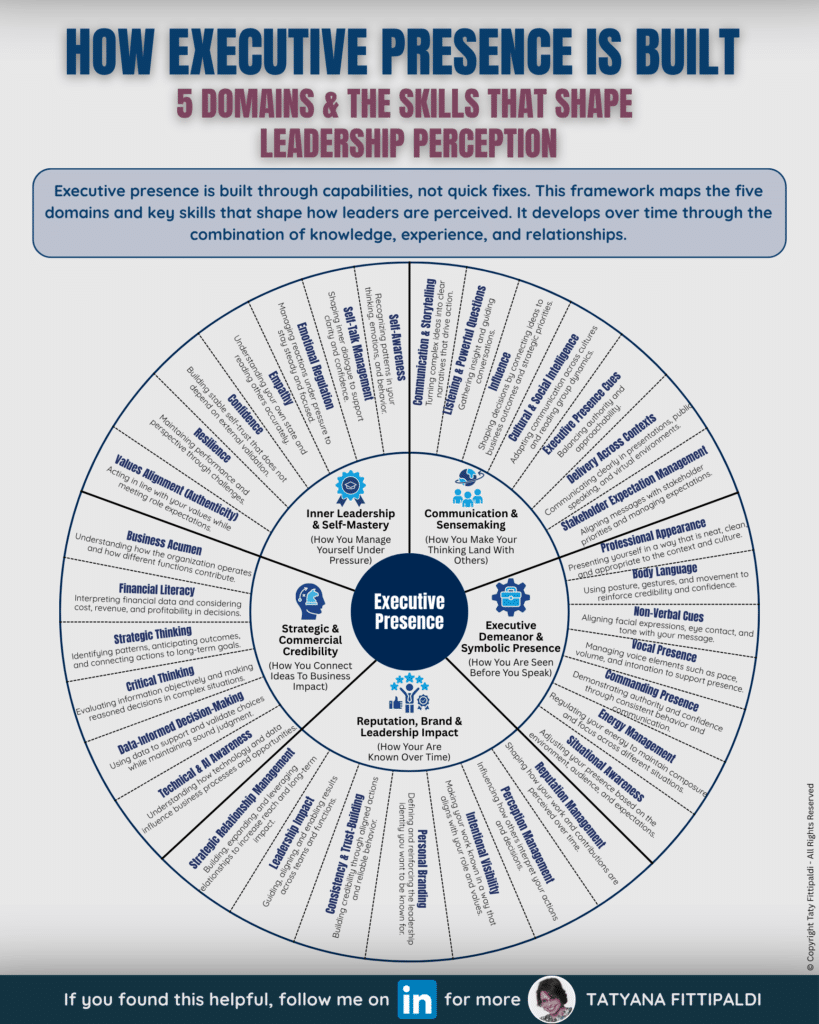
The five domains of executive presence define what you are developing. They represent the capabilities that shape how you think, communicate, act, and relate to others.
But understanding the domains is only the first layer.
You still need to build knowledge within each domain. You need to apply that knowledge through experience. And you need to create relationships that allow those capabilities to be seen and trusted.
Executive presence coaching works across all three drivers. It helps leaders strengthen their capabilities, apply them in real situations, and align their efforts with the right stakeholders. That is what allows presence to grow in a way that is both consistent and visible.

A Note On Feedback And Development
Feedback plays an important role in building executive presence, but not all feedback works in the same way. And not all of it should be interpreted in isolation.
Some feedback systems act like a streetlight that illuminates a wide area, but with less depth. A performance review, for example, or a broad 360-degree feedback process, can give you a general sense of how you are perceived across multiple dimensions. These inputs are useful because they show patterns over time and across stakeholders. They give you range. But they can also lack specificity. You may know that something needs to improve, without fully understanding what is driving it.
Other feedback approaches go deeper. Behavioral assessments, personalized assessments, and targeted coaching tools focus on specific capabilities such as communication, EQ and multiple intelligences, or decision-making. They generate more detailed assessment data and help you understand not only what is happening, but why it is happening. The trade-off is that they tend to focus on a narrower area.
Strong development requires both.
You need enough breadth to understand how you are perceived across the organization, and enough depth to improve the capabilities that drive that perception. If you rely only on broad feedback, your development may stay too general. If you rely only on deep, targeted feedback, you may improve in one area while missing how the system is experienced as a whole.
There is another layer to consider. Development should not be guided only by what you think needs improvement. It also needs to be aligned with what your organization expects from you at your level and in your role.
This is where structured frameworks come into play. Many large international organizations use models such as the ACE Framework to guide performance conversations and align expectations between leaders and their teams. These frameworks help clarify what “good” looks like, not just in terms of results, but in how those results are achieved. They create a shared language for development and help ensure that feedback is not only personal but also contextual.
In addition, organizations often conduct organizational audits, typically led by HR leadership, to identify gaps in capabilities, alignment, and culture. These audits provide a broader view of how leadership is functioning across the company and where development efforts should be focused. They help balance individual feedback with organizational priorities.
When you put all of this together, feedback becomes more than a set of comments or scores. It becomes a system.
A system that combines:
- Broad inputs, like performance reviews and 360-degree feedback
- Deep insights, from behavioral and personalized assessments and coaching
- Organizational alignment, through frameworks and audits
If you only follow what is most visible or easiest to measure, you risk focusing your development in the wrong place. This brings us back to the earlier idea of looking for your keys under the streetlight, not because that is where they were lost, but because that is where the light is.
Strong executive presence development requires a more deliberate approach. One that balances breadth and depth, and aligns personal growth with organizational expectations.
How Executive Presence Compounds
Over time, executive presence builds through the interaction of knowledge, experience, and relationships.
As you strengthen your capabilities, you make better decisions and communicate more clearly. As you apply those capabilities, your behavior becomes more consistent and reliable. As you build relationships, your work becomes more visible and your credibility grows.
These elements reinforce each other.
✅Better capability leads to stronger performance.
✅Stronger performance builds trust.
✅Trust expands your reach.
✅And expanded reach strengthens your presence.
This is why executive presence does not change overnight. It develops through consistent effort, aligned development, and deliberate visibility over time.
And this is also why focusing on only one element rarely works. It is the combination and the compounding effect that create a lasting shift.
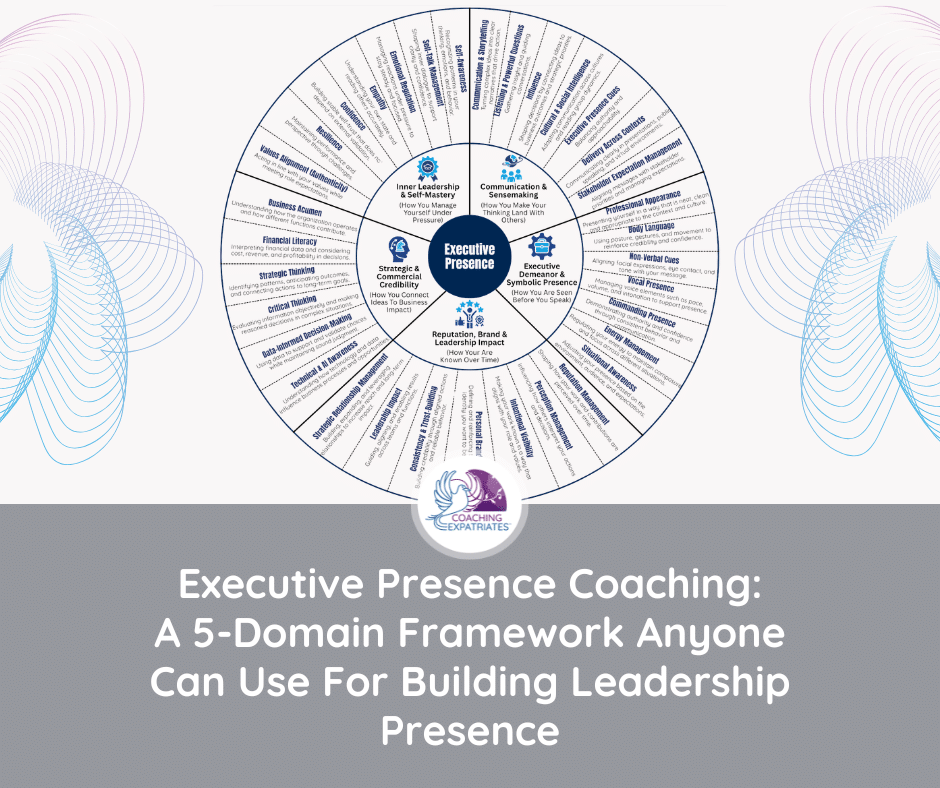
The 5 Domains That Executive Presence Coaching Strengthens
Here’s the executive presence framework that I use with my own clients at my practice.
Domain 1: Inner Leadership & Self-Mastery
(The internal operating system that determines how you show up under pressure.)

When This Starts To Slip
In many cases, this domain does not break down in obvious ways. The leader is capable, experienced, and technically strong. They know what to say and what needs to be done. But in key moments, something feels slightly off.
You may notice hesitation before speaking, or the tendency to over-explain to make sure you are understood. In other situations, the opposite happens. You become more abrupt than intended, reacting quickly instead of responding thoughtfully. Your tone shifts, your pace changes, and your message loses clarity.
These signals are subtle, but they add up. Others may start to perceive inconsistency. One day you appear confident and grounded, the next you seem uncertain or overly reactive. Over time, this affects how your leadership is experienced, especially in high-stakes environments where consistency matters.
The consequence is not always immediate. It shows up in how much trust others place in your judgment, how comfortable they feel relying on your decisions, and how stable your presence feels under pressure.
The Hidden Gap In Domain 1
What many leaders miss is that these moments are rarely about communication alone. They are driven by what is happening internally.
Under pressure, your thinking is influenced by your mental models—how you interpret situations, what you assume is at stake, and how you define success or risk in that moment. If those models are not well calibrated, your reactions will reflect that.
This is where emotional intelligence becomes critical. It is not just about recognizing emotions in others. It is about understanding your own internal state and how it shapes your behavior. Without that awareness, leaders often try to fix the visible behavior without addressing the underlying pattern.
There is also a neurological component to this. Research on mirror neurons suggests that people unconsciously pick up on the emotional and behavioral signals of others. In simple terms, how you show up internally tends to be reflected externally and sensed by those around you becouse humans have mirror neurons. If your internal state is tense, uncertain, or conflicted, others are likely to feel that, even if your words are well structured.
This is why focusing only on external adjustments rarely creates lasting change. The visible behavior is a reflection of a deeper system that includes personal leadership.
What Executive Presence Coaching Builds Here
Executive presence coaching in this domain focuses on strengthening the leader’s internal foundation. It’s rarely associated with corporate culture and leadership, but our inner world has everything to do with it.
Leaders learn to recognize their internal patterns, especially under pressure. They develop the ability to pause, assess what is happening internally, and respond more intentionally. This creates space between stimulus and response, which is where better decisions are made.
There is also a strong focus on reshaping inner narratives. Many leaders operate with unexamined assumptions about how they should perform or how others are evaluating them. Coaching helps bring these assumptions to the surface and replace them with more accurate and constructive perspectives.
Over time, this leads to behavioral change that is both visible and consistent. Leaders become more stable in how they show up. Their tone, pace, and decision-making align more closely with the situation. They are not trying to “act confident.” They are operating from a place that naturally produces confidence.
This is where presence begins to feel grounded rather than performed.
The Skills That Strengthen This Domain
- Self-talk management (inner narratives): Shaping internal dialogue to support clarity and confidence rather than self-doubt.
- Emotional regulation: Managing emotional responses under pressure to maintain stability and focus.
- Empathy: Understanding both your own state and the emotional context of others to respond appropriately.
- Authenticity vs. conformity (values alignment): Balancing personal values with role expectations without creating internal conflict.
- Confidence: Building a stable sense of self-trust that is not dependent on external validation.
- Resilience: Maintaining performance and perspective through challenges and setbacks.
- Self-awareness: Recognizing patterns in thinking, behavior, and emotional responses as a foundation for growth.
Books To Deepen This Domain
- Emotional Intelligence by Daniel Goleman — foundational understanding of emotional intelligence in leadership
- Thinking, Fast and Slow by Daniel Kahneman — how mental models shape decisions and reactions
- The Chimp Paradox by Steve Peters — practical model for managing internal responses under pressure
Note on neuroscience: The concept of mirror neurons was first introduced by researchers such as Giacomo Rizzolatti and his colleagues, highlighting how humans naturally mirror the emotional and behavioral cues of others. This reinforces the idea that internal state and external perception are closely linked.
Domain 2: Communication & Sensemaking Power
(How clearly, credibly, and compellingly you make meaning for others.)

When Communication Feels Clear But Alignment Still Doesn’t Happen
This domain usually shows up in a frustrating way. Leaders communicate often. They explain their ideas, present updates, and contribute in meetings. On the surface, everything seems fine.
But alignment does not follow.
You may notice that after a meeting, people walk away with different interpretations of what was discussed. Decisions take longer than expected. Actions never happen. You repeat the same message across multiple conversations, adjusting your explanation each time, yet the outcome does not fully land.
In some cases, leaders compensate by speaking more. They add detail, provide more context, more arguments, and try to anticipate every possible question. In other cases, they pull back, keeping messages short but leaving important connections unstated.
These patterns show up across formats. In virtual meetings, messages lose impact. In presentations, strong content does not always translate into clear decisions. In public speaking or executive updates, ideas sound well-structured, but do not create momentum. (Think about that Townhall received by crickets.)
The consequence is not just inefficiency. It affects how others perceive your clarity, your strategic thinking, and your ability to lead conversations that move work forward.
The Real Gap Behind The Communication Challenge
What many leaders miss is that communication is not only about expression. It is about how meaning is constructed in the mind of the listener.
Strong communication skills are important, but they are often applied in a one-directional way. Leaders focus on what they want to say, how to structure it, and how to deliver it. Less attention is given to how different audiences interpret that message based on their context, priorities, and assumptions.
This is where sensemaking becomes critical.
Sensemaking is the ability to take complex information and translate it into something that others can understand, relate to, and act on. It requires more than clarity. It requires awareness of the audience, the situation, and the broader environment in which the message is being received.
For example, the difference between using active voice and passive voice is not just grammatical. The same applies if you are using the first-person singular or plural. It changes how responsibility, ownership, and action are perceived. The same applies to how ideas are framed, how much context is provided, and how conclusions are presented.
Listening also plays a central role here. Many leaders listen to respond rather than to understand. As a result, they miss key signals about what their audience actually needs to hear. Without that input, even well-prepared messages can miss the mark.
Something similar happens to the use of questions. Many leaders use questions only to inquire, when they can also be used to explore and engage in generative listening for better problem-solving.
At a deeper level, this domain is influenced by cultural intelligence and social awareness. In global environments, communication is shaped by different norms, expectations, and communication styles. What feels clear in one context may feel incomplete or overly direct in another.
This is why communication breakdowns are often misdiagnosed. The issue is not a lack of communication. It is a gap in how meaning is created and shared.
What Executive Presence Coaching Builds Here
Executive presence coaching in this domain focuses on expanding how leaders communicate and how they guide understanding.
Leaders learn to shift from simply delivering messages to actively shaping how those messages are interpreted. This includes adapting communication to different stakeholders, aligning content with strategic priorities, and creating clear links between ideas and outcomes.
There is also a strong focus on listening and asking as strategic tools. Leaders develop the ability to gather information through conversations, identify underlying concerns, and adjust their approach in real time. This improves both the quality of the dialogue and the relevance of their contributions.
Another important shift is in how leaders structure their communication. Instead of over-explaining or under-explaining, they learn to calibrate their level of detail, using frameworks, 12-Step Business Storytelling, and structured thinking to guide their audience through complex topics.
Over time, communication becomes more intentional. Messages are clearer, conversations are more focused, and alignment happens more efficiently. Leaders are not only heard. They are understood, and their ideas are more likely to lead to action.
The Skills That Strengthen This Domain
- Storytelling Skills for professional success: Turning complex ideas into structured, engaging narratives that drive understanding and action.
- Listening skills: Collecting high-quality information by listening to understand, not just to respond.
- Powerful questions: Guiding conversations and uncovering insights through intentional questioning.
- Psychological safety: Creating an environment where others feel comfortable contributing openly.
- Expectation management: Aligning what is expected, what is delivered, and how success is defined.
- Stakeholder management: The Stakeholder MAME Framework. Identifying key stakeholders and adapting communication to their priorities and influence.
- Influencing skills: Shaping decisions and outcomes through clear, credible, and strategic communication.
- Multicultural communication models: Navigating different communication styles across cultures to avoid miscommunication as much as possible.
- Cultural intelligence (CQ): Adapting communication based on cultural context and expectations.
- Social Quotient (SQ): Understanding group dynamics and social signals in interactions.
- Cue management (warmth & credibility): Balancing approachability with authority in communication.
- Charisma: Creating connection and engagement through presence and delivery.
- Business communication: Communicating ideas in a way that connects to business outcomes and priorities.
- Presentation skills: Structuring and delivering content clearly in formal settings.
- Public speaking: Communicating confidently and effectively to larger audiences.
- Virtual communication: Adapting communication style for virtual meetings and digital environments.
Books To Deepen This Domain
- Made to Stick by Dan Health Chip Heath — how to make ideas clear, memorable, and actionable.
- Mastering Business Storytelling by Taty Fittipaldi — how to use storytelling skills in global leadership environments.
- The Culture Map by Erin Meyer — understanding communication across cultures.
- Talk Like TED by Carmine Gallo — practical insights on effective public speaking and presentations
Domain 3: Executive Demeanor & Symbolic Presence
(The visible and audible signals people subconsciously interpret as “leader.”)

When Presence Feels Off Before You Even Speak
This domain often shows up before a word is said.
A leader walks into a room, joins a virtual meeting, or starts a presentation, and something feels slightly off. It is not always clear what it is. The message may be strong, the ideas well thought out, but the overall impression lacks weight.
You may notice small signals. Posture that feels closed or tense. Limited eye contact. A tone that does not match the message. Movements that feel either too rigid or too scattered. In some cases, leaders overcorrect by trying to appear more confident, adopting exaggerated gestures or forced power poses that do not feel natural.
I used to have a client who frequently said, “Explain this to me like I’m stupid,” whenever someone sounded too confusing. She didn’t want to criticize them, so she instead self-deprecated. Over time, she was perceived as lacking confidence. This might not be intuitive, but our choice of words also reflects demeanor.
These signals are often subtle, but they shape how others interpret credibility and authority. Before people evaluate your ideas, they read your body language, your facial expressions, your pace, and your energy.
Over time, this affects first impressions and ongoing perception. Leaders may be seen as less confident, less decisive, or less ready for higher levels of responsibility. Not because of what they say, but because of how they show up.
What Gets Misinterpreted In This Domain
What many leaders misunderstand is that executive demeanor is not about performance. It is about alignment.
There is a tendency to treat this domain as a set of techniques. Stand this way. Use this gesture. Maintain eye contact for a certain amount of time. While these elements can be helpful, they do not work in isolation.
When demeanor is treated as a script, it often creates tension. The leader is trying to manage visible behavior without addressing what is happening internally. This disconnect is usually noticeable. Others pick up on it through non-verbal cues, even if they cannot explain it directly.
This is where perception becomes important. People form impressions quickly based on visible signals. These impressions are influenced by what they expect from leadership roles and by how consistent your presence feels over time.
Your personal attributes — such as calmness, confidence, and composure — are not only judged by what you say, but by how your behavior aligns with those qualities.
This is also why this domain is closely connected to the previous one. If your internal state is unsettled, it tends to show externally. If your internal state is grounded, your external presence becomes more stable and credible.
What Executive Presence Coaching Builds Here
Executive presence coaching in this domain focuses on helping leaders align their internal state with their external signals.
Leaders develop awareness of their non-verbal communication, including posture, gestures, facial expressions, tone, and pace. More importantly, they learn how these elements interact and how they are interpreted by others in different contexts.
There is also a focus on energy management. Leaders learn how to regulate their presence across situations — whether they are in a high-pressure meeting, presenting to a senior leadership team, or engaging in one-on-one conversations. This includes managing nervous energy, maintaining composure, and adapting their style without losing authenticity. Have you ever lost your temper after being sleep deprived? Was it an energy management problem or an emotional regulation problem? A lot of people answer ’emotion regulation.’ In fact, there’s a high correlation between good energy management and optimal emotional regulation.
Rather than teaching leaders to “act” a certain way, coaching helps them build consistency. The goal is not to create a performance, but to ensure that how they show up supports the message they are trying to convey.
Over time, this leads to a presence that feels more natural and grounded. Leaders are perceived as more confident, more composed, and more credible, not because they are following a script, but because their internal and external signals are aligned.
The Skills That Strengthen This Domain
- Professional appearance: Presenting yourself in a way that is neat, clean, and appropriate to the context and culture.
- Body language: Using posture, gestures, and movement to reinforce credibility and confidence.
- Non-verbal Cues: Aligning facial expressions, eye contact, and tone with your message.
- Vocal Presence (Paralanguage): Managing voice elements such as pace, volume, and intonation to support clarity and authority.
- Commanding presence: Demonstrating authority and confidence through consistent behavior and communication.
- Personal Energy Management: Regulating your energy to maintain composure and focus across different situations.
- Situational Awareness: Adjusting your presence based on the environment, audience, and expectations.
Books To Deepen This Domain
- Presence by Amy Cuddy — how body language and presence influence confidence and perception.
- The Definitive Book of Body Language by Allan & Barbara Pease — understanding non-verbal cues and their impact.
- Executive Presence by Sylvia Ann Hewlett — how demeanor, communication, and appearance shape leadership perception.
Domain 4: Strategic & Commercial Credibility
(The substance that proves you deserve the room.)

When Ideas Sound Good But Don’t Carry Weight
This domain usually becomes visible in decision-making conversations.
A leader presents an idea that sounds well thought out. The structure is clear, the communication is solid, and the delivery is confident. But as the discussion unfolds, questions start to surface. How does this connect to the broader strategy? What are the financial implications? What trade-offs are we making? What data supports this direction?
If those questions are not addressed clearly, the idea begins to lose momentum.
In some cases, leaders rely on intuition without backing it with data. In others, they present detailed information but fail to connect it to business outcomes. You may also see leaders who contribute actively in discussions but struggle to position their thinking within a larger strategic planning context. I often say this to my clients: A person without positioning is the person who gets no visibility.
So, when signals like these occur, ideas are heard but not fully adopted. Contributions are valued, but not always seen as decisive. Over time, this affects how much weight others give to the leader’s voice, especially in conversations that involve senior leadership teams or high-stakes decisions.
Where The Real Gap Sits
What many leaders miss is that credibility at higher levels is not built only through participation. It is built through connection.
Strong ideas are not enough. They need to be connected to the business. That means understanding how a proposal impacts revenue, cost, risk, and long-term direction. It also means being able to explain that connection clearly.
This is where business acumen and financial literacy become essential. Without them, leaders may focus on isolated improvements without considering how those improvements fit into the bigger picture.
There is also a thinking component. Strategic thinking is not only about long-term vision. It is about seeing patterns, understanding dependencies, and anticipating consequences. It requires critical thinking and the ability to evaluate information from multiple angles before making a decision.
In today’s environment, guess what, technical awareness also plays a role. Leaders are increasingly expected to understand how tools like data analytics and AI influence their function and the organization. This does not mean becoming a technical expert, but it does require enough understanding to make informed decisions.
Without this grounding, presence can appear polished but lacks depth. And at higher levels, that gap becomes visible quickly.
What Executive Presence Coaching Builds Here
Executive presence coaching in this domain focuses on strengthening how leaders think and how they connect their thinking to the business.
Leaders develop the ability to frame their ideas within a broader context. Instead of presenting isolated points, they learn to link their proposals to strategic priorities, business outcomes, and organizational goals. This makes their contributions more relevant and easier for others to evaluate.
There is also a strong focus on decision-making. Leaders learn to use data more effectively, to weigh trade-offs, and to communicate the rationale behind their choices. This improves not only the quality of decisions, but also the confidence others have in those decisions.
Another important shift is in how leaders position their expertise. They move from being functional experts to being business partners. Their language reflects a deeper understanding of how their work contributes to the organization’s success.
Over time, this builds credibility. Leaders are not only seen as capable in their area, but as individuals who can contribute to larger strategic initiatives and influence direction at a higher level.
The Skills That Strengthen This Domain
- Business Acumen: Understanding how the organization operates and how different functions contribute to overall performance.
- Financial Literacy: Interpreting financial data and considering cost, revenue, and profitability in decision-making.
- Strategic Thinking: Identifying patterns, anticipating outcomes, and connecting actions to long-term goals.
- Critical Thinking: Evaluating information objectively and making reasoned decisions in complex situations.
- Data-Informed Decision-Making: Using data to support and validate choices while maintaining sound judgment.
- Technical Awareness (Including AI): Understanding how technology and data influence business processes and opportunities.
Books To Deepen This Domain
- Good Strategy/Bad Strategy by Richard Rumelt — understanding what effective strategy looks like in practice.
- The Personal MBA by Josh Kaufman — practical overview of core business concepts.
- Financial Intelligence by Karen Berman — building financial literacy for better business decisions
Note: Many leaders develop these capabilities through formal education, such as programs offered by leading business schools, or through targeted management training courses. These can provide a strong foundation, but the real impact comes from applying that knowledge in real business contexts and connecting it to strategic outcomes.
Domain 5: Reputation, Brand & Leadership Impact
(How your presence compounds over time.)

When Good Work Doesn’t Translate Into Recognition
This domain often shows up in a frustrating way. Leaders are doing strong work. They deliver results, support their teams, and contribute to key initiatives. Yet, when opportunities arise, they are not the first names that come up.
You may notice that others with similar or even less experience seem to have more visibility. They are invited into conversations, considered for strategic initiatives, or recognized as high-potential leaders. Meanwhile, your contributions remain largely within your immediate circle.
The signals are not always direct. You might receive positive feedback in a performance review, but it does not translate into broader opportunities. Your work is appreciated by your team, but not widely known across the organization. In some cases, leaders avoid engaging in workplace politics, hoping that results alone will speak for themselves.
Over time, this creates a gap. The quality of the work is there, but the perception of impact does not match it.
The Hidden Dynamic Behind Reputation
What many leaders miss is that reputation is not built only on performance. It is built on how that performance is seen, interpreted, and remembered over time.
Your personal brand is not what you say about yourself. It is the pattern others recognize in your actions. It is formed through repeated interactions, through how you show up in conversations, and through how your work is communicated across the organization.
This is where relationship management becomes critical. Relationships are not only about connection. They are about context. They determine who is aware of your work, who understands your contributions, and who can speak to your impact when you are not in the room.
There is also a strategic element to this. Building strategic relationships means being intentional about where you invest your time and how you engage with different stakeholders. It requires awareness of the organization, its priorities, and its dynamics.
This is often where the concept of workplace politics becomes relevant. Many leaders view it negatively and try to avoid it altogether. In reality, it is part of how organizations function. Understanding it allows you to navigate it with integrity, rather than being limited by it. Lunches, happy hours, events, and water-cooler conversations are all part of your job. You are still on the job. And your job in those moments is to reinforce your reputation and brand.
Without this layer, presence remains local. It is strong within a team or a function, but it does not expand beyond it.
What Executive Presence Coaching Builds Here
Executive presence coaching in this domain focuses on helping leaders become more intentional about how they spread their work and how their leadership is perceived.
Leaders learn to make their contributions more visible in a way that is aligned with their values and their role. This includes communicating outcomes clearly, connecting their work to broader priorities, and ensuring that key stakeholders are aware of their impact.
There is also a strong focus on building and maintaining relationships. Leaders develop a more structured approach to professional networking, identifying who they need to engage with, how to build trust over time, and how to create mutual value in those relationships.
Another important shift is in consistency. Leaders align their words and actions so that others experience them as reliable and credible over time. This builds trust, which is a key driver of reputation.
Digital presence also plays a role. Platforms like a LinkedIn profile are not just personal tools, but extensions of a leader’s visibility and brand awareness. Used intentionally, they can support how a leader is perceived both inside and outside the organization.
Over time, these elements come together. Reputation becomes clearer, more consistent, and more aligned with the leader’s actual capabilities. Presence is no longer limited to specific situations. It becomes a pattern that others recognize and trust.
The Skills That Strengthen This Domain
- Reputation management: Shaping how your work and contributions are perceived over time.
- Perception management: Understanding and influencing how others interpret your actions and decisions. From impression to perception.
- Intentional visibility: Making your work known in a way that aligns with your role and values.
- Personal branding: Defining and reinforcing the leadership identity you want to be known for.
- Leadership skills: Guiding, inspiring, aligning, and enabling results across teams and functions.
- Consistency between words and actions: Building credibility through alignment and reliability.
- Trust-building: Creating confidence in your judgment and reliability over time.
- Relationship management (a.k.a. Stakeholder Management): Developing and maintaining meaningful connections across the organization and your business industry.
- Professional networking: A sub-skill from stakeholder management that is worth mentioning separately. This is expanding your reach through intentional and value-driven interactions.
- Strategic relationships: Building connections that support long-term impact and visibility.
Books To Deepen This Domain
- The Brand Called You by Peter Montoya — understanding how personal brand shapes perception.
- Never Eat Alone by Keith Ferrazzi & Tahl Raz — building strong professional networks and relationships.
- Give and Take by Adam Grant — how relationships and generosity influence success and reputation.
How To Approach Your Executive Presence Development
By this point, it is clear that executive presence is not built through a single skill or quick adjustment. It develops through a combination of capabilities, applied over time, and made visible through relationships. That can feel like a lot.
The good news is that you do not need to work on everything at once.
What matters is how you approach your development.
1. You Don’t Need To Master Everything
A common reaction when leaders see a full framework like this is to feel the need to improve every domain at the same time. That is not necessary, and it is not effective.
Executive presence is not about perfection. It is about having strong drivers across each domain that are aligned with your role and your leadership identity.
You may already have strength in certain areas. For example, your communication may be clear and engaging, or your strategic thinking may already be well developed. At the same time, there may be gaps in how you manage your internal state or how your work is perceived across the organization.
That is normal.
Leadership development is not a checklist. It is a process of alignment. When your capabilities across domains start to support each other, your presence becomes more consistent and more credible. You do not need every skill at the highest level. You need enough strength in each area to create balance.
2. Start With One Domain (But Know The Others)
A practical way to begin is to focus on one domain at a time.
Start by identifying where you feel the most friction. This could be based on feedback you have received, situations where outcomes are not what you expected, or patterns you have noticed in your work. In some cases, a performance review or input from executive coaching conversations can help highlight where that starting point should be.
Once you identify that domain, you can focus your effort there. Build knowledge, apply it in real situations, and observe what changes.
At the same time, keep the full system in mind.
The five domains are interconnected. Improving one area often reveals opportunities in another. For example, strengthening your communication may highlight gaps in how you position your thinking strategically. Improving your internal state may change how your demeanor is perceived by others.
This is why coaching for leaders often takes a structured approach. It allows you to focus deeply on one area while maintaining awareness of how it connects to the others.
3. Development Requires Practice, Not Just Awareness
Understanding the framework is a useful first step, but awareness alone does not create change.
Executive presence develops through practice. It requires applying new approaches in real situations, reflecting on the outcomes, and adjusting over time. This is where experience plays a critical role.
Some domains require more internal work. Building self-awareness, managing self-talk, and improving emotional regulation often involve reflection and deliberate practice. This is where tools like guided exercises or structured practices, such as those used in leadership development programs or meditation-based approaches, can support progress.
Other domains require external application. Communication, stakeholder management, and strategic positioning improve through interaction, feedback, and iteration. This is where executive coaching becomes particularly valuable. It provides a space to test ideas, receive targeted feedback, and refine your approach in real time.
Formal learning, such as management training courses, can also support this process by providing knowledge and frameworks. But the real shift happens when that knowledge is applied consistently.
This brings us back to the three drivers of executive presence.
You build knowledge by learning and understanding the capabilities across the domains.
You build experience by applying those capabilities and creating behavioral change over time.
You build relationships by making your work visible, building trust, and expanding your reach within the organization.
Executive presence grows when these three elements develop together.
And as they do, your presence becomes more visible and more consistent. Others begin to experience your leadership differently. Your contributions carry more weight, and your role expands.
Because in the end, presence is not only about what you know or what you do.
Presence is only as strong as the reach it has.
Final Thoughts
Executive presence is often described as something intangible. But as we’ve explored, it becomes much clearer when you break it down.
It is not a single skill. It is not a personality trait. And it is not something you fix with a few techniques.
Executive presence is built over time through the interaction of capabilities, experience, and relationships. The five domains give you a structured way to understand what to develop. The three drivers—knowledge, experience, and relationships—explain how that development happens and how it becomes visible.
When these elements start to align, something shifts. Your communication becomes clearer. Your decisions carry more weight. Your presence feels more consistent. And others begin to see you as ready for broader responsibility.
That shift does not happen overnight. It happens through deliberate practice, reflection, and the way your work expands across your environment.
Because in the end, presence is not only about what you know or what you do.
It is about how far that capability reaches and how consistently it is experienced by others.
If you want to keep developing this area, there are a few ways to continue the work.
If you’re looking for ongoing insights, real-world study cases, and practical reflections on executive presence and global leadership, you can join The EP Brief, my weekly email newsletter. Each issue is designed to help you strengthen how you think, communicate, and lead in complex environments.
If you want a more structured way to build these capabilities, you can explore the Executive Presence Meditation Series. This series combines guided exercises, reflection, and cognitive mapping to help you develop clarity, strengthen decision-making, and apply the concepts from this article in a practical way.
And if you are looking for tailored support, executive presence coaching can help you accelerate this process. Through structured executive coaching and coaching for leaders, you can focus on the domains that matter most for your role, receive targeted feedback, and build the capabilities, experience, and relationships that expand your presence over time.
Each of these paths supports the same goal: helping you become more intentional in how you think, how you act, and how you are experienced as a leader.
Frequently Asked Questions About Executive Presence Coaching
1. What does executive presence coaching actually improve?
Executive presence coaching improves how leaders are perceived across multiple dimensions, not just communication or demeanor. It develops internal state, communication effectiveness, strategic thinking, and leadership impact. Rather than focusing on isolated skills, it builds a system of capabilities that shape how leaders think, act, and are experienced over time. The result is greater clarity, credibility, and influence in high-stakes environments.
2. Is executive presence a skill or a personality trait?
Executive presence is not a personality trait. It is a trainable capability system. While some personal attributes may influence how it shows up initially, executive presence is developed through behavioral change, experience, and refined mental models. Leaders can strengthen it over time by working on the underlying capabilities that shape how they think, communicate, and respond under pressure.
3. What is the difference between leadership presence and executive presence?
Leadership presence is a broader concept focused on influence, trust, and relational impact. It answers the question, “Would I follow this person?” Executive presence is more context-specific and relates to readiness for enterprise-level roles. It answers a different question: “Would I trust this person to operate at the highest levels of the organization?” Both overlap, but executive presence reflects how leadership is perceived at scale, especially by senior leadership teams.
4. Why do some high performers lack executive presence?
High performance does not automatically translate into executive presence because presence is shaped by perception. Many leaders develop strong skills and gain experience but lack visibility or strategic relationships that expand their reach. Executive presence grows through the combination of knowledge, experience, and relationships. When one of these is missing, the overall perception of readiness can remain limited.
5. How is executive presence measured or evaluated in organizations?
Organizations typically assess executive presence through formal processes such as performance reviews, 360-degree feedback, behavioral assessments, and structured frameworks like the ACE Framework. Some organizations also conduct organizational audits to evaluate leadership effectiveness more broadly.
However, these processes only provide part of the picture. Executive readiness is often judged informally through perception—how leaders are experienced in meetings, decisions, and interactions. This perception is not always fully aligned with formal evaluations. That is why intentionally shaping how you are perceived, and working on the more abstract aspects of executive presence with an executive coach, can be a powerful complement to formal development processes.
6. What are the key skills that build executive presence?
Executive presence is built through a combination of skills across five domains: inner leadership, communication, executive demeanor, strategic credibility, and reputation. These include emotional intelligence, communication skills, strategic thinking, business acumen, and relationship management. Rather than acting as a checklist, these skills work together to shape how leaders are perceived in different contexts.
7. Can executive presence be developed without coaching?
Yes, executive presence can be developed without coaching, but it is often slower and less precise. Without structured feedback, leaders may struggle to identify blind spots or understand how they are perceived. Executive coaching accelerates development by providing targeted feedback, structured practice, and guidance tailored to specific roles and challenges. This helps leaders focus on the capabilities that will have the greatest impact.
8. How long does it take to build executive presence?
There is no fixed timeline for developing executive presence. It depends on factors such as the leader’s starting point, the domains that need development, and the level of exposure they have within the organization. Executive presence builds over time as leaders develop skills, apply them through experience, and expand their relationships. It is a compounding process rather than a quick transformation.
9. Why does executive presence depend on perception?
Executive presence depends on perception because it is not something a leader declares. It is something others experience and interpret. Every interaction contributes to how a leader is perceived, including how they communicate, make decisions, and engage with others. Over time, these experiences form a consistent pattern. That is why executive presence is often described as the result of how far your capabilities reach and how consistently they are experienced.
10. What is the most overlooked factor in executive presence?
One of the most overlooked factors in executive presence is the alignment between internal state and external visibility. Many leaders focus on improving communication or technical skills while overlooking how their internal patterns or their lack of strategic relationships limit how they are perceived. Executive presence strengthens when both the internal foundation and external reach are developed together.